Department of Genetics, University of Georgia, Athens, GA 30602 USA ; The BioEnergy Science Center, Oak Ridge National Laboratory, Oak Ridge, TN 37831 USA.
Department of Biochemistry and Molecular Biology, Complex Carbohydrate Research Center, University of Georgia, Athens, GA 30602 USA ; The BioEnergy Science Center, Oak Ridge National Laboratory, Oak Ridge, TN 37831 USA.
Biotechnol Biofuels. 2014 Oct 10;7(1):147. doi: 10.1186/s13068-014-0147-1. eCollection 2014.
A major obstacle, and perhaps the most important economic barrier to the effective use of plant biomass for the production of fuels, chemicals, and bioproducts, is our current lack of knowledge of how to efficiently and effectively deconstruct wall polymers for their subsequent use as feedstocks. Plants represent the most desired source of renewable energy and hydrocarbons because they fix CO2, making their use carbon neutral. Their biomass structure, however, is a barrier to deconstruction, and this is often referred to as recalcitrance. Members of the bacterial genus Caldicellulosiruptor have the ability to grow on unpretreated plant biomass and thus provide an assay for plant deconstruction and biomass recalcitrance.
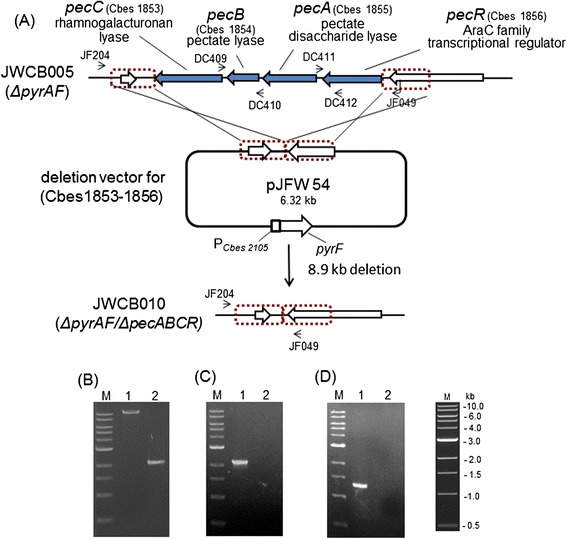
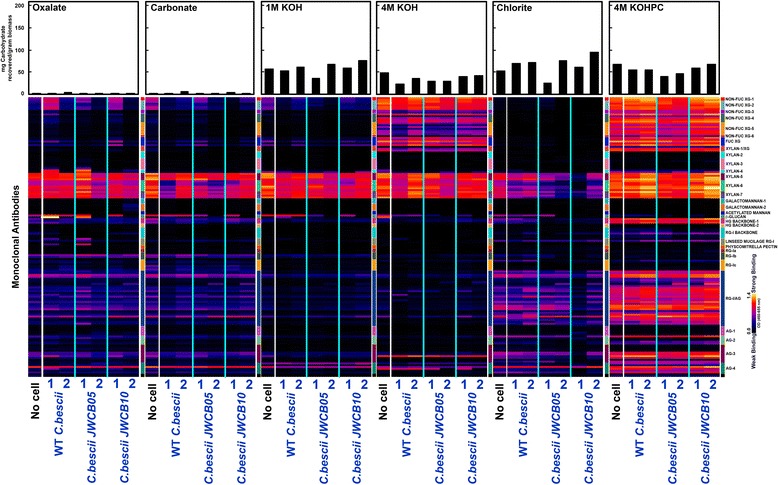
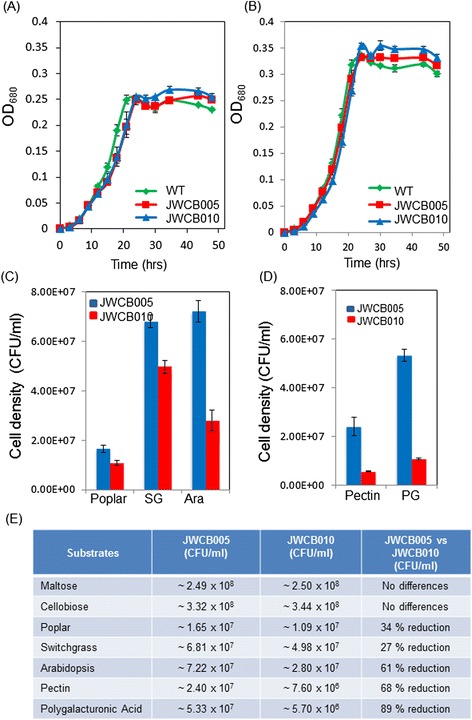
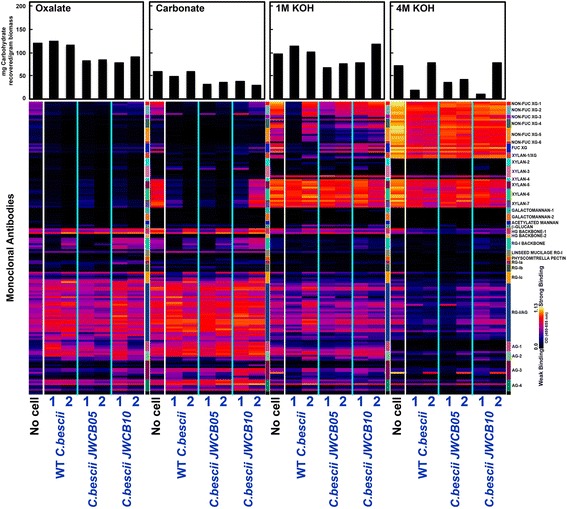
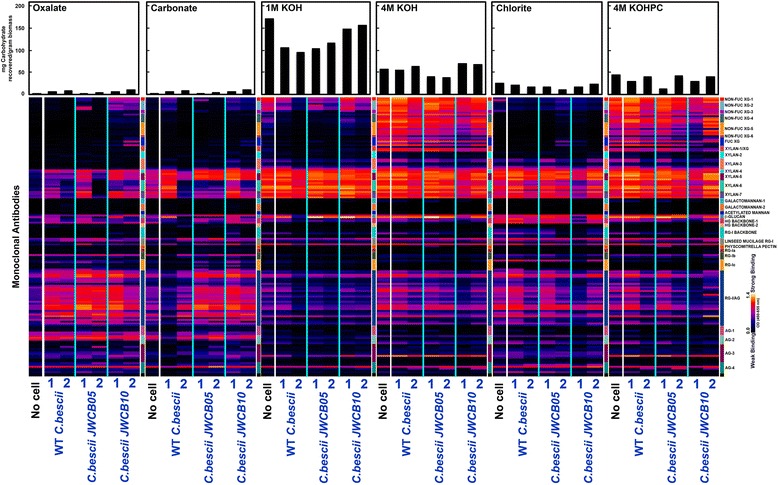
Using recently developed genetic tools for manipulation of these bacteria, a deletion of a gene cluster encoding enzymes for pectin degradation was constructed, and the resulting mutant was reduced in its ability to grow on both dicot and grass biomass, but not on soluble sugars. The plant biomass from three phylogenetically diverse plants, Arabidopsis (a herbaceous dicot), switchgrass (a monocot grass), and poplar (a woody dicot), was used in these analyses. These biomass types have cell walls that are significantly different from each other in both structure and composition. While pectin is a relatively minor component of the grass and woody dicot substrates, the reduced growth of the mutant on all three biomass types provides direct evidence that pectin plays an important role in biomass recalcitrance. Glycome profiling of the plant material remaining after growth of the mutant on Arabidopsis biomass compared to the wild-type revealed differences in the rhamnogalacturonan I, homogalacturonan, arabinogalactan, and xylan profiles. In contrast, only minor differences were observed in the glycome profiles of the switchgrass and poplar biomass.
The combination of microbial digestion and plant biomass analysis provides a new and important platform to identify plant wall structures whose presence reduces the ability of microbes to deconstruct plant walls and to identify enzymes that specifically deconstruct those structures.
将植物生物质有效用于生产燃料、化学品和生物制品的主要障碍,也许是最重要的经济障碍,是我们目前缺乏如何高效、有效地解构细胞壁聚合物以将其随后用作原料的知识。植物是最理想的可再生能源和碳氢化合物来源,因为它们固定二氧化碳,使其使用具有碳中性。然而,它们的生物质结构是解构的障碍,这通常被称为抗降解性。属名 Caldicellulosiruptor 的细菌能够在未经预处理的植物生物质上生长,因此为植物解构和生物质抗降解性提供了一种测定方法。
使用最近开发的用于这些细菌操作的遗传工具,构建了一个缺失编码果胶降解酶的基因簇的突变体,并且该突变体在生长于双子叶植物和草类生物质上的能力降低,但不能在可溶性糖上生长。这些分析使用了来自三种系统发育上不同的植物的植物生物质,拟南芥(草本双子叶植物)、柳枝稷(单子叶草类)和杨树(木本双子叶植物)。这些生物质类型在结构和组成上彼此的细胞壁有显著差异。虽然果胶是草类和木本双子叶植物基质的相对次要成分,但突变体在所有三种生物质类型上的生长减少提供了直接证据,表明果胶在生物质抗降解性中起着重要作用。与野生型相比,突变体在拟南芥生物质上生长后剩余植物材料的糖组分析显示,在 RG-I、同聚半乳糖醛酸、阿拉伯半乳聚糖和木聚糖的图谱中存在差异。相比之下,在柳枝稷和杨树生物质的糖组图谱中仅观察到微小差异。
微生物消化和植物生物质分析的组合为识别降低微生物解构植物细胞壁能力的植物细胞壁结构以及鉴定专门解构这些结构的酶提供了一个新的重要平台。