Chmielarczyk Agnieszka, Wójkowska-Mach Jadwiga, Romaniszyn Dorota, Adamski Paweł, Helwich Ewa, Lauterbach Ryszard, Pobiega Monika, Borszewska-Kornacka Maria, Gulczyńska Ewa, Kordek Agnieszka, Heczko Piotr B
Department of Microbiology, Jagiellonian University Medical College, 18 Czysta Street, 31-121 Krakow, Poland.
BMC Pediatr. 2014 Oct 18;14:274. doi: 10.1186/1471-2431-14-274.
Infections in newborns remain one of the most significant problems in modern medicine. Escherichia coli is an important cause of neonatal bloodstream and respiratory tract infections and is associated with high mortality. The aim of our study was to investigate the epidemiology of E. coli infection in Polish neonatal intensive care units (NICUs) and resistance to antibiotics, with particular reference to the safety of very low birth weight infants.
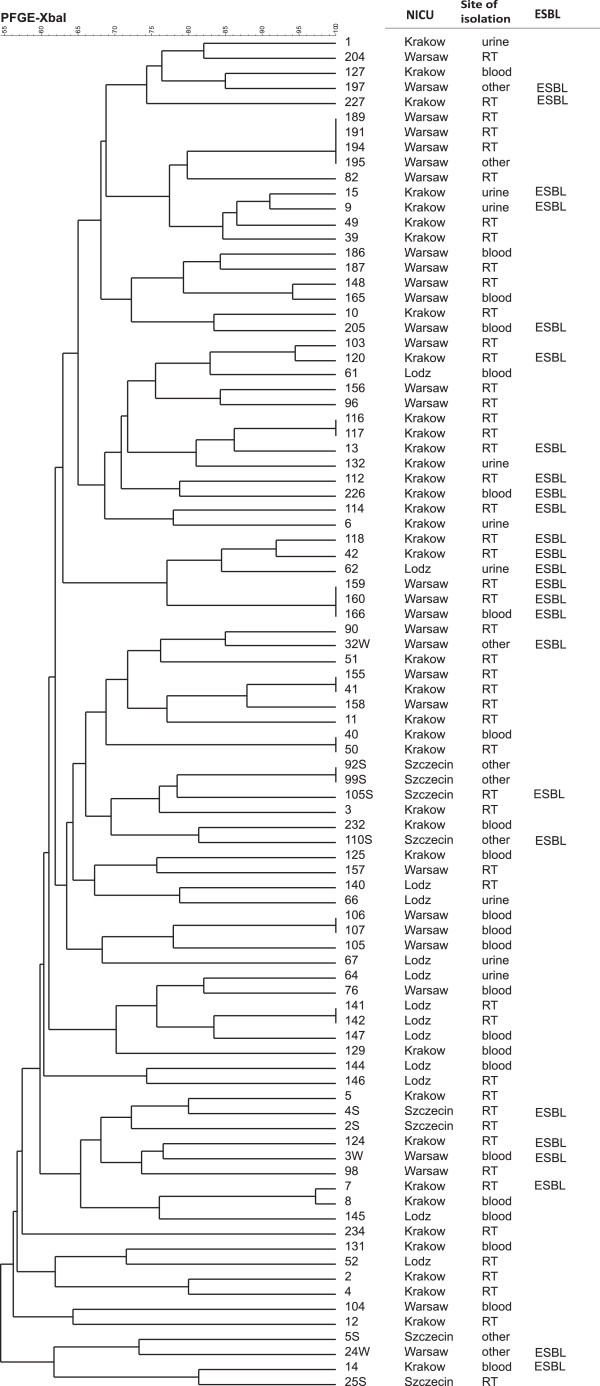
Continuous prospective infection surveillance was conducted in 2009-2012 in five NICUs, including 1,768 newborns whose birth weight was <1.5 kg. Escherichia coli isolates from different diagnostic specimens including blood, tracheal/bronchial secretions and others were collected. All isolates were tested using disk diffusion antimicrobial susceptibility methods. Pulsed-field gel electrophoresis was used to determine the possible horizontal transfer of E. coli among patients.
The incidence of E. coli infections was 5.4% and 2.0/1,000 patient-days. The occurrence of E. coli infections depended significantly on the NICU and varied between 3.9% and 17.9%. Multivariate analysis that took into account the combined effect of demographic data (gender, gestational age and birth weight) and place of birth showed that only the place of hospitalisation had a significant effect on the E. coli infection risk. The highest levels of resistance among all E. coli isolates were observed against ampicillin (88.8%) and amoxicillin/clavulanic acid (62.2%). Among E. coli isolates, 17.7% were classified as multidrug resistant. Escherichia coli isolates showed different pulsotypes and dominant epidemic clones were not detected.
Our data indicate that antibiotic prophylaxis in the presence of symptoms such as chorioamnionitis and premature rupture of membranes did not help reduce the risk of E. coli infection. Multivariate analysis demonstrated only one significant risk factor for E. coli infection among infants with a birth weight <1.5 kg, that is, the impact of the NICU, it means that both neonatal care and care during pregnancy and labour were found to be significant.
新生儿感染仍然是现代医学中最重要的问题之一。大肠杆菌是新生儿血流感染和呼吸道感染的重要病因,且与高死亡率相关。我们研究的目的是调查波兰新生儿重症监护病房(NICU)中大肠杆菌感染的流行病学情况以及对抗生素的耐药性,尤其关注极低出生体重儿的安全性。
2009年至2012年期间,在5个新生儿重症监护病房对1768名出生体重<1.5千克的新生儿进行了连续的前瞻性感染监测。收集了来自不同诊断标本(包括血液、气管/支气管分泌物等)的大肠杆菌分离株。所有分离株均采用纸片扩散法进行抗菌药物敏感性测试。脉冲场凝胶电泳用于确定患者之间大肠杆菌的可能水平传播。
大肠杆菌感染的发生率为5.4%,每1000个患者日发生2.0例。大肠杆菌感染的发生显著取决于新生儿重症监护病房,发生率在3.9%至17.9%之间变化。多因素分析考虑了人口统计学数据(性别、胎龄和出生体重)和出生地点的综合影响,结果显示只有住院地点对大肠杆菌感染风险有显著影响。在所有大肠杆菌分离株中,对氨苄西林(88.8%)和阿莫西林/克拉维酸(62.2%)的耐药水平最高。在大肠杆菌分离株中,17.7%被归类为多重耐药。大肠杆菌分离株表现出不同的脉冲型,未检测到优势流行克隆。
我们的数据表明,在存在绒毛膜羊膜炎和胎膜早破等症状时进行抗生素预防无助于降低大肠杆菌感染的风险。多因素分析表明,出生体重<1.5千克的婴儿中,大肠杆菌感染只有一个显著的风险因素,即新生儿重症监护病房的影响,这意味着新生儿护理以及孕期和分娩期间的护理都很重要。