Haugaard M M, Pehrson S, Carstensen H, Flethøj M, Hesselkilde E Z, Praestegaard K F, Diness J G, Grunnet M, Jespersen T, Buhl R
Department of Large Animal Sciences, Faculty of Health and Medical Sciences, University of Copenhagen, Taastrup, Denmark.
J Vet Intern Med. 2015 Jan;29(1):339-47. doi: 10.1111/jvim.12496. Epub 2014 Oct 18.
Only few pharmacologic compounds have been validated for treatment of atrial fibrillation (AF) in horses. Studies investigating the utility and safety of flecainide to treat AF in horses have produced conflicting results, and the antiarrhythmic mechanisms of flecainide are not fully understood.
To study the potential of flecainide to terminate acutely induced AF of short duration (≥ 15 minutes), to examine flecainide-induced changes in AF duration and AF vulnerability, and to investigate the in vivo effects of flecainide on right atrial effective refractory period, AF cycle length, and ventricular depolarization and repolarization.
Nine Standardbred horses. Eight received flecainide, 3 were used as time-matched controls, 2 of which also received flecainide.
Prospective study. The antiarrhythmic and electrophysiologic effects of flecainide were based on 5 parameters: ability to terminate acute pacing-induced AF (≥ 15 minutes), and drug-induced changes in atrial effective refractory period, AF duration, AF vulnerability, and ventricular depolarization and repolarization times. Parameters were assessed at baseline and after flecainide by programmed electrical stimulation methods.
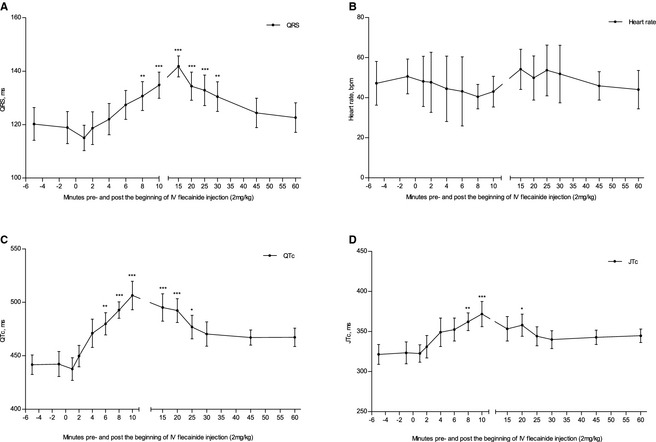
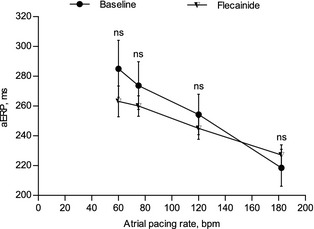
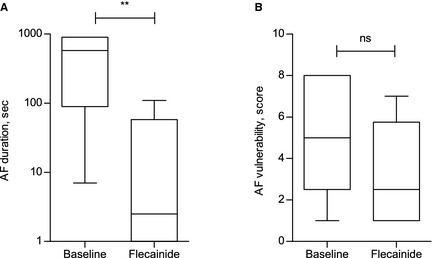
Flecainide terminated all acutely induced AF episodes (n = 7); (AF duration, 21 ± 5 minutes) and significantly decreased the AF duration, but neither altered atrial effective refractory period nor AF vulnerability significantly. Ventricular repolarization time was prolonged between 8 and 20 minutes after initiation of flecainide infusion, but no ventricular arrhythmias were detected.
Flecainide had clear antiarrhythmic properties in terminating acute pacing-induced AF, but showed no protective properties against immediate reinduction of AF. Flecainide caused temporary prolongation in the ventricular repolarization, which may be a proarrhythmic effect.
仅有少数药物被证实可用于治疗马匹心房颤动(AF)。关于氟卡尼治疗马匹AF的效用和安全性的研究结果相互矛盾,且氟卡尼的抗心律失常机制尚未完全明确。
研究氟卡尼终止急性诱发的短期(≥15分钟)AF的潜力,检查氟卡尼引起的AF持续时间和AF易感性变化,并研究氟卡尼对右心房有效不应期、AF周期长度以及心室去极化和复极化的体内影响。
9匹标准赛马。8匹接受氟卡尼治疗,3匹作为时间匹配的对照,其中2匹也接受了氟卡尼治疗。
前瞻性研究。氟卡尼的抗心律失常和电生理作用基于5个参数:终止急性起搏诱发的AF(≥15分钟)的能力,以及药物引起的心房有效不应期、AF持续时间、AF易感性以及心室去极化和复极化时间的变化。通过程控电刺激方法在基线和给予氟卡尼后评估这些参数。
氟卡尼终止了所有急性诱发的AF发作(n = 7);(AF持续时间,21±5分钟),并显著缩短了AF持续时间,但对心房有效不应期和AF易感性均无显著改变。在开始输注氟卡尼后8至20分钟,心室复极化时间延长,但未检测到室性心律失常。
氟卡尼在终止急性起搏诱发的AF方面具有明确的抗心律失常特性,但对AF的立即再诱发无保护作用。氟卡尼导致心室复极化暂时延长,这可能是一种促心律失常作用。