State Key Laboratory of Oncology in South China, Guangzhou, People's Republic of China ; Collaborative Innovation Center for Cancer Medicine, Guangzhou, People's Republic of China ; Department of Medical Oncology, Sun Yat-Sen University Cancer Center, Guangzhou, People's Republic of China.
State Key Laboratory of Oncology in South China, Guangzhou, People's Republic of China ; Collaborative Innovation Center for Cancer Medicine, Guangzhou, People's Republic of China.
Onco Targets Ther. 2014 Sep 26;7:1733-42. doi: 10.2147/OTT.S66692. eCollection 2014.
Patients with triple-negative breast cancer (TNBC) present a higher probability of distant metastasis and lack of effective targeted therapy. ETS translocation variant 4 (ETV4) is an ETS (E-26) transcription factor and has been associated with tumor metastasis. However, the clinical and functional significance of ETV4 in TNBC still remains unclear.
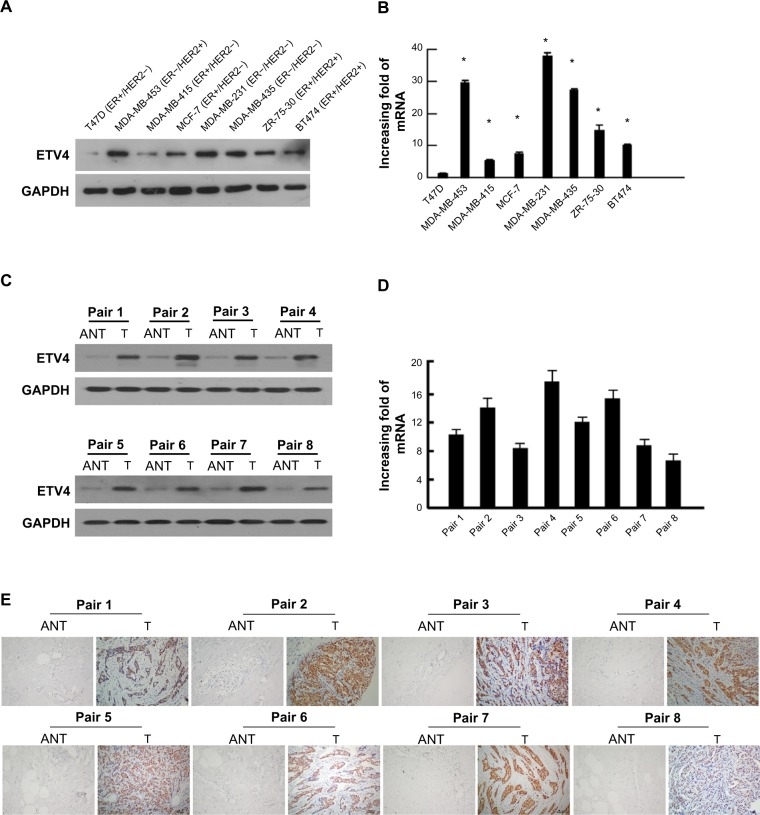
A human tumor metastasis polymerase chain reaction array was used to profile differential expression of tumor metastasis-related genes in TNBC tissue. Real-time reverse transcription and Western blot analyses were performed to verify ETV4 expression in TNBC cells and tissue. Immunohistochemistry was used to detect expression of ETV4 protein in 135 TNBC tissue samples for association between ETV4 protein expression and clinical outcomes.
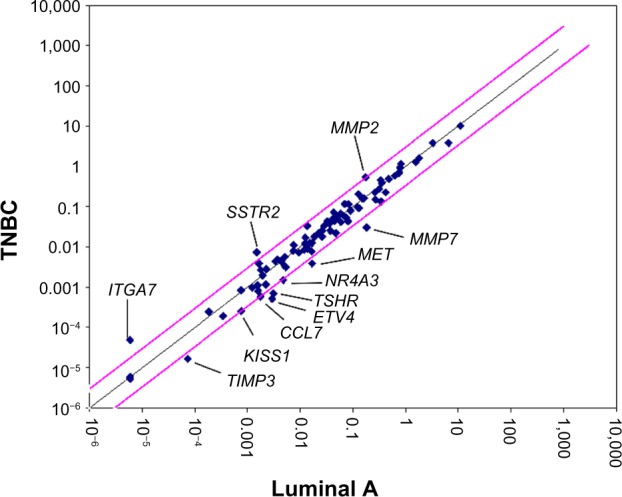
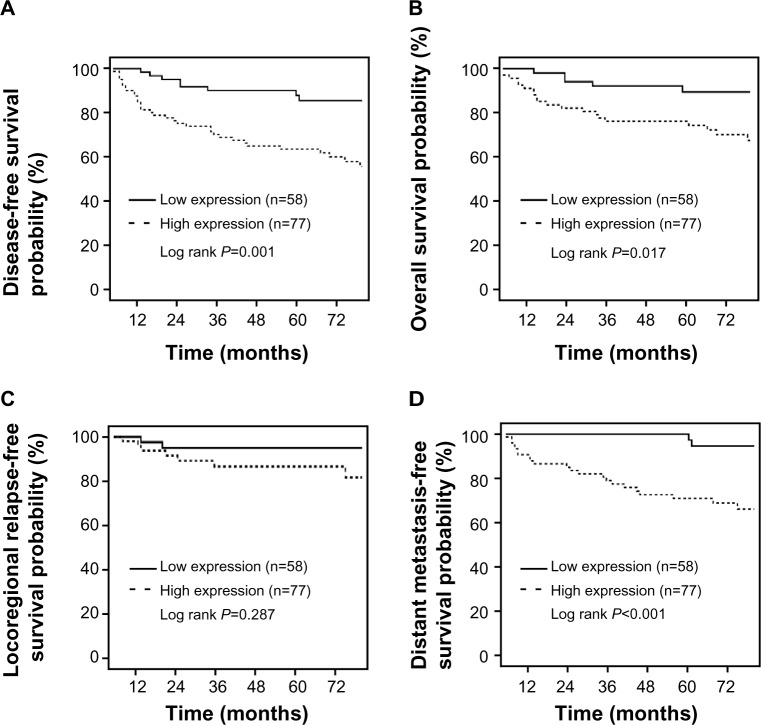
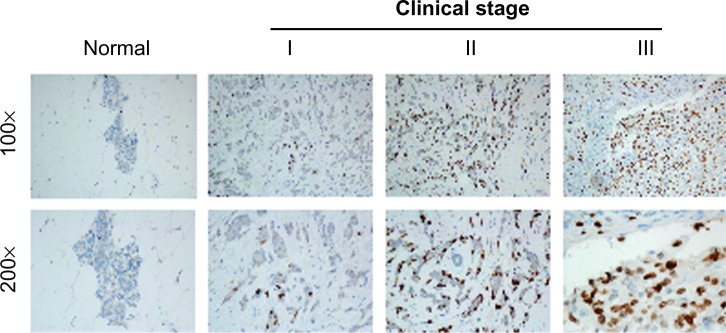
A total total of eight upregulated (CCL7, KISS1, MET, MMP7, NR4A3, ETV4, TIMP3, and TSHR) and three downregulated (ITGA7, SSTR, and MMP2) genes were identified between TNBC tissue and the luminal subtype of breast cancer tissue. ETV4 messenger ribonucleic acid was more than five-fold upregulated in TNBC tissue compared with the control tissue. ETV4 overexpression was found in 57.0% of 135 TNBC cases. Overexpression of ETV4 protein was associated with an advanced stage and a higher proportion of positive lymph node and lymphovascular invasion. Patients with an ETV4-overexpressed tumor had a significantly higher risk of developing distant metastasis (P<0.0001) and shorter overall survival and disease-free survival. Overexpression of ETV4 protein was an independent predictor of short disease-free survival of TNBC patients (P=0.021).
Overexpression of ETV4 protein increases risk of developing distant metastasis and results in a poor prognosis for TNBC patients. Thus, ETV4 might be a novel target for developing an alternative therapeutic strategy for prevention of TNBC distant metastasis.
三阴性乳腺癌(TNBC)患者发生远处转移的可能性更高,且缺乏有效的靶向治疗。ETS 易位变体 4(ETV4)是一种 ETS(E-26)转录因子,与肿瘤转移有关。然而,ETV4 在 TNBC 中的临床和功能意义仍不清楚。
采用人肿瘤转移聚合酶链反应阵列分析 TNBC 组织中肿瘤转移相关基因的差异表达。采用实时逆转录和 Western blot 分析验证 TNBC 细胞和组织中 ETV4 的表达。采用免疫组化法检测 135 例 TNBC 组织样本中 ETV4 蛋白的表达,分析 ETV4 蛋白表达与临床结局的关系。
在 TNBC 组织与乳腺癌管腔亚型组织之间,共鉴定出 8 个上调(CCL7、KISS1、MET、MMP7、NR4A3、ETV4、TIMP3 和 TSHR)和 3 个下调(ITGA7、SSTR 和 MMP2)基因。与对照组织相比,TNBC 组织中 ETV4 信使 RNA 表达上调了 5 倍以上。在 135 例 TNBC 病例中,有 57.0%存在 ETV4 过表达。ETV4 蛋白过表达与晚期、阳性淋巴结和脉管侵犯比例较高有关。肿瘤 ETV4 过表达的患者发生远处转移的风险显著增加(P<0.0001),总生存期和无病生存期较短。ETV4 蛋白过表达是 TNBC 患者无病生存期较短的独立预测因子(P=0.021)。
ETV4 蛋白过表达增加了发生远处转移的风险,并导致 TNBC 患者预后不良。因此,ETV4 可能成为开发预防 TNBC 远处转移的新治疗策略的新靶点。