Gonzalez Jaime, Donoso Wendy, Díaz Natalia, Albornoz María Eliana, Huilcaman Ricardo, Morales Erik, Moore-Carrasco Rodrigo
Departamento de Bioquímica Clínica e Inmunohematología, Facultad de Ciencias de la Salud, Universidad de Talca, P.O. Box 747, Talca, Chile.
Departamento de Estomatología, Facultad de Ciencias de la Salud, Universidad de Talca, Avenida Lircay s/n, Talca, Chile.
J Obes. 2014;2014:591270. doi: 10.1155/2014/591270. Epub 2014 Sep 28.
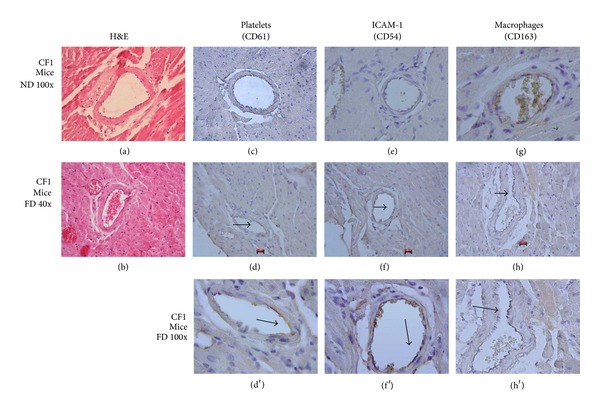
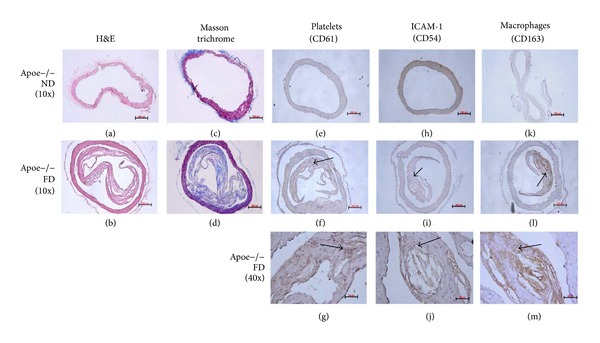
Cardiovascular diseases (CVD) represent about 30% of all global deaths. It is currently accepted that, in the atherogenic process, platelets play an important role, contributing to endothelial activation and modulation of the inflammatory phenomenon, promoting the beginning and formation of lesions and their subsequent thrombotic complications. The objective of the present work was to study using immunohistochemistry, the presence of platelets, monocytes/macrophages, and cell adhesion molecules (CD61, CD163, and CD54), in two stages of the atheromatous process. CF-1 mice fed a fat diet were used to obtain early stages of atheromatous process, denominated early stage of atherosclerosis, and ApoE(-/-) mice fed a fat diet were used to observe advanced stages of atherosclerosis. The CF-1 mice model presented immunostaining on endothelial surface for all three markers studied; the advanced atherosclerosis model in ApoE(-/-) mice also presented granular immunostaining on lesion thickness, for the same markers. These results suggest that platelets participate in atheromatous process from early stages to advance d stages. High fat diet induces adhesion of platelets to endothelial cells in vivo. These findings support studying the participation of platelets in the formation of atheromatous plate.
心血管疾病(CVD)约占全球总死亡人数的30%。目前人们公认,在动脉粥样硬化形成过程中,血小板发挥着重要作用,它会导致内皮细胞活化并调节炎症现象,促进病变的起始和形成及其随后的血栓并发症。本研究的目的是通过免疫组织化学方法,研究动脉粥样硬化过程两个阶段中血小板、单核细胞/巨噬细胞以及细胞黏附分子(CD61、CD163和CD54)的存在情况。喂食高脂饮食的CF-1小鼠用于获取动脉粥样硬化过程的早期阶段,即动脉粥样硬化早期,而喂食高脂饮食的载脂蛋白E基因敲除(ApoE(-/-))小鼠则用于观察动脉粥样硬化的晚期阶段。CF-1小鼠模型对所研究的所有三种标志物在内皮表面均呈现免疫染色;ApoE(-/-)小鼠的晚期动脉粥样硬化模型对相同标志物在病变厚度处也呈现颗粒状免疫染色。这些结果表明,血小板从动脉粥样硬化的早期阶段到晚期阶段均参与其中。高脂饮食在体内诱导血小板黏附于内皮细胞。这些发现支持研究血小板在动脉粥样硬化斑块形成中的作用。