Marden Jessica R, Walter Stefan, Tchetgen Tchetgen Eric J, Kawachi Ichiro, Glymour M Maria
Department of Social and Behavioral Sciences, Harvard School of Public Health 677 Huntington Ave, Boston, Massachusetts, 02115.
Department of Social and Behavioral Sciences, Harvard School of Public Health 677 Huntington Ave, Boston, Massachusetts, 02115 ; Department of Epidemiology and Biostatistics, University of California at San Francisco San Francisco, California.
Brain Behav. 2014 Sep;4(5):687-97. doi: 10.1002/brb3.248. Epub 2014 Jul 18.
To determine whether a polygenic risk score for Alzheimer's disease (AD) predicts dementia probability and memory functioning in non-Hispanic black (NHB) and non-Hispanic white (NHW) participants from a sample not used in previous genome-wide association studies.
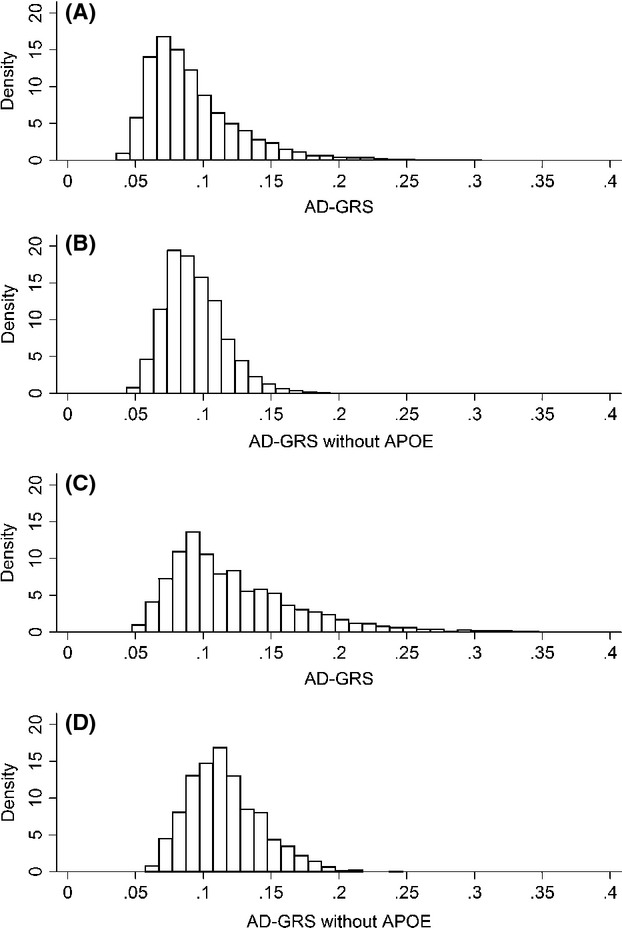
Non-Hispanic white and NHB Health and Retirement Study (HRS) participants provided genetic information and either a composite memory score (n = 10,401) or a dementia probability score (n = 7690). Dementia probability score was estimated for participants' age 65+ from 2006 to 2010, while memory score was available for participants age 50+. We calculated AD genetic risk scores (AD-GRS) based on 10 polymorphisms confirmed to predict AD, weighting alleles by beta coefficients reported in AlzGene meta-analyses. We used pooled logistic regression to estimate the association of the AD-GRS with dementia probability and generalized linear models to estimate its effect on memory score.
Each 0.10 unit change in the AD-GRS was associated with larger relative effects on dementia among NHW aged 65+ (OR = 2.22; 95% CI: 1.79, 2.74; P < 0.001) than NHB (OR=1.33; 95% CI: 1.00, 1.77; P = 0.047), although additive effect estimates were similar. Each 0.10 unit change in the AD-GRS was associated with a -0.07 (95% CI: -0.09, -0.05; P < 0.001) SD difference in memory score among NHW aged 50+, but no significant differences among NHB (β = -0.01; 95% CI: -0.04, 0.01; P = 0.546). [Correction added on 29 July 2014, after first online publication: confidence intervalshave been amended.] The estimated effect of the GRS was significantly smaller among NHB than NHW (P < 0.05) for both outcomes.
This analysis provides evidence for differential relative effects of the GRS on dementia probability and memory score among NHW and NHB in a new, national data set.
在一个未用于先前全基因组关联研究的样本中,确定阿尔茨海默病(AD)的多基因风险评分是否能预测非西班牙裔黑人(NHB)和非西班牙裔白人(NHW)参与者的痴呆症概率和记忆功能。
非西班牙裔白人和NHB健康与退休研究(HRS)参与者提供了遗传信息以及综合记忆评分(n = 10401)或痴呆症概率评分(n = 7690)。2006年至2010年期间,对65岁及以上参与者的痴呆症概率评分进行了估计,而50岁及以上参与者可获得记忆评分。我们基于10个已证实可预测AD的多态性计算了AD遗传风险评分(AD-GRS),并根据AlzGene荟萃分析中报告的β系数对等位基因进行加权。我们使用汇总逻辑回归来估计AD-GRS与痴呆症概率之间的关联,并使用广义线性模型来估计其对记忆评分的影响。
AD-GRS每增加0.10个单位,对65岁及以上NHW痴呆症的相对影响(OR = 2.22;95%CI:1.79,2.74;P < 0.001)大于NHB(OR = 1.33;95%CI:1.00,1.77;P = 0.047),尽管相加效应估计相似。AD-GRS每增加0.10个单位,与50岁及以上NHW记忆评分标准差相差-0.07(95%CI:-0.09,-0.05;P < 0.001),但在NHB中无显著差异(β = -0.01;95%CI:-0.04,0.01;P = 0.546)。[2014年7月29日首次在线发表后添加的校正:置信区间已修正。]对于这两个结果,NHB中GRS的估计效应显著小于NHW(P < 0.05)。
本分析为在一个新的全国性数据集中,GRS对NHW和NHB痴呆症概率和记忆评分的不同相对影响提供了证据。