Loko Roka Jerlie, Van den Bergh Rafael, Au Sokhieng, De Plecker Eva, Zachariah Rony, Manzi Marcel, Lambert Vincent, Abi-Aad Elias, Nanan-N'Zeth Kassi, Nzuya Serge, Omba Brigitte, Shako Charly, MuishaBaroki Derick, Basimuoneye Jean Paul, Moke Didier Amudiandroy, Lampaert Emmanuel, Masangu Lucien, De Weggheleire Anja
Médecins Sans Frontières, Operational Centre Brussels, DRC Mission, Kinshasa, Democratic Republic of Congo.
Médecins Sans Frontières, Operational Centre Brussels, Operational Research Unit (LuxOR), Luxembourg, Luxembourg.
PLoS One. 2014 Oct 20;9(10):e111096. doi: 10.1371/journal.pone.0111096. eCollection 2014.
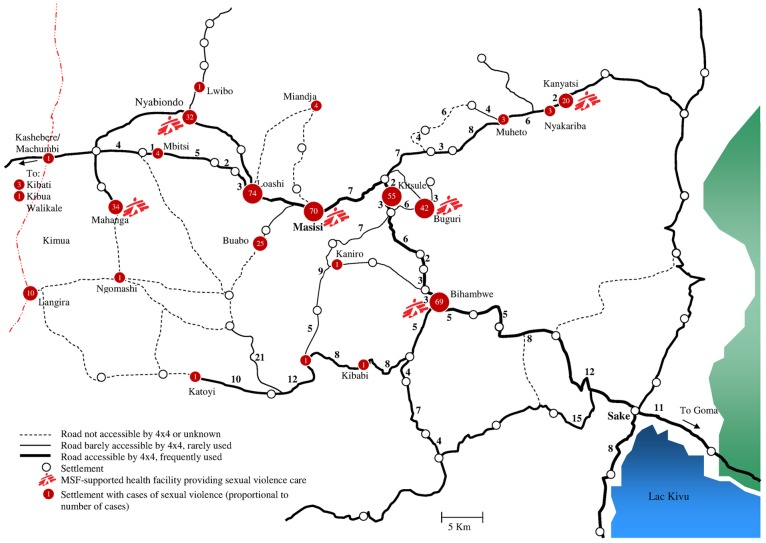
Outcomes of sexual violence care programmes may vary according to the profile of survivors, type of violence suffered, and local context. Analysis of existing sexual violence care services could lead to their better adaptation to the local contexts. We therefore set out to compare the Médecins Sans Frontières sexual violence programmes in the Democratic Republic of Congo (DRC) in a zone of conflict (Masisi, North Kivu) and post-conflict (Niangara, Haut-Uélé).
A retrospective descriptive cohort study, using routine programmatic data from the MSF sexual violence programmes in Masisi and Niangara, DRC, for 2012.
In Masisi, 491 survivors of sexual violence presented for care, compared to 180 in Niangara. Niangara saw predominantly sexual violence perpetrated by civilians who were known to the victim (48%) and directed against children and adolescents (median age 15 (IQR 13-17)), while sexual violence in Masisi was more directed towards adults (median age 26 (IQR 20-35)), and was characterised by marked brutality, with higher levels of gang rape, weapon use, and associated violence; perpetrated by the military (51%). Only 60% of the patients in Masisi and 32% of those in Niangara arrived for a consultation within the critical timeframe of 72 hours, when prophylaxis for HIV and sexually transmitted infections is most effective. Survivors were predominantly referred through community programmes. Treatment at first contact was typically efficient, with high (>95%) coverage rates of prophylaxes. However, follow-up was poor, with only 49% of all patients in Masisi and 61% in Niangara returning for follow-up, and consequently low rates of treatment and/or vaccination completion.
This study has identified a number of weak and strong points in the sexual violence programmes of differing contexts, indicating gaps which need to be addressed, and strengths of both programmes that may contribute to future models of context-specific sexual violence programmes.
性暴力护理项目的结果可能因幸存者的特征、遭受的暴力类型以及当地情况而异。对现有性暴力护理服务进行分析有助于使其更好地适应当地情况。因此,我们着手比较无国界医生组织在刚果民主共和国(DRC)冲突地区(北基伍省马西西)和冲突后地区(上韦莱省尼亚加拉)开展的性暴力项目。
采用回顾性描述性队列研究,使用来自无国界医生组织在刚果民主共和国马西西和尼亚加拉的性暴力项目2012年的常规项目数据。
在马西西,有491名性暴力幸存者前来寻求护理,而在尼亚加拉为180名。尼亚加拉地区主要是受害者认识的平民实施的性暴力(48%),且针对儿童和青少年(中位年龄15岁(四分位间距13 - 17岁)),而马西西的性暴力更多针对成年人(中位年龄26岁(四分位间距20 - 35岁)),其特点是极其残忍,轮奸、使用武器及相关暴力行为发生率更高;实施者为军方人员(51%)。在马西西,只有60%的患者以及在尼亚加拉32%的患者在72小时这一关键时间段内前来咨询,而这是预防艾滋病毒和性传播感染最有效的时间。幸存者主要通过社区项目被转诊。首次接触时的治疗通常很有效,预防措施的覆盖率很高(>95%)。然而,后续跟进情况不佳,马西西所有患者中只有49%、尼亚加拉为61%返回接受随访,因此治疗和/或疫苗接种完成率较低。
本研究确定了不同背景下性暴力项目的一些优缺点,指出了需要解决的差距以及两个项目的优势,这些优势可能有助于形成未来针对具体情况的性暴力项目模式。