Yamaguchi Makoto, Ando Masahiko, Yamamoto Ryohei, Akiyama Shinichi, Kato Sawako, Katsuno Takayuki, Kosugi Tomoki, Sato Waichi, Tsuboi Naotake, Yasuda Yoshinari, Mizuno Masashi, Ito Yasuhiko, Matsuo Seiichi, Maruyama Shoichi
Department of Nephrology, Nagoya University Graduate School of Medicine, Nagoya, Japan.
Center for Advanced Medicine and Clinical Research, Nagoya University Hospital, Nagoya, Japan.
PLoS One. 2014 Oct 20;9(10):e110376. doi: 10.1371/journal.pone.0110376. eCollection 2014.
Idiopathic membranous nephropathy (IMN) is increasingly seen in older patients. However, differences in disease presentation and outcomes between older and younger IMN patients remain controversial. We compared patient characteristics between younger and older IMN patients.
We recruited 171 Japanese patients with IMN, including 90 (52.6%) patients <65 years old, 40 (23.4%) patients 65-70 years, and 41 (24.0%) patients ≥ 71 years. Clinical characteristics and outcomes were compared between younger and older IMN patients.
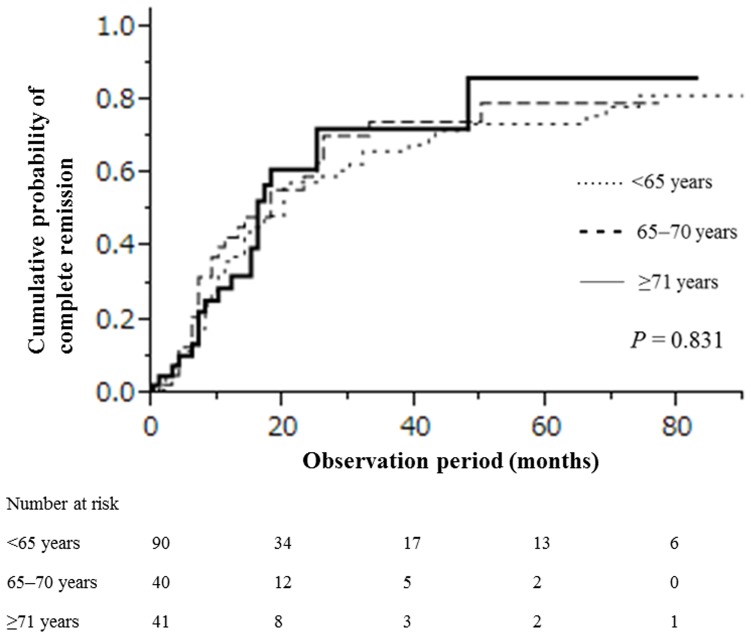
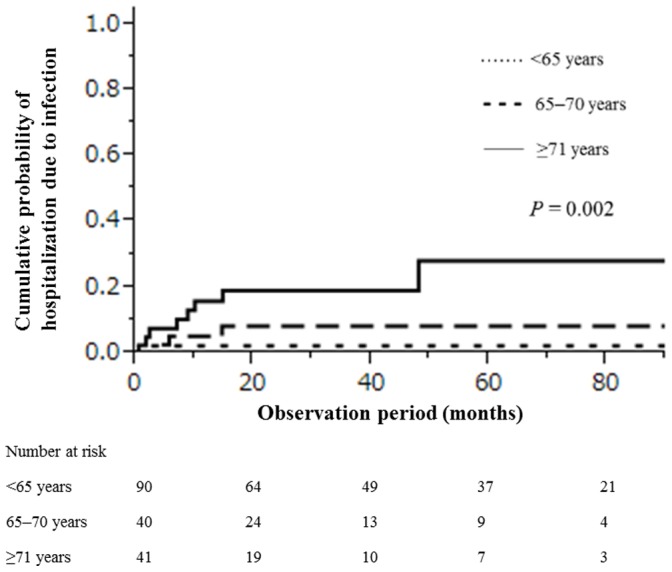
During a median observation period of 37 months, 103 (60.2%) patients achieved complete proteinuria remission, which was not significantly associated with patient age (P = 0.831). However, 13 (7.6%) patients were hospitalized because of infection. Multivariate Cox proportional hazards models identified older age [adjusted hazard ratio (HR) = 3.11, 95% confidence interval (CI): 1.45-7.49, per 10 years; P = 0.003], prednisolone use (adjusted HR = 11.8, 95% CI: 1.59-242.5; P = 0.014), and cyclosporine used in combination with prednisolone (adjusted HR = 10.3, 95% CI: 1.59-204.4; P = 0.012) as significant predictors of infection. A <25% decrease in proteinuria at 1 month after immunosuppressive therapy initiation also predicted infection (adjusted HR = 6.72, 95% CI: 1.51-37.8; P = 0.012).
Younger and older IMN patients had similar renal outcomes. However, older patients were more likely to develop infection when using immunosuppressants. Patients with a poor response in the first month following the initiation of immunosuppressive therapy should be carefully monitored for infection and may require a faster prednisolone taper.
特发性膜性肾病(IMN)在老年患者中越来越常见。然而,老年和年轻IMN患者在疾病表现和预后方面的差异仍存在争议。我们比较了年轻和老年IMN患者的特征。
我们招募了171例日本IMN患者,其中90例(52.6%)年龄<65岁,40例(23.4%)年龄在65 - 70岁之间,41例(24.0%)年龄≥71岁。比较了年轻和老年IMN患者的临床特征和预后。
在中位观察期37个月内,103例(60.2%)患者实现了蛋白尿完全缓解,这与患者年龄无显著相关性(P = 0.831)。然而,13例(7.6%)患者因感染住院。多因素Cox比例风险模型确定年龄较大[调整后风险比(HR)= 3.11,95%置信区间(CI):1.45 - 7.49,每10年;P = 0.003]、使用泼尼松龙(调整后HR = 11.8,95% CI:1.59 - 242.5;P = 0.014)以及环孢素与泼尼松龙联合使用(调整后HR = 10.3,95% CI:1.59 - 204.4;P = 0.012)是感染的显著预测因素。免疫抑制治疗开始后1个月蛋白尿降低<25%也预测感染(调整后HR = 6.72,95% CI:1.51 - 37.8;P = 0.012)。
年轻和老年IMN患者的肾脏预后相似。然而,老年患者在使用免疫抑制剂时更容易发生感染。免疫抑制治疗开始后第一个月反应不佳的患者应密切监测感染情况,可能需要更快地减量泼尼松龙。