Reges Orna, Vilchinsky Noa, Leibowitz Morton, Khaskia Abdulrahem, Mosseri Morris, Kark Jeremy D
Hebrew University-Hadassah School of Public Health and Community Medicine , Jerusalem , Israel ; Clalit Research Institute , Tel-Aviv , Israel ; Department of Cardiology , Meir Medical Center , Kfar-Saba , Israel.
Department of Psychology , Bar Ilan University , Ramat Gan , Israel.
Open Heart. 2014 Aug 14;1(1):e000097. doi: 10.1136/openhrt-2014-000097. eCollection 2014.
Participation rates of patients with acute coronary syndrome (ACS) in efficacious cardiac prevention and rehabilitation programmes (CPRPs) are low, particularly in ethnic minorities. Few studies have evaluated the full array of potential barriers to participation in a multiethnic cohort with identical insurance coverage.
To assess the hierarchy of multiple barriers (ie, sociodemographic, systemic, illness related, psychological and cultural) to participation in CPRP of Jewish and Arab patients served by a regional hospital in Israel.
Patients with ACS (N=420) were interviewed during hospitalisation about potential barriers and subsequently about participation in CPRP. Decision tree analysis determined, hierarchically, the best predictors of participation in CPRP.
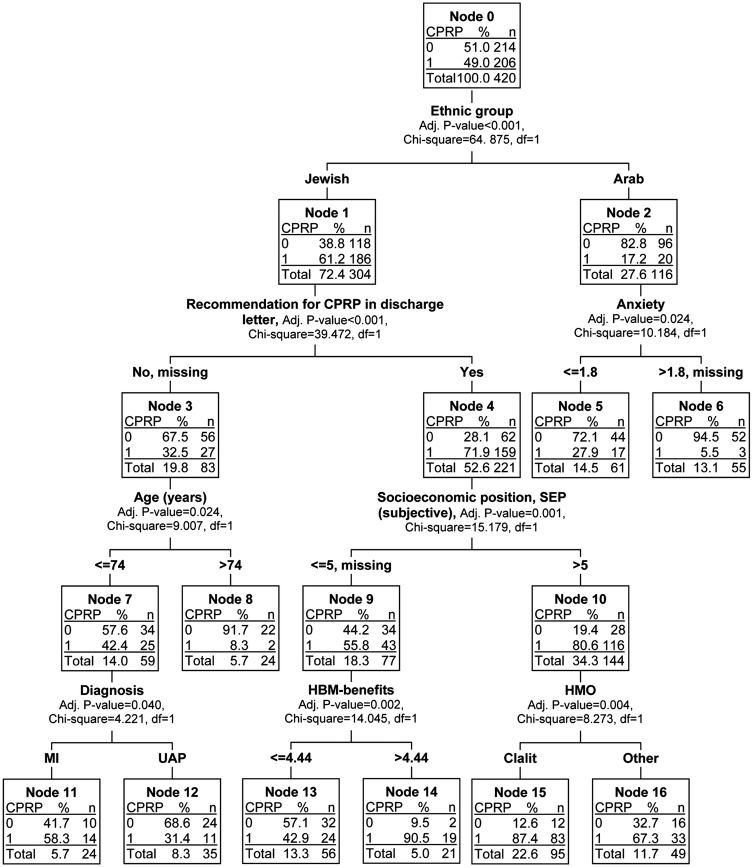
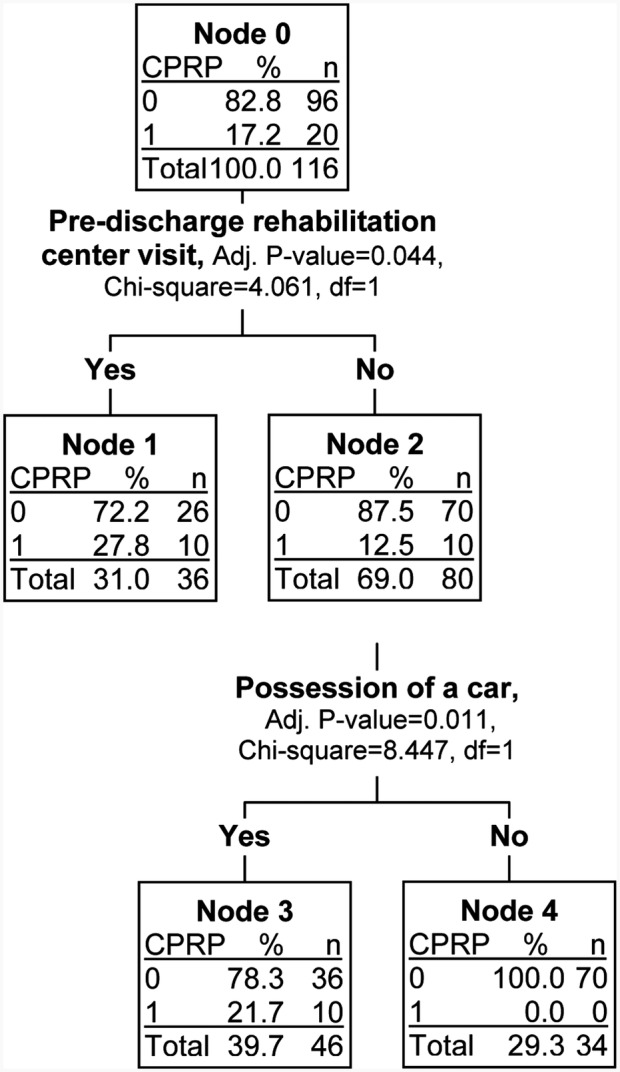
Ethnicity was the salient predictor of participation in CPRP (61.1% (95% CI 55.6% to 66.5%) of Jewish patients versus 17.2% (95% CI 11.2% to 24.9%) of Arab patients). Among Jewish patients the dominant determinant was a recommendation for CPRP in the hospital discharge letter (32.5% (95% CI 23.1% to 43.1%) vs 71.9% (95% CI 65.8% to 77.6%) participation without and with a recommendation, respectively). Other major hierarchical determinants included age, discharge diagnosis, socioeconomic position and perceived benefits of exercise. Among Arab patients, anxiety was the main predictor (5.5% (95% CI 1.1% to 14.1%) vs 27.9% (95% CI 17.7% to 40.0%) participation among those with high vs lower anxiety levels). Additional contributors were a predischarge visit to the rehabilitation centre (familiarisation) and car ownership (access).
Utilisation of decision tree analysis enables us to identify the key barriers to participation in CPRP in an ethnic-specific mode. Interventions to improve participation can then be designed to address each group's specific barriers.
急性冠状动脉综合征(ACS)患者参与有效的心脏预防和康复项目(CPRP)的比例较低,尤其是少数族裔。很少有研究评估在具有相同保险覆盖范围的多民族队列中参与的一系列潜在障碍。
评估以色列一家地区医院服务的犹太和阿拉伯患者参与CPRP的多种障碍(即社会人口学、系统、疾病相关、心理和文化障碍)的层次结构。
对420例ACS患者在住院期间进行关于潜在障碍的访谈,随后询问其参与CPRP的情况。决策树分析按层次确定了参与CPRP的最佳预测因素。
种族是参与CPRP的显著预测因素(61.1%(95%CI 55.6%至66.5%)的犹太患者参与,而阿拉伯患者为17.2%(95%CI 11.2%至24.9%))。在犹太患者中,主要决定因素是出院信中对CPRP的推荐(无推荐时参与率为32.5%(95%CI 23.1%至43.1%),有推荐时为71.9%(95%CI 65.8%至77.6%))。其他主要的层次决定因素包括年龄、出院诊断、社会经济地位和运动的感知益处。在阿拉伯患者中,焦虑是主要预测因素(高焦虑水平患者参与率为5.5%(95%CI 1.1%至14.1%),低焦虑水平患者为27.9%(95%CI 17.7%至40.0%))。其他促成因素包括出院前到康复中心的参观(熟悉情况)和拥有汽车(交通便利)。
使用决策树分析使我们能够以特定种族的方式识别参与CPRP的关键障碍。然后可以设计干预措施来解决每个群体特定的障碍。