Magpusao Anniefer N, Omolloh George, Johnson Joshua, Gascón José, Peczuh Mark W, Fenteany Gabriel
Department of Chemistry, University of Connecticut , 55 N. Eagleville Road, U3060, Storrs, Connecticut 06269, United States.
ACS Chem Biol. 2015 Feb 20;10(2):561-9. doi: 10.1021/cb500665r. Epub 2014 Nov 26.
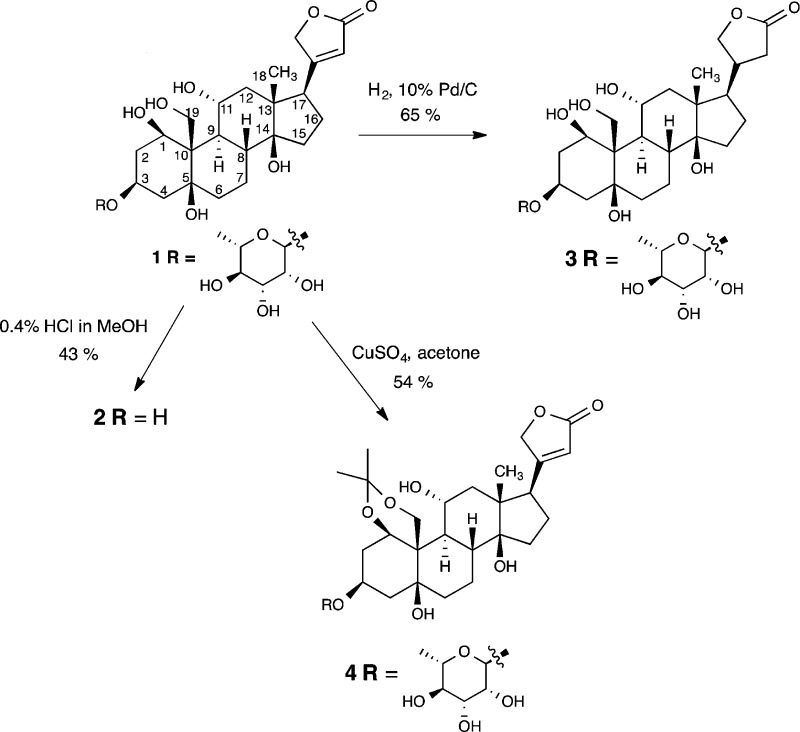
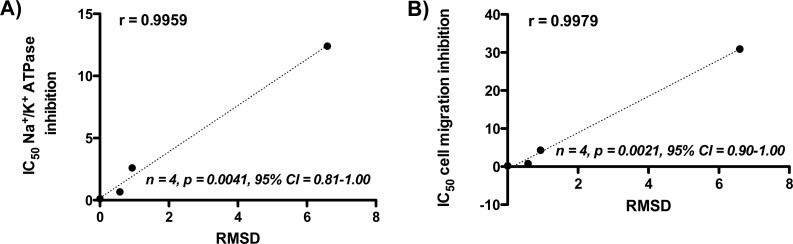
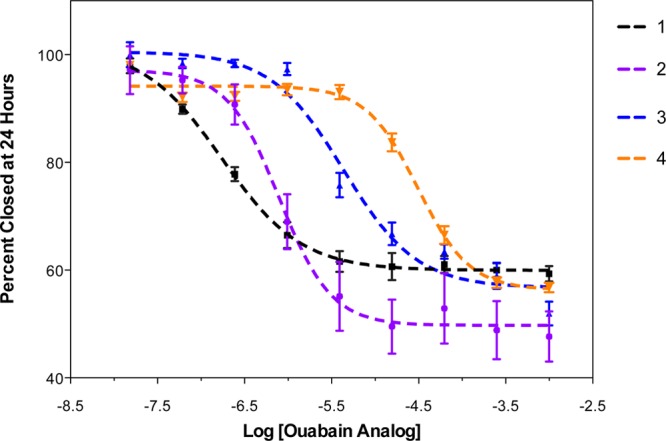
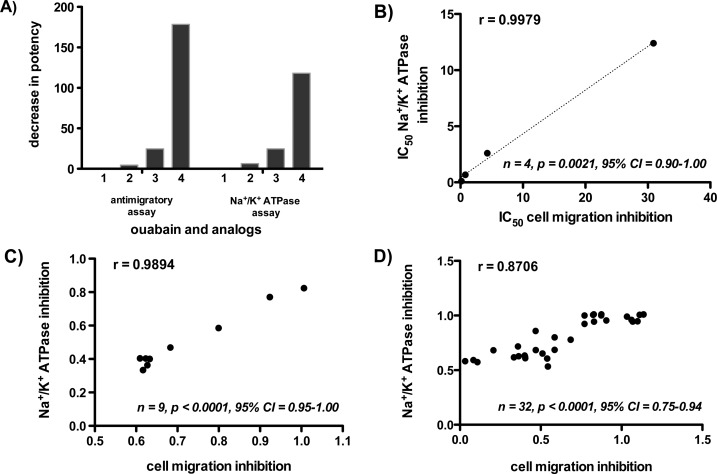
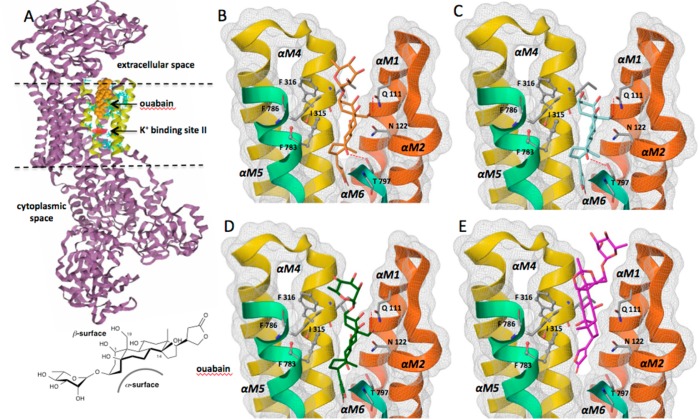
The cardiac glycosides ouabain and digitoxin, established Na(+)/K(+) ATPase inhibitors, were found to inhibit MDA-MB-231 breast cancer cell migration through an unbiased chemical genetics screen for cell motility. The Na(+)/K(+) ATPase acts both as an ion-transporter and as a receptor for cardiac glycosides. To delineate which function is related to breast cancer cell migration, structure-activity relationship (SAR) profiles of cardiac glycosides were established at the cellular (cell migration inhibition), molecular (Na(+)/K(+) ATPase inhibition), and atomic (computational docking) levels. The SAR of cardiac glycosides and their analogs revealed a similar profile, a decrease in potency when the parent cardiac glycoside structure was modified, for each activity investigated. Since assays were done at the cellular, molecular, and atomic levels, correlation of SAR profiles across these multiple assays established links between cellular activity and specific protein-small molecule interactions. The observed antimigratory effects in breast cancer cells are directly related to the inhibition of Na(+)/K(+) transport. Specifically, the orientation of cardiac glycosides at the putative cation permeation path formed by transmembrane helices αM1-M6 correlates with the Na(+) pump activity and cell migration. Other Na(+)/K(+) ATPase inhibitors that are structurally distinct from cardiac glycosides also exhibit antimigratory activity, corroborating the conclusion that the antiport function of Na(+)/K(+) ATPase and not the receptor function is important for supporting the motility of MDA-MB-231 breast cancer cells. Correlative SAR can establish new relationships between specific biochemical functions and higher-level cellular processes, particularly for proteins with multiple functions and small molecules with unknown or various modes of action.
强心苷哇巴因和地高辛是已确定的钠钾ATP酶抑制剂,通过针对细胞运动性的无偏化学遗传学筛选发现,它们可抑制MDA - MB - 231乳腺癌细胞的迁移。钠钾ATP酶既作为离子转运体,又作为强心苷的受体发挥作用。为了阐明哪种功能与乳腺癌细胞迁移相关,在细胞(细胞迁移抑制)、分子(钠钾ATP酶抑制)和原子(计算对接)水平建立了强心苷的构效关系(SAR)图谱。强心苷及其类似物的SAR显示出相似的图谱,即对于所研究的每种活性,当母体强心苷结构被修饰时,活性会降低。由于在细胞、分子和原子水平进行了测定,这些多重测定的SAR图谱的相关性建立了细胞活性与特定蛋白质 - 小分子相互作用之间的联系。在乳腺癌细胞中观察到的抗迁移作用与钠钾转运的抑制直接相关。具体而言,强心苷在由跨膜螺旋αM1 - M6形成的假定阳离子渗透路径上的取向与钠泵活性和细胞迁移相关。其他结构上与强心苷不同的钠钾ATP酶抑制剂也表现出抗迁移活性,这证实了钠钾ATP酶的反向转运功能而非受体功能对于支持MDA - MB - 231乳腺癌细胞的运动性很重要这一结论。相关构效关系可以在特定生化功能与更高水平的细胞过程之间建立新的关系,特别是对于具有多种功能的蛋白质和作用方式未知或多样的小分子。