West Vivian L, Borland David, Hammond W Ed
Duke Center for Health Informatics, Duke University, Durham, North Carolina, USA.
The University of North Carolina at Chapel Hill, Chapel Hill, North Carolina, USA.
J Am Med Inform Assoc. 2015 Mar;22(2):330-9. doi: 10.1136/amiajnl-2014-002955. Epub 2014 Oct 21.
This study investigates the use of visualization techniques reported between 1996 and 2013 and evaluates innovative approaches to information visualization of electronic health record (EHR) data for knowledge discovery.
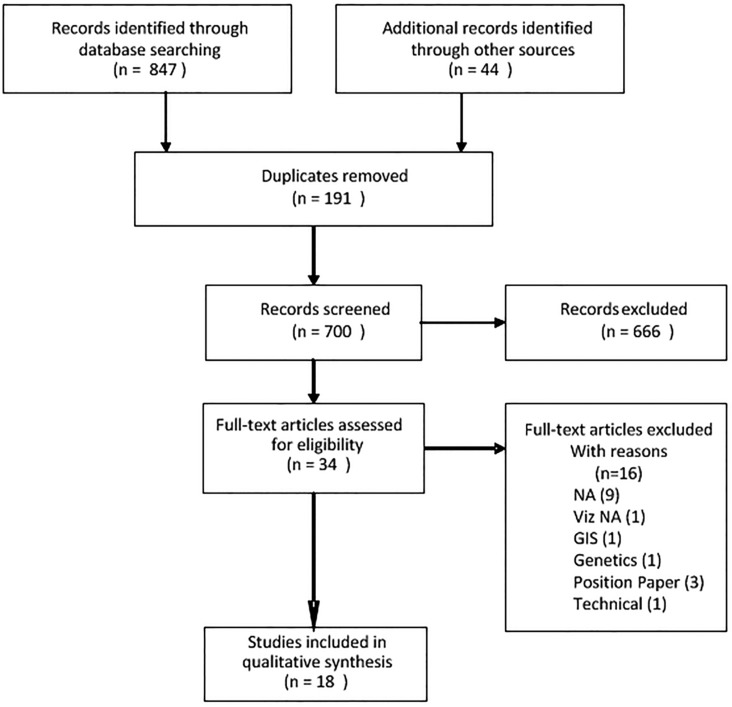
An electronic literature search was conducted May-July 2013 using MEDLINE and Web of Knowledge, supplemented by citation searching, gray literature searching, and reference list reviews. General search terms were used to assure a comprehensive document search.
Beginning with 891 articles, the number of articles was reduced by eliminating 191 duplicates. A matrix was developed for categorizing all abstracts and to assist with determining those to be excluded for review. Eighteen articles were included in the final analysis.
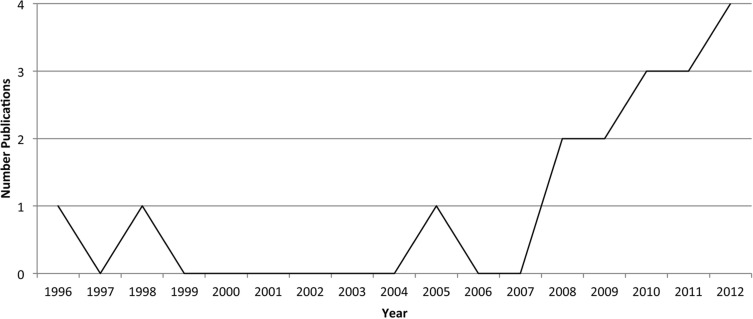
Several visualization techniques have been extensively researched. The most mature system is LifeLines and its applications as LifeLines2, EventFlow, and LifeFlow. Initially, research focused on records from a single patient and visualization of the complex data related to one patient. Since 2010, the techniques under investigation are for use with large numbers of patient records and events. Most are linear and allow interaction through scaling and zooming to resize. Color, density, and filter techniques are commonly used for visualization.
With the burgeoning increase in the amount of electronic healthcare data, the potential for knowledge discovery is significant if data are managed in innovative and effective ways. We identify challenges discovered by previous EHR visualization research, which will help researchers who seek to design and improve visualization techniques.
本研究调查了1996年至2013年间报道的可视化技术的应用情况,并评估了用于电子健康记录(EHR)数据知识发现的信息可视化创新方法。
2013年5月至7月使用MEDLINE和Web of Knowledge进行了电子文献检索,并辅以引文检索、灰色文献检索和参考文献列表回顾。使用通用检索词以确保全面的文献检索。
从891篇文章开始,通过消除191篇重复文章减少了文章数量。开发了一个矩阵用于对所有摘要进行分类,并协助确定那些应排除以供审查的摘要。最终分析纳入了18篇文章。
几种可视化技术已得到广泛研究。最成熟的系统是LifeLines及其作为LifeLines2、EventFlow和LifeFlow的应用。最初,研究集中在单个患者的记录以及与一名患者相关的复杂数据的可视化。自2010年以来,正在研究的技术用于大量患者记录和事件。大多数是线性的,并允许通过缩放进行交互以调整大小。颜色、密度和过滤技术通常用于可视化。
随着电子医疗数据量的迅速增加,如果以创新和有效的方式管理数据,知识发现的潜力巨大。我们确定了先前EHR可视化研究发现的挑战,这将有助于寻求设计和改进可视化技术的研究人员。