Chen Si, Wang Qian, Wu Ziyan, Li Yuan, Li Ping, Sun Fei, Zheng Wenjie, Wu Qingjun, Wu Chanyuan, Deng Chuiwen, Zhang Fengchun, Li Yongzhe
Department of Rheumatology and Clinical Immunology, Peking Union Medical College Hospital, Chinese Academy of Medical Sciences & Peking Union Medical College, Key Laboratory of Rheumatology and Clinical Immunology, Ministry of Education, Beijing, China.
PLoS One. 2014 Oct 22;9(10):e110044. doi: 10.1371/journal.pone.0110044. eCollection 2014.
Single-nucleotide polymorphisms (SNPs) in the TNFAIP3, IFIH1, and IRF5 genes have been associated with several auto-inflammation diseases, while the susceptibility between these genes and idiopathic inflammatory myopathies (IIMs) were not reported. This study aimed to investigate whether TNFAIP3, IFIH1, and IRF5 gene polymorphisms confer susceptibility for the IIMs in Chinese Han population.
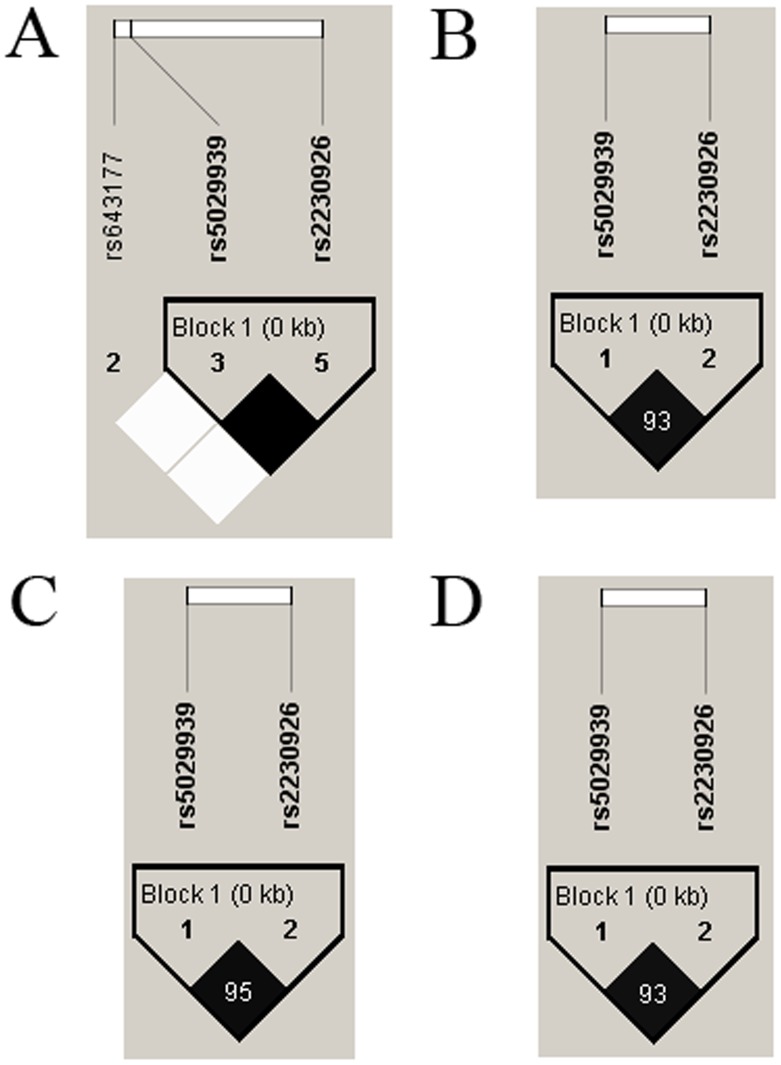
A large case-control study of Chinese subjects with polymyositis (PM) (n = 298) and dermatomyositis (DM) (n = 530) was accomplished. 968 healthy and ethnically matched controls were available for comparison. Six SNPs in the TNFAIP3 region (rs2230926 and rs5029939), the IFIH1 gene (rs1990760 and rs3747517) and the IRF5 region (rs4728142 and rs729302) were assessed and genotyped using the Sequenom MassArray iPLEX platform.
Our study indicated a strong allele association was observed in PM/DM and PM patients for rs2230926 (OR: 1.61, 95%CI: 1.20-2.16, P(c) = 7.5×10(-3); OR: 1.88, 95%CI: 1.30-2.74, P(c) = 4.0×10(-3), respectively) and rs5029939 (OR: 1.64, 95%CI: 1.21-2.21, P(c) = 6.0×10(-3); OR: 1.88, 95%CI: 1.28-2.76, P(c) = 5.5×10(-3), respectively). And rs2230926 and rs5029939 were significantly associated with interstitial lung disease (ILD) in PM/DM and PM patients (P(c) = 0.04 and P(c) = 0.016; P(c) = 0.02 and P(c) = 0.03, respectively). In addition, rs4728142 allele and genotype had significant association with PM/DM patients (P(c) = 0.026 and P(c) = 0.048, respectively). Further analysis with three logistic regression genetic models revealed statistically significant difference in the genotypic distribution in the PM/DM, PM or DM patients when the additive and dominant models were used.
This was the first study to reveal TNFAIP3 and IRF5 polymorphisms were associated with PM/DM patients or these patients with ILD, indicating that TNFAIP3 and IRF5 might be the susceptibility gene for PM/DM patients in Chinese Han population.
TNFAIP3、IFI1H和IRF5基因中的单核苷酸多态性(SNP)与多种自身炎症性疾病相关,而这些基因与特发性炎性肌病(IIM)之间的易感性尚未见报道。本研究旨在探讨TNFAIP3、IFI1H和IRF5基因多态性是否会使中国汉族人群易患IIM。
完成了一项针对中国多发性肌炎(PM)患者(n = 298)和皮肌炎(DM)患者(n = 530)的大型病例对照研究。有968名健康且种族匹配的对照可供比较。使用Sequenom MassArray iPLEX平台对TNFAIP3区域(rs2230926和rs5029939)、IFI1H基因(rs1990760和rs3747517)和IRF5区域(rs4728142和rs729302)中的六个SNP进行评估和基因分型。
我们的研究表明,在PM/DM患者和PM患者中,rs2230926(OR:1.61,95%CI:1.20 - 2.16,P(c) = 7.5×10(-3);OR:1.88,95%CI:1.30 - 2.74,P(c) = 4.0×10(-3))和rs5029939(OR:1.64,95%CI:1.21 - 2.21,P(c) = 6.0×10(-3);OR:1.88,95%CI:1.28 - 2.76,P(c) = 5.5×10(-3))均观察到强等位基因关联。并且rs2230926和rs5029939与PM/DM患者和PM患者的间质性肺病(ILD)显著相关(P(c) = 0.04和P(c) = 0.016;P(c) = 0.02和P(c) = 0.03)。此外,rs4728142等位基因和基因型与PM/DM患者显著相关(P(c)分别为0.026和0.048)。使用三种逻辑回归遗传模型进行的进一步分析显示,当采用加性和显性模型时,PM/DM患者、PM或DM患者的基因型分布存在统计学显著差异。
这是首次揭示TNFAIP3和IRF5多态性与PM/DM患者或这些合并ILD的患者相关的研究,表明TNFAIP3和IRF5可能是中国汉族人群中PM/DM患者的易感基因。