Okebe Joseph, Affara Muna, Correa Simon, Muhammad Abdul Khalie, Nwakanma Davis, Drakeley Chris, D'Alessandro Umberto
Disease Control & Elimination Theme, Medical Research Council Unit, Fajara, The Gambia.
Department of Immunology and Infection, London school of Hygiene and Tropical Medicine, London, United Kingdom.
PLoS One. 2014 Oct 22;9(10):e110926. doi: 10.1371/journal.pone.0110926. eCollection 2014.
As the geographical distribution of malaria transmission becomes progressively clustered, identifying residual pockets of transmission is important for research and for targeting interventions. Malarial antibody-based surveillance is increasingly recognised as a valuable complement to classic methods for the detection of infection foci especially at low transmission levels. The study presents serological evidence for transmission heterogeneity among school children in The Gambia measured during the dry, non-transmission season.
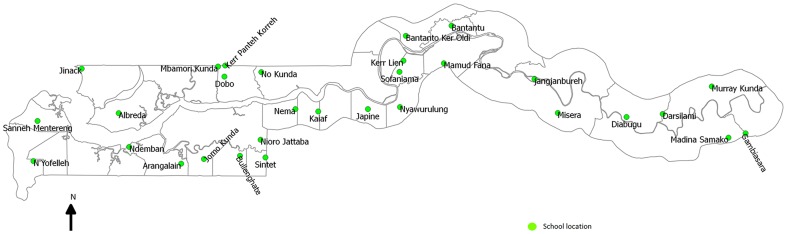
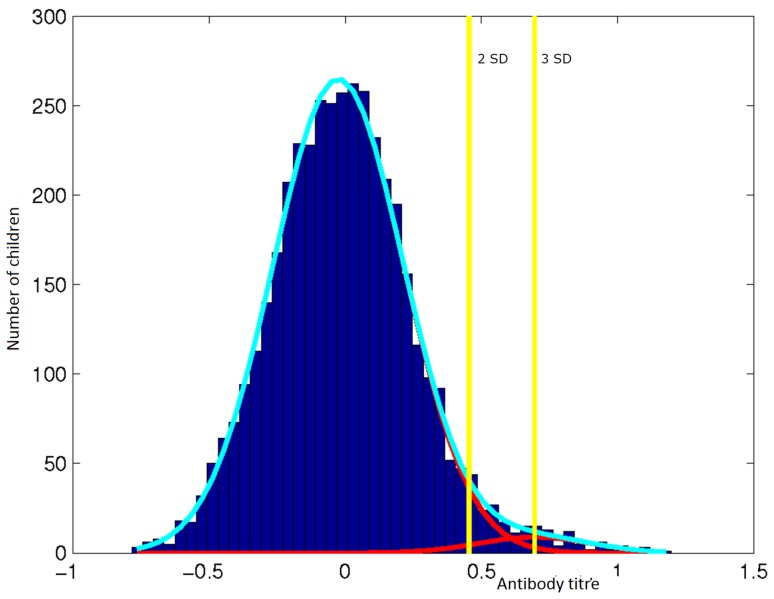
Healthy primary school children were randomly selected from 30 schools across the country and screened for malaria infection (microscopy) and antimalarial antibodies (MSP119). Antibody distribution was modelled using 2-component finite mixture model with cut-off for positivity from pooled sera set at 2-standard deviation from the mean of the first component. Factors associated with a positive serological status were identified in a univariate model and then combined in a multilevel mixed-effects logistic regression model, simultaneously adjusting for variations between individuals and school.
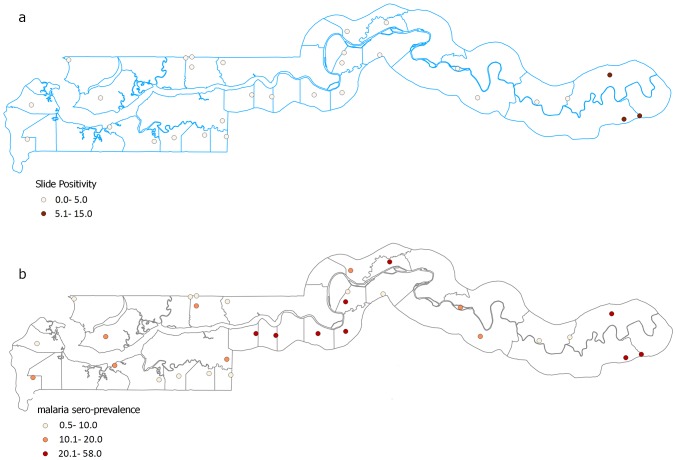
A total of 4140 children, 1897 (46%) boys, were enrolled with mean age of 10.2 years (SD 2.6, range 4-20 years). Microscopy results available for 3640 (87.9%) children showed that 1.9% (69) were positive for Plasmodium falciparum infections, most of them (97.1%, 67/69) asymptomatic. The overall seroprevalence was 12.7% (527/4140) with values for the schools ranging from 0.6% to 43.8%. Age (OR 1.12, 95% CI 1.07-1.16,) and parasite carriage (OR 3.36, 95% CI 1.95-5.79) were strongly associated with seropositivity.
Serological responses to malaria parasites could identify individuals who were or had been infected, and clusters of residual transmission. Field-adapted antibody tests able to guide mass screening and treatment campaigns would be extremely useful.
随着疟疾传播的地理分布逐渐聚集,识别残留的传播区域对于研究和确定干预目标至关重要。基于疟疾抗体的监测越来越被认为是对经典感染病灶检测方法的宝贵补充,特别是在低传播水平时。本研究提供了在冈比亚旱季(非传播季节)对在校儿童进行检测时,疟疾传播异质性的血清学证据。
从全国30所学校中随机选取健康的小学生,对其进行疟疾感染筛查(显微镜检查)和抗疟抗体检测(MSP119)。抗体分布采用双组分有限混合模型进行建模,将混合血清的阳性临界值设定为第一组分均值的2个标准差。在单变量模型中确定与血清学阳性状态相关的因素,然后将这些因素纳入多水平混合效应逻辑回归模型,同时调整个体和学校之间的差异。
共纳入4140名儿童,其中1897名(46%)为男孩,平均年龄为10.2岁(标准差2.6,范围4 - 20岁)。3640名(87.9%)儿童的显微镜检查结果显示,1.9%(69名)恶性疟原虫感染呈阳性,其中大多数(97.1%,67/69)无症状。总体血清阳性率为12.7%(527/4140),各学校的血清阳性率在0.6%至43.8%之间。年龄(比值比1.12,95%置信区间1.07 - 1.16)和寄生虫携带情况(比值比3.36,95%置信区间1.95 - 5.79)与血清阳性密切相关。
对疟原虫的血清学反应可以识别曾经感染或正在感染的个体,以及残留传播区域。能够指导大规模筛查和治疗活动的现场适应性抗体检测将非常有用。