Nava Elena, Steiger Tineke, Röder Brigitte
Biopsychology and Neuropsychology, University of Hamburg, Von-Melle-Park 11, 20146 Hamburg, Germany.
Department of Systems Neuroscience, University Medical Center Hamburg-Eppendorf, Martinistr. 52, 20246 Hamburg, Germany.
Sci Rep. 2014 Oct 23;4:6622. doi: 10.1038/srep06622.
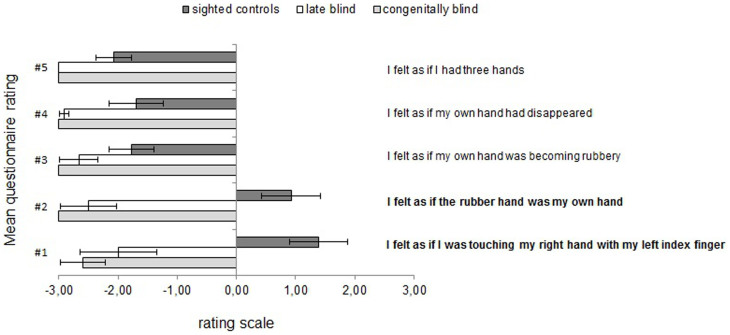
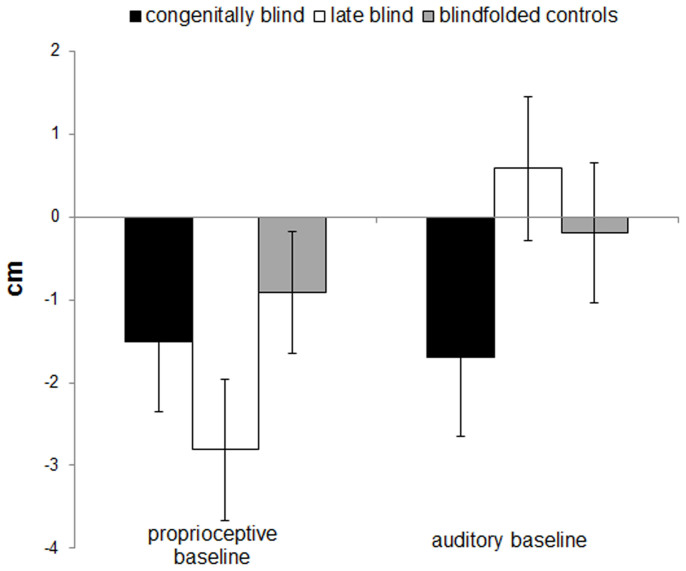
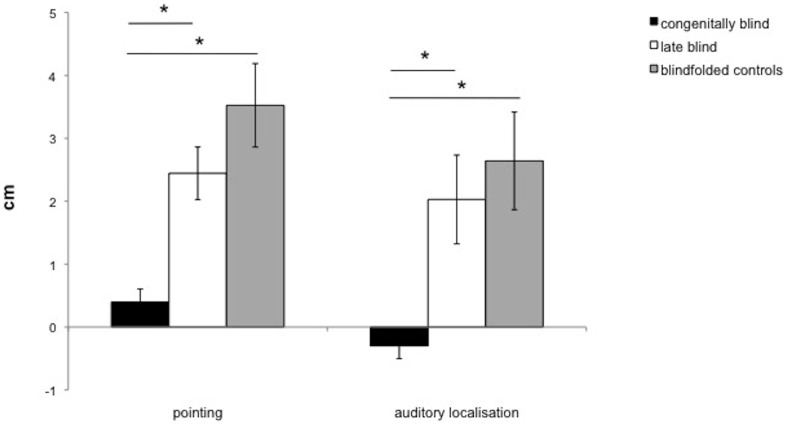
Sense of body ownership and body representation are fundamental parts of human consciousness, but the contribution of the visual modality to their development remains unclear. We tested congenitally and late blind adults on a somatosensory version of the rubber hand illusion, and on the Aristotle illusion, in which sighted controls touching a single sphere with crossed fingers commonly report perceiving two. We found that congenitally and late blind individuals did not report subjectively experiencing the rubber hand illusion. However, in an objective measure, the congenitally blind did not show a recalibration of the position of their hand towards the rubber hand while late blind and sighted individuals did. By contrast, all groups experienced the Aristotle illusion. This pattern of results provides evidence for a dissociation of the concepts of body ownership and spatial recalibration and, furthermore, suggests different reference frames for hands (external space) and fingers (anatomical space).
身体所有权感和身体表征是人类意识的基本组成部分,但视觉模态对其发展的贡献仍不明确。我们对先天性失明和后天失明的成年人进行了体感版的橡胶手错觉测试,以及亚里士多德错觉测试,在亚里士多德错觉测试中,用交叉手指触摸单个球体的视力正常对照组通常报告感觉到两个球体。我们发现,先天性失明和后天失明的个体并未报告主观体验到橡胶手错觉。然而,在一项客观测量中,先天性失明者并未表现出其手部位置朝着橡胶手重新校准,而后天失明者和视力正常者则表现出了这种校准。相比之下,所有组都体验到了亚里士多德错觉。这种结果模式为身体所有权概念和空间重新校准的分离提供了证据,此外,还表明了手部(外部空间)和手指(解剖学空间)的不同参照系。