Strazza Marianne, Banerjee Anupam, Alexaki Aikaterini, Passic Shendra R, Meucci Olimpia, Pirrone Vanessa, Wigdahl Brian, Nonnemacher Michael R
Department of Microbiology and Immunology, Drexel University College of Medicine, 245 N, 15th Street, MS# 1013A, Philadelphia, PA 19102, USA.
BMC Res Notes. 2014 Oct 23;7:752. doi: 10.1186/1756-0500-7-752.
Approximately one-third of the AIDS cases in the United States have been attributed to the use of injected drugs, frequently involving the abuse of opioids. Consequently, it is critical to address whether opioid use directly contributes to altered susceptibility to HIV-1 beyond the increased risk of exposure. Previous in vitro and in vivo studies addressing the role of μ-opioid agonists in altering levels of the co-receptor CXCR4 and subsequent HIV-1 replication have yielded contrasting results. The bone marrow is believed to be a potential anatomical sanctuary for HIV-1.
The well-characterized CD34+CD38+ human bone marrow-derived hematopoietic progenitor cell line TF-1 was used as a model to investigate the effects of the μ-opioid receptor-specific peptide DAMGO (D-Ala2,N-Me-Phe4, Gly5-ol-enkephalin) on CXCR4 expression as well as infection of undifferentiated human hematopoietic progenitor cells.
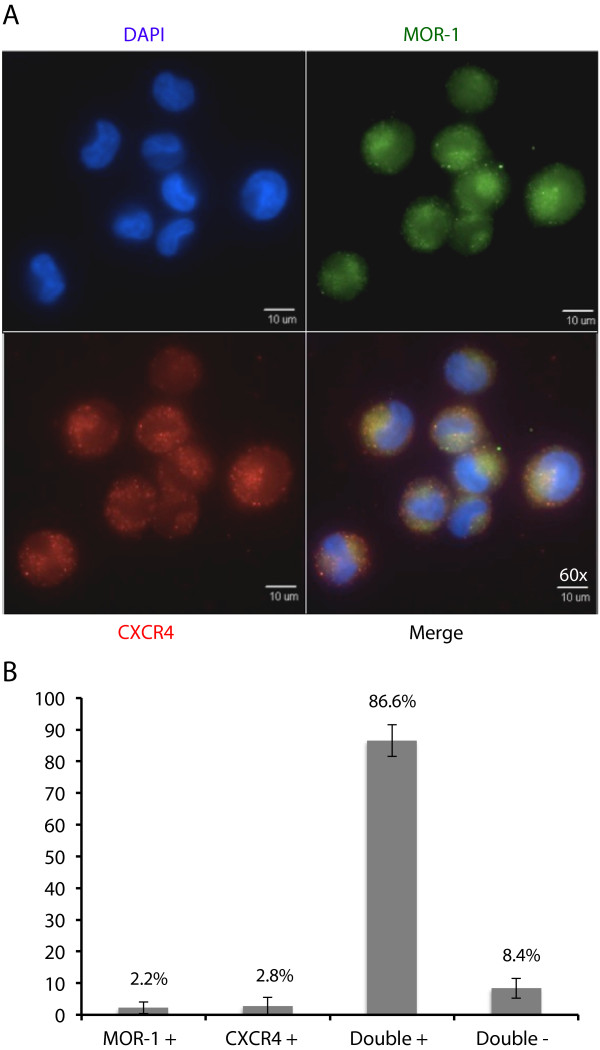
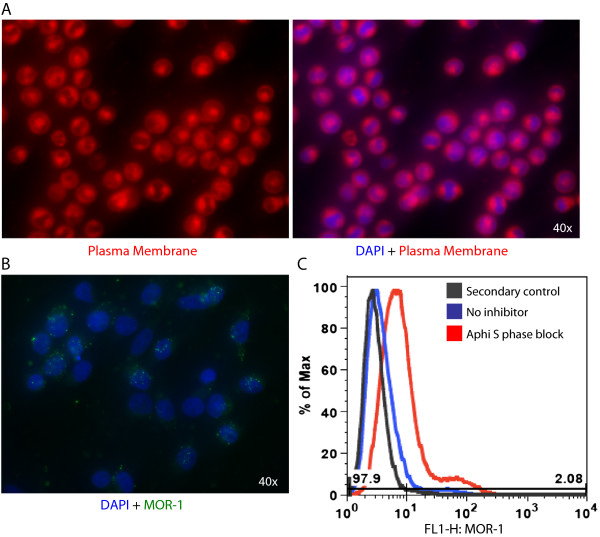
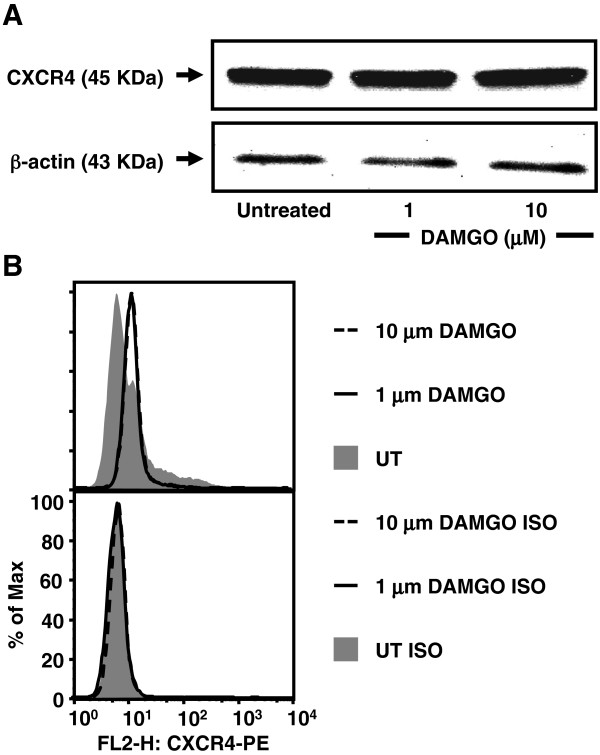
The results revealed the presence of the μ-opioid receptor-1 isoform (MOR-1) on the surface of TF-1 cells. Furthermore, immunostaining revealed that the majority of TF-1 cells co-express MOR-1 and CXCR4, and a subpopulation of these double-positive cells express the two receptors in overlapping membrane domains. Three subpopulations of TF-1 cells were categorized based on their levels of surface CXCR4 expression, defined as non-, low-, and high-expressing. Flow cytometry indicated that treatment with DAMGO resulted in a shift in the relative proportion of CXCR4+ cells to the low-expressing phenotype. This result correlated with a >3-fold reduction in replication of the X4 HIV-1 strain IIIB, indicating a role for the CXCR4 high-expression subpopulation in sustaining infection within this progenitor cell line.
These experiments provide insight into the impact of μ-opioid exposure with respect to inhibition of viral replication in this human TF-1 bone marrow progenitor cell line model.
在美国,约三分之一的艾滋病病例被认为是由于注射吸毒所致,其中经常涉及阿片类药物滥用。因此,至关重要的是要探讨阿片类药物的使用是否除了增加暴露风险之外,还直接导致对HIV-1易感性的改变。先前关于μ-阿片受体激动剂在改变共受体CXCR4水平及随后HIV-1复制中作用的体外和体内研究得出了相互矛盾的结果。骨髓被认为是HIV-1的一个潜在解剖学庇护所。
使用特征明确的CD34+CD38+人骨髓来源的造血祖细胞系TF-1作为模型,研究μ-阿片受体特异性肽DAMGO(D-丙氨酸2,N-甲基苯丙氨酸4,甘氨酸5-醇脑啡肽)对CXCR4表达以及未分化人造血祖细胞感染的影响。
结果显示TF-1细胞表面存在μ-阿片受体-1亚型(MOR-1)。此外,免疫染色显示大多数TF-1细胞共表达MOR-1和CXCR4,并且这些双阳性细胞的一个亚群在重叠的膜结构域中表达这两种受体。根据其表面CXCR4表达水平将TF-1细胞分为三个亚群,分别定义为非表达、低表达和高表达。流式细胞术表明,用DAMGO处理导致CXCR4+细胞相对比例向低表达表型转变。这一结果与X4 HIV-1毒株IIIB的复制减少>3倍相关,表明CXCR4高表达亚群在维持该祖细胞系内感染中起作用。
这些实验为μ-阿片暴露对该人TF-1骨髓祖细胞系模型中病毒复制的抑制作用提供了见解。