Tsukamoto Tetsuo
Department of Immunology, Faculty of Medicine, Kindai University, Osaka, Japan.
Front Cell Infect Microbiol. 2020 Feb 21;10:60. doi: 10.3389/fcimb.2020.00060. eCollection 2020.
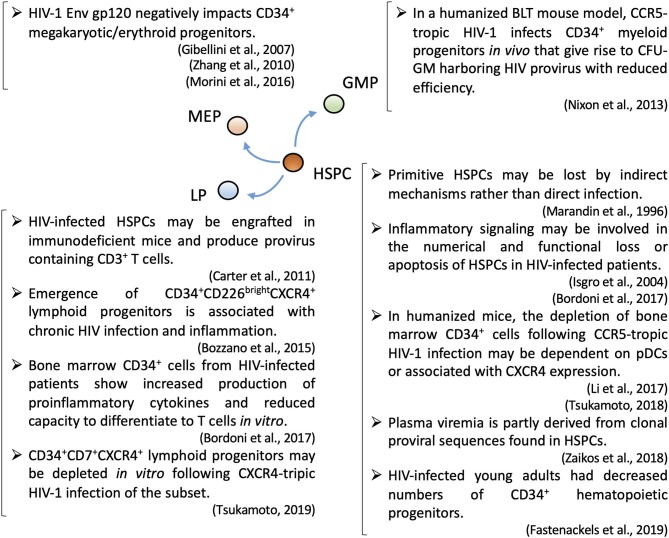
The interaction between human immunodeficiency virus (HIV) and hematopoietic stem/progenitor cells (HSPCs) has been of great interest. However, it remains unclear whether HSPCs can act as viral reservoirs. Many studies have reported the presence of latently infected HSPCs in the bone marrow of HIV-infected patients, whereas many other investigators have reported negative results. Hence, further evidence is required to elucidate this controversy. The other arm of HSPC investigations of HIV infection involves dynamics analysis in the early and late stages of infection to understand the impact on the pathogenesis of acquired immunodeficiency syndrome. Several recent studies have suggested reduced amounts and/or functional impairment of multipotent, myeloid, and lymphoid progenitors in HIV infection that may contribute to hematological manifestations, including anemia, pancytopenia, and T-cell depletion. In addition, ongoing and future studies on the senescence of HSPCs are expected to further the understanding of HIV pathogenesis. This mini review summarizes reports describing the basic aspects of hematopoiesis in response to HIV infection and offers insights into the association of HIV infection/exposure of the host HSPCs and hematopoietic potential.
人类免疫缺陷病毒(HIV)与造血干细胞/祖细胞(HSPCs)之间的相互作用一直备受关注。然而,HSPCs是否可作为病毒储存库仍不清楚。许多研究报告了在HIV感染患者的骨髓中存在潜伏感染的HSPCs,而许多其他研究人员则报告了阴性结果。因此,需要进一步的证据来阐明这一争议。对HIV感染的HSPCs研究的另一个方面涉及感染早期和晚期的动力学分析,以了解对获得性免疫缺陷综合征发病机制的影响。最近的几项研究表明,HIV感染中多能、髓系和淋巴系祖细胞数量减少和/或功能受损,这可能导致血液学表现,包括贫血、全血细胞减少和T细胞耗竭。此外,正在进行的和未来关于HSPCs衰老的研究有望进一步加深对HIV发病机制的理解。本综述总结了描述HIV感染后造血基本方面的报告,并深入探讨了宿主HSPCs的HIV感染/暴露与造血潜能之间的关联。