Rotheram-Borus Mary Jane, Tomlinson Mark, le Roux Ingrid M, Harwood Jessica M, Comulada Scott, O'Connor Mary J, Weiss Robert E, Worthman Carol M
Department of Psychiatry and Biobehavioral Medicine, Semel Institute, University of California Los Angeles, Los Angeles, California, United States of America.
Department of Psychology, Stellenbosch University, Stellenbosch, South Africa.
PLoS One. 2014 Oct 23;9(10):e105934. doi: 10.1371/journal.pone.0105934. eCollection 2014.
Interventions are needed to reduce poor perinatal health. We trained community health workers (CHWs) as home visitors to address maternal/infant risks.
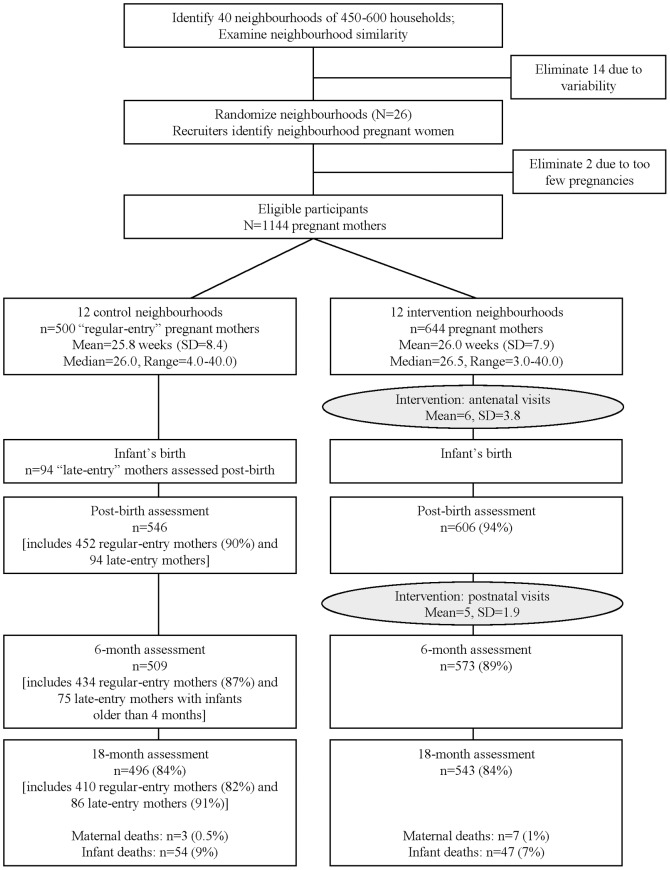
In a cluster randomised controlled trial in Cape Town townships, neighbourhoods were randomised within matched pairs to 1) the control, healthcare at clinics (n = 12 neighbourhoods; n = 594 women), or 2) a home visiting intervention by CBW trained in cognitive-behavioural strategies to address health risks (by the Philani Maternal, Child Health and Nutrition Programme), in addition to clinic care (n = 12 neighbourhoods; n = 644 women). Participants were assessed during pregnancy (2% refusal) and 92% were reassessed at two weeks post-birth, 88% at six months and 84% at 18 months later. We analysed 32 measures of maternal/infant well-being over the 18 month follow-up period using longitudinal random effects regressions. A binomial test for correlated outcomes evaluated overall effectiveness over time. The 18 month post-birth assessment outcomes also were examined alone and as a function of the number of home visits received.
Benefits were found on 7 of 32 measures of outcomes, resulting in significant overall benefits for the intervention compared to the control when using the binomial test (p = 0.008); nevertheless, no effects were observed when only the 18 month outcomes were analyzed. Benefits on individual outcomes were related to the number of home visits received. Among women living with HIV, intervention mothers were more likely to implement the PMTCT regimens, use condoms during all sexual episodes (OR = 1.25; p = 0.014), have infants with healthy weight-for-age measurements (OR = 1.42; p = 0.045), height-for-age measurements (OR = 1.13, p<0.001), breastfeed exclusively for six months (OR = 3.59; p<0.001), and breastfeed longer (OR = 3.08; p<0.001). Number of visits was positively associated with infant birth weight ≥2500 grams (OR = 1.07; p = 0.012), healthy head-circumference-for-age measurements at 6 months (OR = 1.09, p = 0.017), and improved cognitive development at 18 months (OR = 1.02, p = 0.048).
Home visits to neighbourhood mothers by CHWs may be a feasible strategy for enhancing maternal/child outcomes. However, visits likely must extend over several years for persistent benefits.
ClinicalTrials.gov NCT00996528.
需要采取干预措施来改善围产期健康状况不佳的问题。我们培训社区卫生工作者(CHW)作为家访员,以应对孕产妇/婴儿风险。
在开普敦城镇进行的一项整群随机对照试验中,社区在匹配对中随机分为两组:1)对照组,在诊所接受医疗保健(n = 12个社区;n = 594名妇女);2)除了诊所护理外,由接受认知行为策略培训以应对健康风险的社区卫生工作者进行家访干预(由菲拉尼母婴健康与营养项目进行)(n = 12个社区;n = 644名妇女)。在孕期对参与者进行评估(2%拒绝参与),92%的参与者在产后两周重新接受评估,88%在六个月时重新接受评估,84%在18个月后重新接受评估。我们在18个月的随访期内使用纵向随机效应回归分析了32项孕产妇/婴儿福祉指标。对相关结果进行二项式检验以评估随时间的总体有效性。产后18个月的评估结果也单独进行了检查,并作为接受家访次数的函数进行了检查。
在32项结果指标中有7项发现了益处,使用二项式检验时,与对照组相比,干预组总体上有显著益处(p = 0.008);然而,仅分析18个月的结果时未观察到效果。个体结果的益处与接受家访的次数有关。在感染艾滋病毒的妇女中,接受干预的母亲更有可能实施预防母婴传播方案,在所有性行为中使用避孕套(比值比[OR] = 1.25;p = 0.014),其婴儿的年龄别体重测量值健康(OR = 1.42;p = 0.045),年龄别身高测量值健康(OR = 1.13,p<0.001),纯母乳喂养六个月(OR = 3.59;p<0.001),且母乳喂养时间更长(OR = 3.08;p<0.001)。家访次数与婴儿出生体重≥2500克呈正相关(OR = 1.07;p = 0.012),与6个月时年龄别头围测量值健康呈正相关(OR = 1.09,p = 0.017),与18个月时认知发展改善呈正相关(OR = 1.02,p = 0.048)。
社区卫生工作者对社区母亲进行家访可能是改善母婴结局的一种可行策略。然而,家访可能必须持续数年才能获得持续的益处。
ClinicalTrials.gov NCT00996528。