Gaston Daniel, Hansford Samantha, Oliveira Carla, Nightingale Mathew, Pinheiro Hugo, Macgillivray Christine, Kaurah Pardeep, Rideout Andrea L, Steele Patricia, Soares Gabriela, Huang Weei-Yuarn, Whitehouse Scott, Blowers Sarah, LeBlanc Marissa A, Jiang Haiyan, Greer Wenda, Samuels Mark E, Orr Andrew, Fernandez Conrad V, Majewski Jacek, Ludman Mark, Dyack Sarah, Penney Lynette S, McMaster Christopher R, Huntsman David, Bedard Karen
Department of Pathology, Dalhousie University, Halifax, Nova Scotia, Canada.
Department of Pathology and Laboratory Medicine, University of British Columbia, Vancouver, British Columbia, Canada.
PLoS Genet. 2014 Oct 23;10(10):e1004669. doi: 10.1371/journal.pgen.1004669. eCollection 2014 Oct.
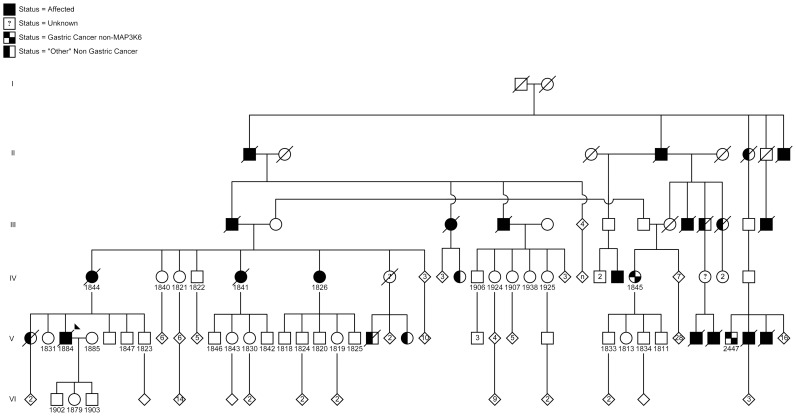
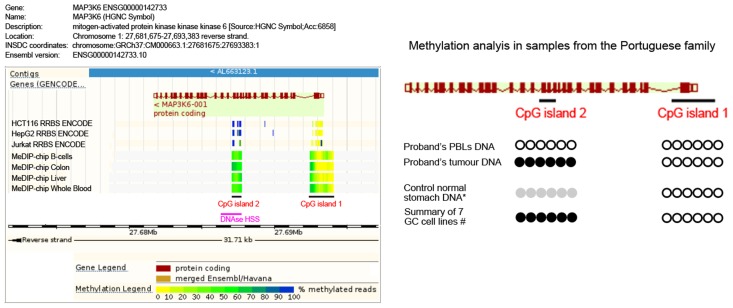
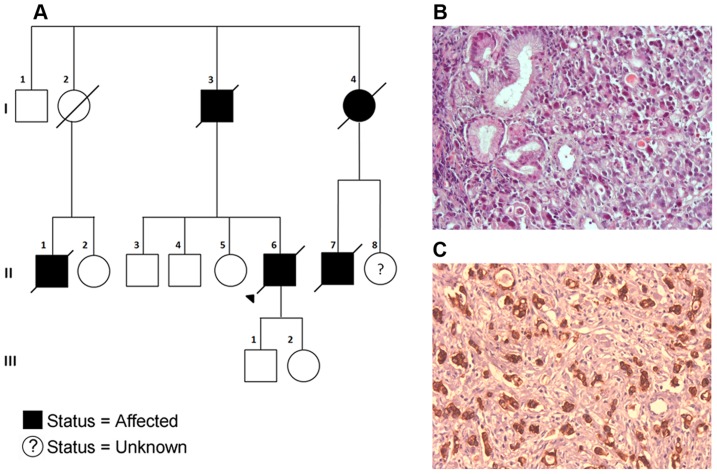
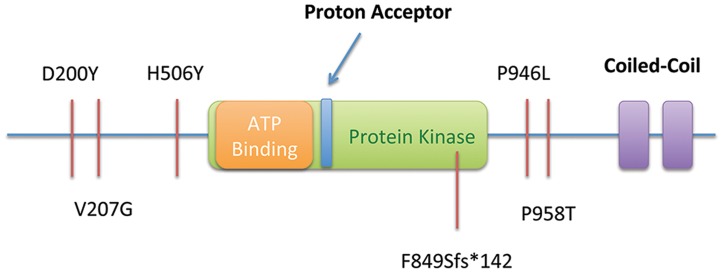
Gastric cancer is among the leading causes of cancer-related deaths worldwide. While heritable forms of gastric cancer are relatively rare, identifying the genes responsible for such cases can inform diagnosis and treatment for both hereditary and sporadic cases of gastric cancer. Mutations in the E-cadherin gene, CDH1, account for 40% of the most common form of familial gastric cancer (FGC), hereditary diffuse gastric cancer (HDGC). The genes responsible for the remaining forms of FGC are currently unknown. Here we examined a large family from Maritime Canada with FGC without CDH1 mutations, and identified a germline coding variant (p.P946L) in mitogen-activated protein kinase kinase kinase 6 (MAP3K6). Based on conservation, predicted pathogenicity and a known role of the gene in cancer predisposition, MAP3K6 was considered a strong candidate and was investigated further. Screening of an additional 115 unrelated individuals with non-CDH1 FGC identified the p.P946L MAP3K6 variant, as well as four additional coding variants in MAP3K6 (p.F849Sfs*142, p.P958T, p.D200Y and p.V207G). A somatic second-hit variant (p.H506Y) was present in DNA obtained from one of the tumor specimens, and evidence of DNA hypermethylation within the MAP3K6 gene was observed in DNA from the tumor of another affected individual. These findings, together with previous evidence from mouse models that MAP3K6 acts as a tumor suppressor, and studies showing the presence of somatic mutations in MAP3K6 in non-hereditary gastric cancers and gastric cancer cell lines, point towards MAP3K6 variants as a predisposing factor for FGC.
胃癌是全球癌症相关死亡的主要原因之一。虽然遗传性胃癌相对罕见,但确定导致此类病例的基因可为遗传性和散发性胃癌的诊断和治疗提供依据。E-钙黏蛋白基因(CDH1)的突变占家族性胃癌(FGC)最常见形式——遗传性弥漫性胃癌(HDGC)的40%。导致其余FGC形式的基因目前尚不清楚。在这里,我们研究了来自加拿大滨海地区一个患有FGC但无CDH1突变的大家族,并在丝裂原活化蛋白激酶激酶激酶6(MAP3K6)中鉴定出一种种系编码变异(p.P946L)。基于保守性、预测的致病性以及该基因在癌症易感性中的已知作用,MAP3K6被认为是一个强有力的候选基因,并进行了进一步研究。对另外115名患有非CDH1 FGC的无关个体进行筛查,发现了p.P946L MAP3K6变异,以及MAP3K6中的另外四个编码变异(p.F849Sfs*142、p.P958T、p.D200Y和p.V207G)。在从一个肿瘤标本获得的DNA中存在体细胞二次打击变异(p.H506Y),并且在另一名受影响个体的肿瘤DNA中观察到MAP3K6基因内DNA高甲基化的证据。这些发现,连同之前来自小鼠模型的证据表明MAP3K6作为一种肿瘤抑制因子,以及研究表明在非遗传性胃癌和胃癌细胞系中存在MAP3K6的体细胞突变,都表明MAP3K6变异是FGC的一个易感因素。