Lecour Sandrine, Bøtker Hans E, Condorelli Gianluigi, Davidson Sean M, Garcia-Dorado David, Engel Felix B, Ferdinandy Peter, Heusch Gerd, Madonna Rosalinda, Ovize Michel, Ruiz-Meana Marisol, Schulz Rainer, Sluijter Joost P G, Van Laake Linda W, Yellon Derek M, Hausenloy Derek J
Hatter Institute for Cardiovascular Research in Africa and MRC Inter-University Cape Heart Group, University of Cape Town, Cape Town, South Africa.
Department of Cardiology, Aarhus University Hospital Skejby, Aarhus N, Denmark.
Cardiovasc Res. 2014 Dec 1;104(3):399-411. doi: 10.1093/cvr/cvu225. Epub 2014 Oct 24.
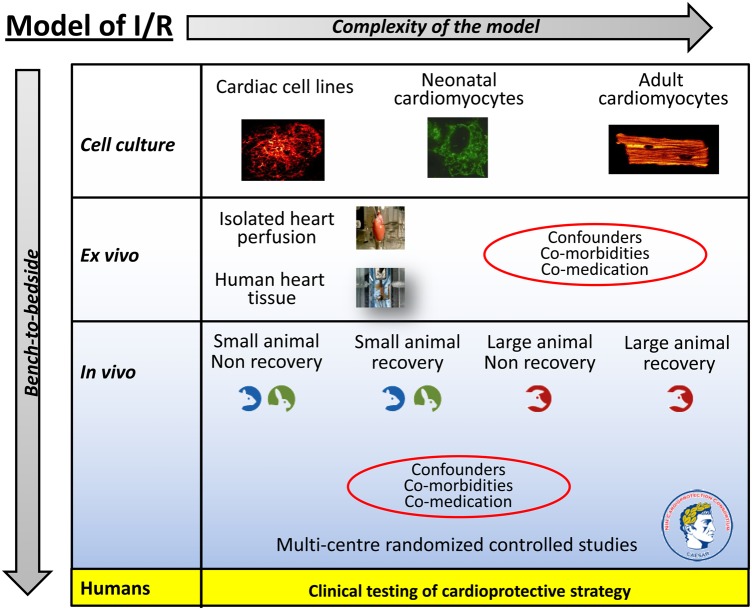
Ischaemic heart disease (IHD) remains the leading cause of death and disability worldwide. As a result, novel therapies are still needed to protect the heart from the detrimental effects of acute ischaemia-reperfusion injury, in order to improve clinical outcomes in IHD patients. In this regard, although a large number of novel cardioprotective therapies discovered in the research laboratory have been investigated in the clinical setting, only a few of these have been demonstrated to improve clinical outcomes. One potential reason for this lack of success may have been the failure to thoroughly assess the cardioprotective efficacy of these novel therapies in suitably designed preclinical experimental animal models. Therefore, the aim of this Position Paper by the European Society of Cardiology Working Group Cellular Biology of the Heart is to provide recommendations for improving the preclinical assessment of novel cardioprotective therapies discovered in the research laboratory, with the aim of increasing the likelihood of success in translating these new treatments into improved clinical outcomes.
缺血性心脏病(IHD)仍然是全球范围内死亡和残疾的主要原因。因此,仍需要新的疗法来保护心脏免受急性缺血再灌注损伤的有害影响,以改善IHD患者的临床结局。在这方面,尽管研究实验室中发现的大量新型心脏保护疗法已在临床环境中进行了研究,但其中只有少数已被证明能改善临床结局。这种缺乏成功的一个潜在原因可能是未能在设计合理的临床前实验动物模型中彻底评估这些新型疗法的心脏保护功效。因此,欧洲心脏病学会心脏细胞生物学工作组撰写本立场文件的目的是为改进对研究实验室中发现的新型心脏保护疗法的临床前评估提供建议,以期提高将这些新疗法转化为改善临床结局的成功率。