Key Laboratory for Thin Film and Microfabrication Technology of the Ministry of Education School of Electronics, Information and Electrical Engineering Shanghai Jiao Tong University, Shanghai 200240, China.
State Key Laboratory of Electronic Thin Film and Integrated Devices, School of Microelectronics and Solid-state Electronics, University of Electronic Science and Technology of China, Chengdu 610054, China.
Nanoscale Res Lett. 2014 Oct 21;9(1):583. doi: 10.1186/1556-276X-9-583. eCollection 2014.
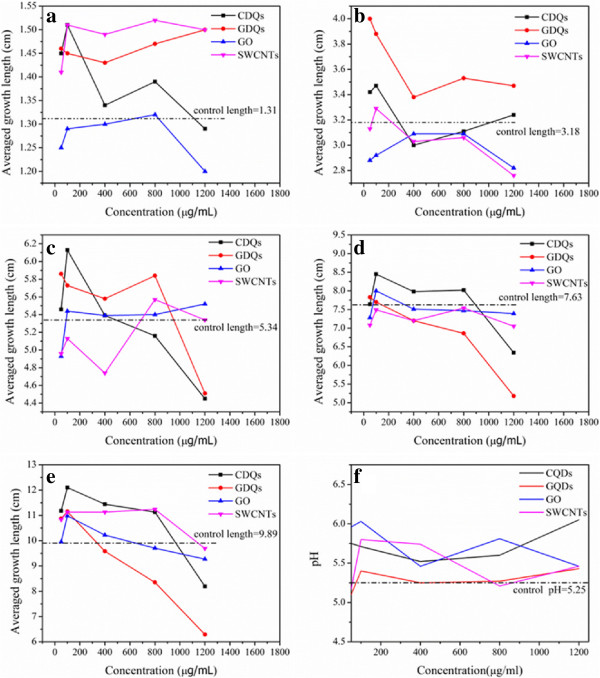
We examined the toxicity of four carbon-based nanomaterials (unmodified) by using carbon quantum dots (CQDs), graphene quantum dots (GQDs), graphene oxide (GO), and single-walled carbon nanotubes (SWCNTs) to cultivate bean sprout. Results showed that the toxicity of these four carbon nanomaterials increases with the increasing of concentration and cultivating time. In addition, pH test was applied to study the effect of carbon-based nanomaterials on water. pH of culture solution displayed unconspicuous dose-dependent, but nanomaterials indeed have a considerable impact on the pH even at low concentration.
我们使用碳量子点(CQDs)、石墨烯量子点(GQDs)、氧化石墨烯(GO)和单壁碳纳米管(SWCNTs)来培养豆芽,考察了四种碳基纳米材料(未修饰)的毒性。结果表明,这四种碳纳米材料的毒性随着浓度和培养时间的增加而增加。此外,还进行了 pH 值测试,以研究碳基纳米材料对水的影响。培养溶液的 pH 值显示出无明显的剂量依赖性,但即使在低浓度下,纳米材料确实对 pH 值有相当大的影响。