Nicoli Francesca, Verschueren Daniel, Klein Misha, Dekker Cees, Jonsson Magnus P
Department of Bionanoscience, Kavli Institute of Nanoscience, Delft University of Technology , Lorentzweg 1, 2628 CJ Delft, The Netherlands.
Nano Lett. 2014 Dec 10;14(12):6917-25. doi: 10.1021/nl503034j. Epub 2014 Nov 7.
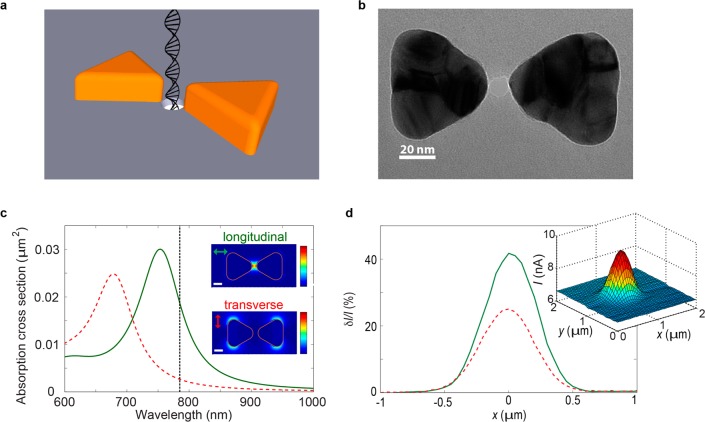
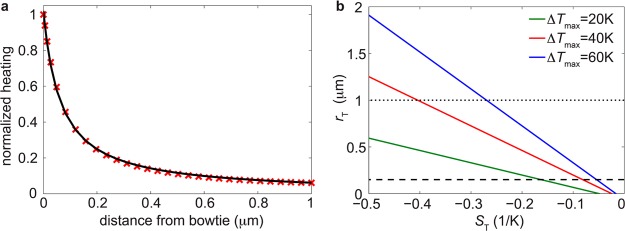
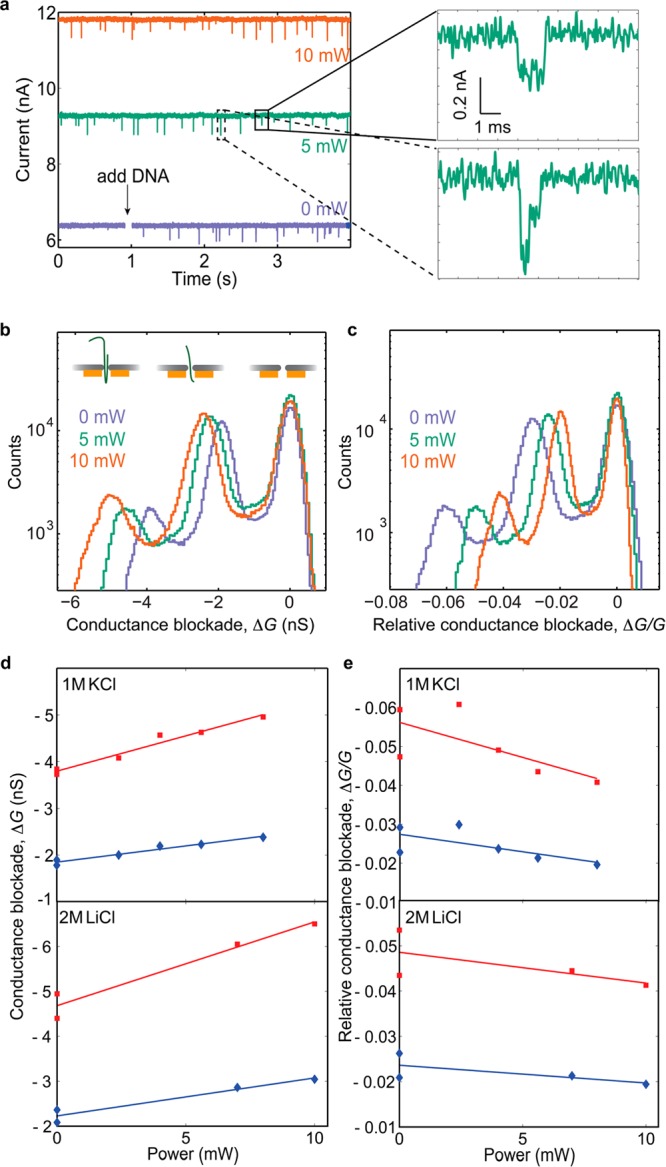
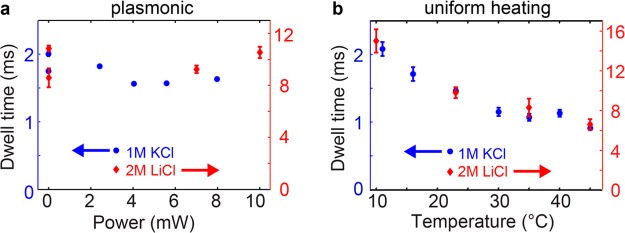
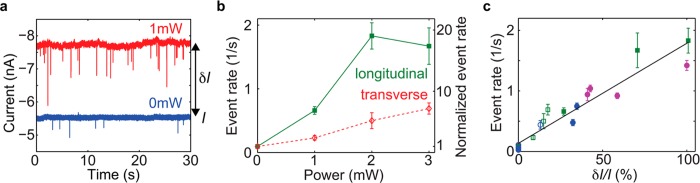
Nanopores enable label-free detection and analysis of single biomolecules. Here, we investigate DNA translocations through a novel type of plasmonic nanopore based on a gold bowtie nanoantenna with a solid-state nanopore at the plasmonic hot spot. Plasmonic excitation of the nanopore is found to influence both the sensor signal (nanopore ionic conductance blockade during DNA translocation) and the process that captures DNA into the nanopore, without affecting the duration time of the translocations. Most striking is a strong plasmon-induced enhancement of the rate of DNA translocation events in lithium chloride (LiCl, already 10-fold enhancement at a few mW of laser power). This provides a means to utilize the excellent spatiotemporal resolution of DNA interrogations with nanopores in LiCl buffers, which is known to suffer from low event rates. We propose a mechanism based on plasmon-induced local heating and thermophoresis as explanation of our observations.
纳米孔能够实现对单个生物分子的无标记检测和分析。在此,我们研究了通过一种新型等离子体纳米孔的DNA转位情况,该纳米孔基于在等离子体热点处带有固态纳米孔的金蝴蝶结纳米天线。研究发现,纳米孔的等离子体激发既会影响传感器信号(DNA转位过程中的纳米孔离子电导阻断),也会影响将DNA捕获到纳米孔中的过程,但不影响转位的持续时间。最引人注目的是,在氯化锂(LiCl)中,等离子体强烈诱导DNA转位事件速率的增强(在几毫瓦激光功率下,增强倍数已达10倍)。这提供了一种利用纳米孔在LiCl缓冲液中对DNA进行询问时出色的时空分辨率的方法,而LiCl缓冲液中已知存在事件发生率低的问题。我们提出了一种基于等离子体诱导局部加热和热泳的机制来解释我们的观察结果。