Department of Pathology, New York University School of Medicine, New York, NY 10016 USA.
Department of Radiology, New York University School of Medicine, New York, NY 10016 USA.
J Immunother Cancer. 2014 Oct 14;2(1):37. doi: 10.1186/s40425-014-0037-x. eCollection 2014.
Invariant natural killer T (iNKT) cells are CD1d-restricted T cells, which respond rapidly to antigen recognition and promote development of anti-tumor immunity in many tumor models. Surprisingly, we previously found that mice deficient in iNKT cells developed spontaneous CD8(+) T cells responses partially effective at inhibiting metastases in mice bearing the 4T1 mammary carcinoma, and showed a markedly improved response to treatment with local radiotherapy and anti-CTLA-4 antibody compared to wild type (WT) mice.
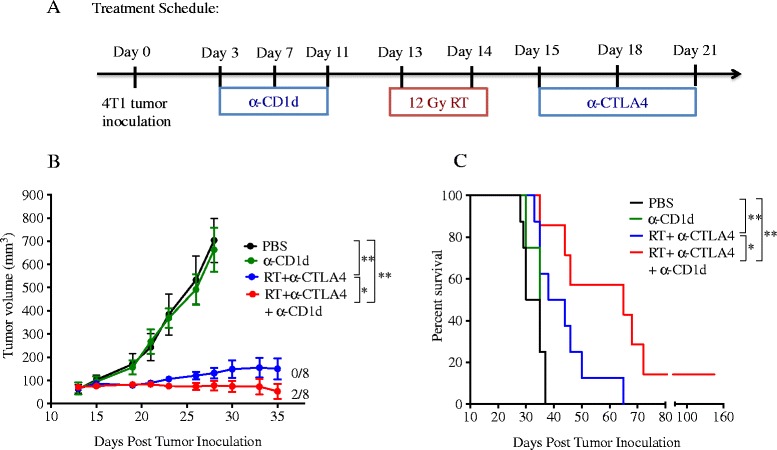
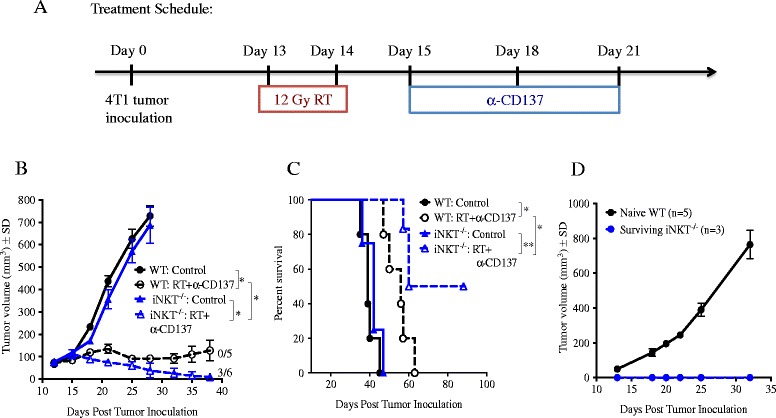
To understand the mechanisms of the immunosuppressive function of iNKT cells, dendritic cells (DCs) were analyzed by immunohistochemistry and flow cytometry in WT and iNKT-deficient (iNKT(-/-)) mice. The effects of antibody-mediated blockade of CD1d on DC number and phenotype, priming of anti-tumor T cells, and tumor response to treatment with local radiotherapy and anti-CTLA-4 antibody were evaluated. To determine if the improved response to treatment in the absence of iNKT cells was independent from the immunotherapy employed, 4T1-tumor bearing WT and iNKT(-/-) mice were treated with local radiotherapy in combination with antibody-mediated CD137 co-stimulation.
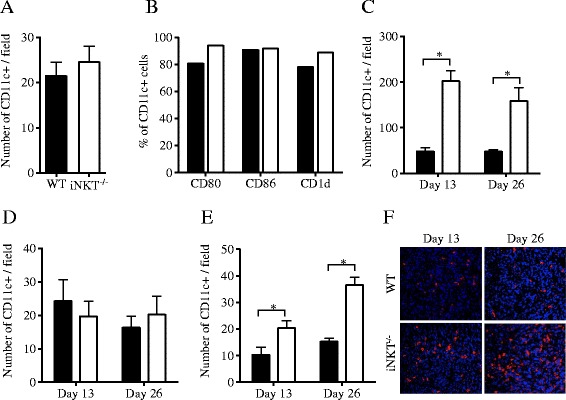
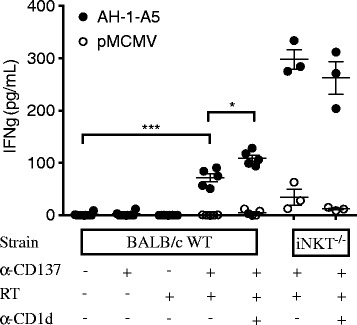
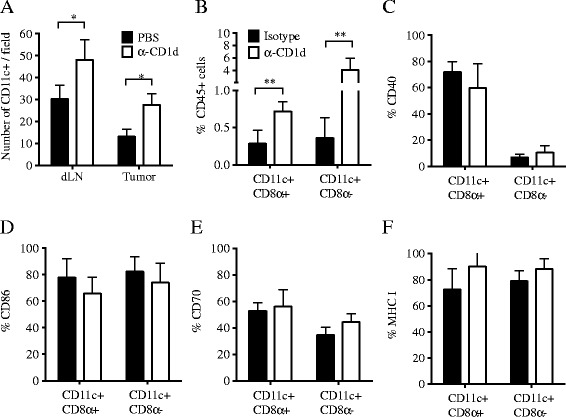
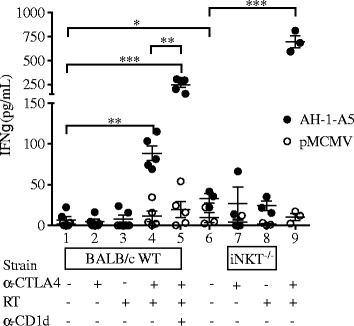
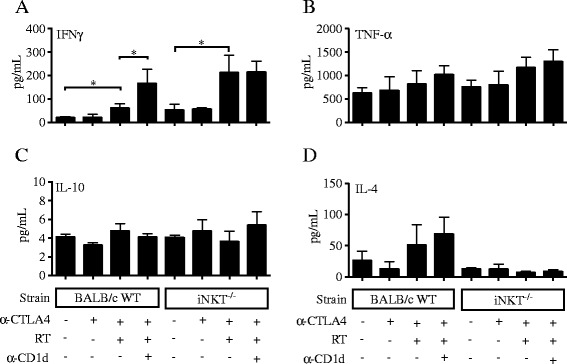
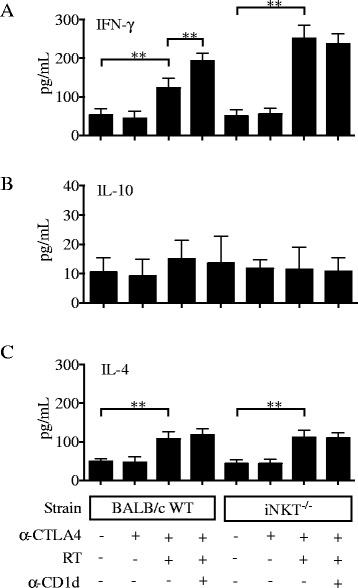
DCs in 4T1 tumors and tumor-draining lymph nodes but not distant lymph nodes were significantly reduced in WT mice compared to iNKT(-/-) mice (p < 0.05), suggesting the selective elimination of DCs cross-presenting tumor-associated antigens by iNKT cells. Consistently, priming of T cells to a tumor-specific CD8 T cell epitope in mice treated with radiotherapy and anti-CTLA-4 or anti-CD137 was markedly enhanced in iNKT(-/-) compared to WT mice. CD1d blockade restored the number of DC in WT mice, improved T cell priming in draining lymph nodes and significantly enhanced response to treatment.
Here we describe a novel mechanism of tumor immune escape mediated by iNKT cells that limit priming of anti-tumor T cells by controlling DC in tumors and draining lymph nodes. These results have important implications for the design of immunotherapies targeting iNKT cells.
天然不变型自然杀伤 T(iNKT)细胞是 CD1d 限制性 T 细胞,它们对抗原识别反应迅速,并在许多肿瘤模型中促进抗肿瘤免疫的发展。令人惊讶的是,我们之前发现缺乏 iNKT 细胞的小鼠会自发产生部分有效的 CD8+T 细胞反应,抑制携带 4T1 乳腺癌的小鼠的转移,并且与野生型(WT)小鼠相比,对局部放射治疗和抗 CTLA-4 抗体的治疗反应明显改善。
为了了解 iNKT 细胞免疫抑制功能的机制,通过免疫组织化学和流式细胞术分析 WT 和 iNKT 缺陷(iNKT(-/-))小鼠中的树突状细胞(DC)。评估抗体介导的 CD1d 阻断对 DC 数量和表型、抗肿瘤 T 细胞的启动以及肿瘤对局部放射治疗和抗 CTLA-4 抗体的反应的影响。为了确定在缺乏 iNKT 细胞的情况下,对治疗的改善反应是否独立于所使用的免疫疗法,用局部放射治疗联合抗体介导的 CD137 共刺激处理携带 4T1 肿瘤的 WT 和 iNKT(-/-)小鼠。
与 iNKT(-/-)小鼠相比,WT 小鼠的 4T1 肿瘤和肿瘤引流淋巴结中的 DC 明显减少(p<0.05),但远处淋巴结中没有减少,这表明 iNKT 细胞选择性消除了呈递肿瘤相关抗原的 DC。一致地,用放射治疗和抗 CTLA-4 或抗 CD137 处理的小鼠中对肿瘤特异性 CD8 T 细胞表位的 T 细胞启动明显增强,iNKT(-/-)小鼠比 WT 小鼠增强。CD1d 阻断恢复了 WT 小鼠中的 DC 数量,改善了引流淋巴结中的 T 细胞启动,并显著增强了对治疗的反应。
在这里,我们描述了一种由 iNKT 细胞介导的肿瘤免疫逃逸的新机制,该机制通过控制肿瘤和引流淋巴结中的 DC 来限制抗肿瘤 T 细胞的启动。这些结果对设计针对 iNKT 细胞的免疫疗法具有重要意义。