Park Jae-Hak, Novilla Meliton N, Song Juha, Kim Kyung-Sul, Chang Seo-Na, Han Ju-Hee, Lee Byung Hee, Lee Do-Hun, Kim Hyun-Mac, Kim Young-Ha, Youn Hee-Jeong, Kil Jihyon
Department of Laboratory Animal Medicine, College of Veterinary Medicine and Research Institute for Veterinary Science, Seoul National University, Seoul 151-742, Korea.
SNBL USA, Ltd., 6605 Merrill Creek Parkway, Everett, Washington, USA.
Korean J Parasitol. 2014 Oct;52(5):527-9. doi: 10.3347/kjp.2014.52.5.527. Epub 2014 Oct 22.
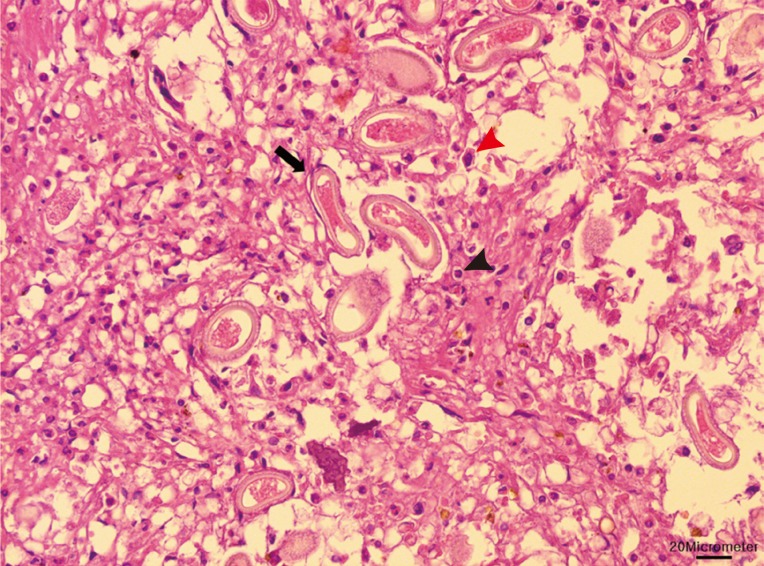
This study reports the first case of Capillaria hepatica infection in a nutria in Korea. Ten nutrias, captured near the Nakdong River, were submitted to our laboratory for necropsy. White-yellowish nodules were found in the liver of 1 of the nutrias at necropsy. Histologically, the lesions were granulomatous, and infiltrations of lipid-laden macrophages, eosinophils, and several multinucleated giant cells were observed. The lesions consisted of numerous eggs and necrotic hepatocytes. The eggs were lemon-shaped and had polar plugs at the ends of both long sides. The eggs were morphologically identified as those of C. hepatica. Worldwide, C. hepatica infection in nutrias is very rare. Nutrias are a kind of livestock, as well as wildlife; therefore, an epidemiological study for parasitic infections needs to be conducted.
本研究报告了韩国首例海狸鼠感染肝毛细线虫的病例。在洛东江附近捕获的10只海狸鼠被送到我们实验室进行尸检。尸检时在其中1只海狸鼠的肝脏中发现了黄白色结节。组织学上,病变为肉芽肿性,观察到充满脂质的巨噬细胞、嗜酸性粒细胞和几个多核巨细胞浸润。病变由大量虫卵和坏死的肝细胞组成。虫卵呈柠檬形,在两侧长边的末端有极塞。这些虫卵在形态上被鉴定为肝毛细线虫的虫卵。在世界范围内,海狸鼠感染肝毛细线虫非常罕见。海狸鼠既是一种家畜,也是野生动物;因此,需要对寄生虫感染进行流行病学研究。