Merscher Sandra, Pedigo Christopher E, Mendez Armando J
Peggy and Harold Katz Family Drug Discovery Center and Division of Nephrology and Hypertension, Department of Medicine, University of Miami , Miami, FL , USA.
Division of Diabetes, Endocrinology and Metabolism, Department of Medicine, Diabetes Research Institute, University of Miami , Miami, FL , USA.
Front Endocrinol (Lausanne). 2014 Oct 14;5:169. doi: 10.3389/fendo.2014.00169. eCollection 2014.
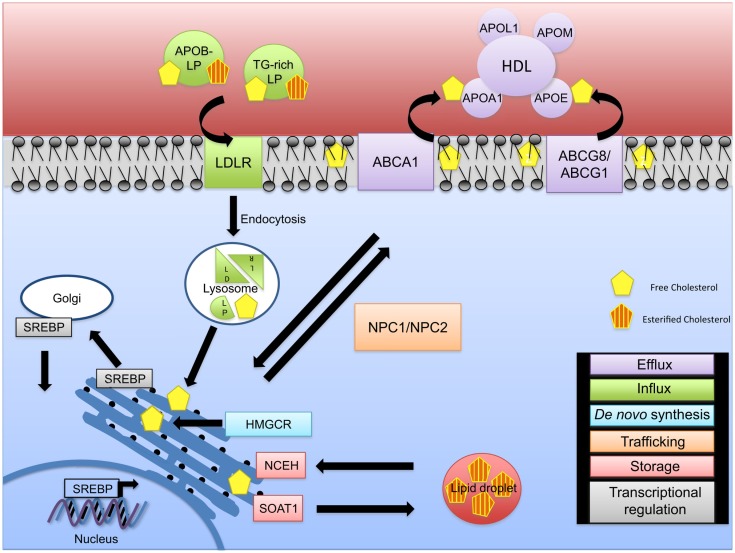
Chronic kidney disease (CKD) is associated with a high risk of death. Dyslipidemia is commonly observed in patients with CKD and is accompanied by a decrease in plasma high-density lipoprotein, and an increase in plasma triglyceride-rich lipoproteins and oxidized lipids. The observation that statins may decrease albuminuria but do not stop the progression of CKD indicates that pathways other than the cholesterol synthesis contribute to cholesterol accumulation in the kidneys of patients with CKD. Recently, it has become clear that increased lipid influx and impaired reverse cholesterol transport can promote glomerulosclerosis, and tubulointerstitial damage. Lipid-rafts are cholesterol-rich membrane domains with important functions in regulating membrane fluidity, membrane protein trafficking, and in the assembly of signaling molecules. In podocytes, which are specialized cells of the glomerulus, they contribute to the spatial organization of the slit diaphragm (SD) under physiological and pathological conditions. The discovery that podocyte-specific proteins such as podocin can bind and recruit cholesterol contributing to the formation of the SD underlines the importance of cholesterol homeostasis in podocytes and suggests cholesterol as an important regulator in the development of proteinuric kidney disease. Cellular cholesterol accumulation due to increased synthesis, influx, or decreased efflux is an emerging concept in podocyte biology. This review will focus on the role of cellular cholesterol accumulation in the pathogenesis of kidney diseases with a focus on glomerular diseases.
慢性肾脏病(CKD)与高死亡风险相关。血脂异常在CKD患者中很常见,伴有血浆高密度脂蛋白降低,富含甘油三酯的脂蛋白和氧化脂质增加。他汀类药物可降低蛋白尿但不能阻止CKD进展这一观察结果表明,除胆固醇合成途径外,其他途径也导致CKD患者肾脏中胆固醇蓄积。最近,脂质流入增加和胆固醇逆向转运受损可促进肾小球硬化和肾小管间质损伤已变得清晰。脂筏是富含胆固醇的膜结构域,在调节膜流动性、膜蛋白运输以及信号分子组装方面具有重要功能。在肾小球的特化细胞足细胞中,它们在生理和病理条件下有助于裂孔隔膜(SD)的空间组织。足细胞特异性蛋白如足突蛋白可结合并募集胆固醇有助于SD形成这一发现强调了足细胞中胆固醇稳态的重要性,并提示胆固醇是蛋白尿性肾病发生发展中的重要调节因子。由于合成增加、流入增加或流出减少导致的细胞胆固醇蓄积是足细胞生物学中一个新出现的概念。本综述将聚焦于细胞胆固醇蓄积在肾脏疾病发病机制中的作用,重点是肾小球疾病。