
与KYS标准系相比,热带玉米姊妹自交系和杂交种的核型变异
Karyotype variability in tropical maize sister inbred lines and hybrids compared with KYS standard line.
作者信息
Mondin Mateus, Santos-Serejo Janay A, Bertäo Mônica R, Laborda Prianda, Pizzaia Daniel, Aguiar-Perecin Margarida L R
机构信息
Department of Genetics, Luiz de Queiroz College of Agriculture, University of São Paulo, Piracicaba, Brazil.
Department of Genetics, Luiz de Queiroz College of Agriculture, University of São Paulo, Piracicaba, Brazil ; Embrapa Cassava and Fruits, Brazilian Agricultural Research Corporation Cruz das Almas, Brazil.
出版信息
Front Plant Sci. 2014 Oct 13;5:544. doi: 10.3389/fpls.2014.00544. eCollection 2014.
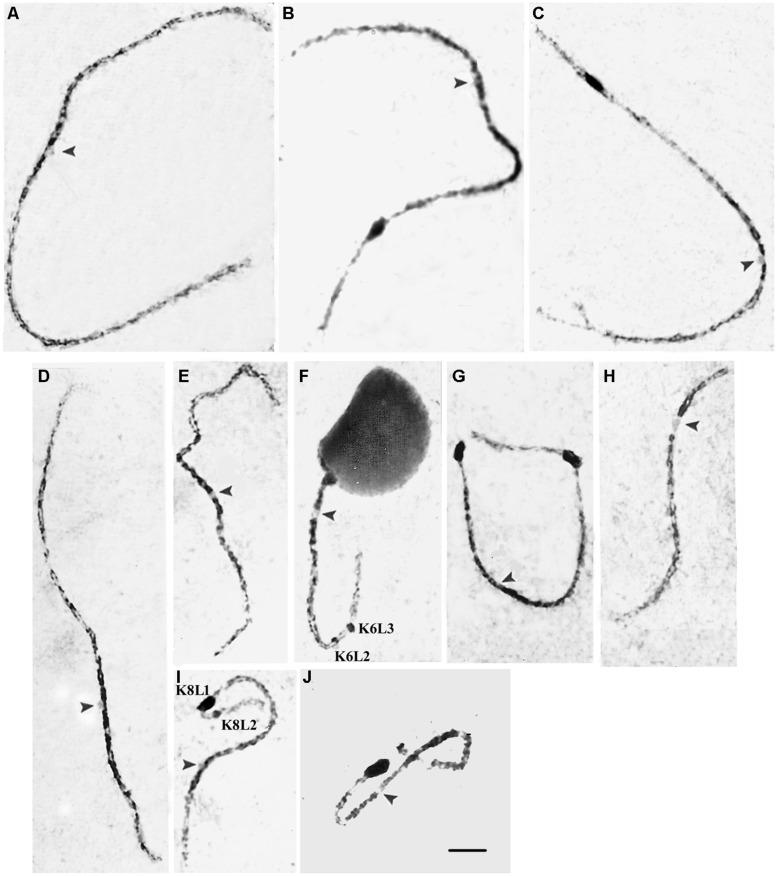
Maize karyotype variability has been extensively investigated. The identification of maize somatic and pachytene chromosomes has improved with the development of fluorescence in situ hybridization (FISH) using tandemly repeated DNA sequences as probes. We identified the somatic chromosomes of sister inbred lines that were derived from a tropical flint maize population (Jac Duro [JD]), and hybrids between them, using FISH probes for the 180-bp knob repeat, centromeric satellite (CentC), centromeric satellite 4 (Cent4), subtelomeric clone 4-12-1, 5S ribosomal DNA and nucleolus organizing region DNA sequences. The observations were integrated with data based on C-banded mitotic metaphases and conventional analysis of pachytene chromosomes. Heterochromatic knobs visible at pachynema were coincident with C-bands and 180-bp FISH signals on somatic chromosomes, and most of them were large. Variation in the presence of some knobs was observed among lines. Small 180-bp knob signals were invariant on the short arms of chromosomes 1, 6, and 9. The subtelomeric 4-12-1 signal was also invariant and useful for identifying some chromosomes. The centromere location of chromosomes 2 and 4 differed from previous reports on standard maize lines. Somatic chromosomes of a JD line and the commonly used KYS line were compared by FISH in a hybrid of these lines. The pairing behavior of chromosomes 2 and 4 at pachytene stage in this hybrid was investigated using FISH with chromosome-specific probes. The homologues were fully synapsed, including the 5S rDNA and CentC sites on chromosome 2, and Cent4 and subtelomeric 4-12-1 sites on chromosome 4. This suggests that homologous chromosomes could pair through differential degrees of chromatin packaging in homologous arms differing in size. The results contribute to current knowledge of maize global diversity and also raise questions concerning the meiotic pairing of homologous chromosomes possibly differing in their amounts of repetitive DNA.
玉米核型变异已得到广泛研究。随着使用串联重复DNA序列作为探针的荧光原位杂交(FISH)技术的发展,玉米体细胞染色体和粗线期染色体的识别有了改进。我们使用针对180bp着丝粒结重复序列、着丝粒卫星(CentC)、着丝粒卫星4(Cent4)、亚端粒克隆4-12-1、5S核糖体DNA和核仁组织区DNA序列的FISH探针,鉴定了源自热带硬粒玉米群体(Jac Duro [JD])的姊妹自交系及其杂种的体细胞染色体。这些观察结果与基于C带有丝分裂中期和粗线期染色体常规分析的数据相结合。在粗线期可见的异染色质结与体细胞染色体上的C带和180bp FISH信号一致,并且大多数结都很大。在不同品系间观察到一些结存在情况的变异。180bp的小结信号在染色体1、6和9的短臂上是不变的。亚端粒4-12-1信号也是不变的,并且有助于识别一些染色体。染色体2和4的着丝粒位置与先前关于标准玉米品系的报道不同。通过FISH在这些品系的杂种中比较了JD品系和常用的KYS品系的体细胞染色体。使用针对特定染色体的探针,通过FISH研究了该杂种中染色体2和4在粗线期的配对行为。同源染色体完全配对,包括染色体2上的5S rDNA和CentC位点,以及染色体4上的Cent4和亚端粒4-12-1位点。这表明同源染色体可以通过大小不同的同源臂中染色质包装程度的差异进行配对。这些结果有助于我们了解当前玉米的全球多样性,也提出了关于可能在重复DNA含量上不同的同源染色体减数分裂配对的问题。



 Zotero 插件