He Jianghua, Yu Qing, Zhang Huiquan, Mahnken Jonathan D
Department of Biostatistics, University of Kansas Medical Center, Mail Stop 1026, 3901 Rainbow Blvd, 66160 Kansas City, KS, USA.
Sanofi Pasteur Research & Development in China, Beijing, China.
Emerg Themes Epidemiol. 2014 Oct 24;11:17. doi: 10.1186/1742-7622-11-17. eCollection 2014.
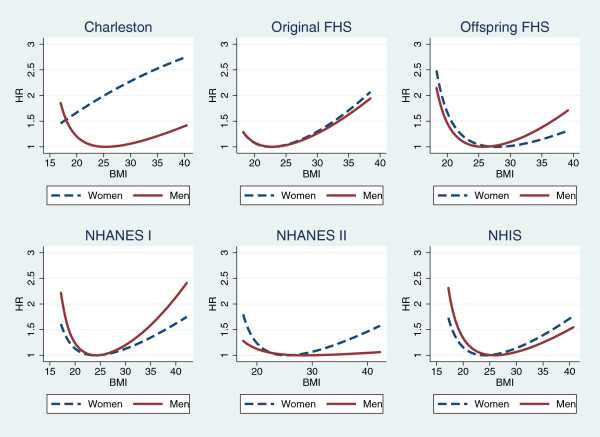
In the literature, different shapes of associations have been found between body mass index (BMI) and mortality and some of the findings were opposite to each other. The association of BMI and mortality in a single cohort has been found to be dynamic that can lead to different findings under different settings. The identified dynamic features were consistent with the heterogeneity in the literature. It is meaningful to find out whether such dynamic associations exist in other populations.
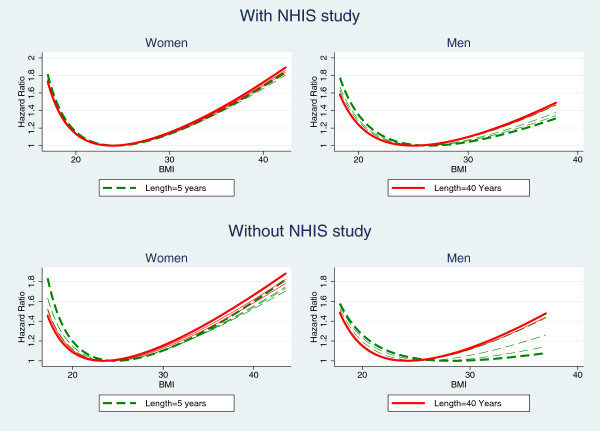
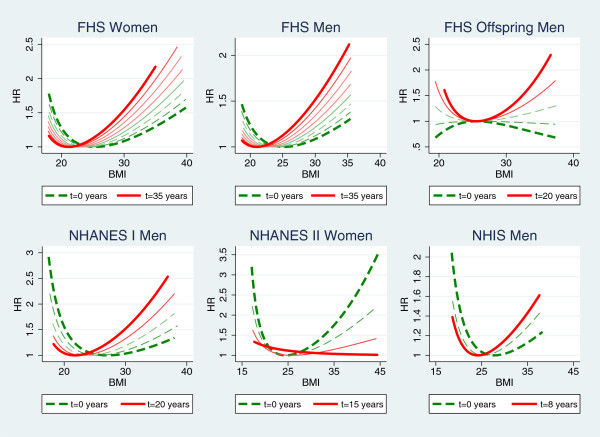
Data of six different cohorts were used for analysis and comparison. The proportional hazards assumptions for BMI in Cox models were tested to identify dynamic associations in each cohort. Time-dependent covariates Cox model was used to model the association of BMI and mortality risk as functions of follow-up time. The Cox model was applied to the pooled data with survival times censored at 5 to 40 years to show the potential impact of the dynamic association on traditional Meta-analysis.
Dynamic associations were identified in six models (4 for men and 2 for women), four of which showed the same changing pattern: the elevated mortality risk for low BMI decreased while that for high BMI increased with follow-up time. When the Cox model was applied to the pooled data excluding the largest and also the shortest cohort, low BMI was but high BMI was not associated with high mortality for men with censoring at 5 years but the association for low BMI became weaker and that for high BMI became much stronger when censoring time was at 40 years. The dynamic association indicated that shorter studies tend to obtain inverse associations between BMI and mortality while longer studies tend to obtain J-shaped associations.
Different or even opposite results about body weight and mortality in the literature may be in part due to the underlying dynamic association of BMI and mortality. The dynamic features need to be taken into consideration in future studies.
在文献中,已发现体重指数(BMI)与死亡率之间存在不同形状的关联,且部分研究结果相互矛盾。在单个队列中,BMI与死亡率的关联具有动态性,这可能导致在不同情况下得出不同的结果。所识别出的动态特征与文献中的异质性相符。探究其他人群中是否存在这种动态关联具有重要意义。
使用六个不同队列的数据进行分析和比较。对Cox模型中BMI的比例风险假设进行检验,以识别每个队列中的动态关联。采用时间依存协变量Cox模型,将BMI与死亡风险的关联建模为随访时间的函数。将Cox模型应用于生存时间在5至40年进行截尾处理的合并数据,以显示动态关联对传统Meta分析的潜在影响。
在六个模型中识别出了动态关联(男性4个,女性2个),其中四个呈现相同的变化模式:低BMI人群的死亡风险升高随着随访时间降低,而高BMI人群的死亡风险升高则随着随访时间增加。当将Cox模型应用于排除最大和最小队列后的合并数据时,对于5年截尾的男性,低BMI与高死亡率相关,但高BMI与高死亡率不相关;而当截尾时间为40年时,低BMI的关联变弱,高BMI的关联则变强。这种动态关联表明,较短的研究倾向于得出BMI与死亡率之间的负相关,而较长的研究倾向于得出J形关联。
文献中关于体重与死亡率的不同甚至相反结果,可能部分归因于BMI与死亡率之间潜在的动态关联。在未来的研究中需要考虑这种动态特征。