Signolet Jason, Hendrich Brian
Wellcome Trust - Medical Research Council Cambridge Stem Cell Institute, University of Cambridge, UK.
FEBS J. 2015 May;282(9):1692-702. doi: 10.1111/febs.13132. Epub 2014 Nov 20.
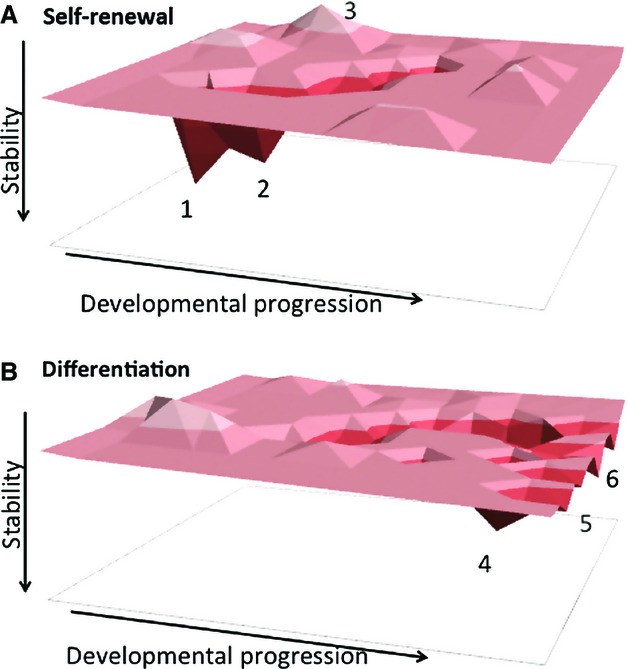
Proteins that modify the structure of chromatin are known to be important for various aspects of metazoan biology including development, disease and possibly ageing. Yet functional details of why these proteins are important, i.e. how their action influences a given biological process, are lacking. While it is now possible to describe the biochemistry of how these proteins remodel chromatin, their chromatin binding profiles in cell lines, or gene expression changes upon loss of a given protein, in very few cases has this easily translated into an understanding of how the function of that protein actually influences a developmental process. Given that many chromatin modifying proteins will largely exert their influence through control of gene expression, it is useful to consider developmental processes as changes in the gene regulatory network (GRN), with each cell type exhibiting a unique gene expression profile. In this essay we consider the impact of two abundant and highly conserved chromatin modifying complexes, namely the nucleosome remodelling and deacetylation (NuRD) complex and the polycomb repressive complex 2 (PRC2), on the change in GRNs associated with lineage commitment during early mammalian development. We propose that while the NuRD complex limits the stability of cell states and defines the developmental trajectory between two stable states, PRC2 activity is important for stabilizing a new GRN once established. Although these two complexes display different biochemical activities, chromatin binding profiles and mutant phenotypes, we propose a model to explain how they cooperate to facilitate the transition through cell states that is development.
已知修饰染色质结构的蛋白质对于后生动物生物学的各个方面都很重要,包括发育、疾病以及可能的衰老。然而,这些蛋白质为何重要的功能细节,即它们的作用如何影响特定的生物学过程,仍不清楚。虽然现在已经能够描述这些蛋白质如何重塑染色质的生物化学过程、它们在细胞系中的染色质结合图谱,或者特定蛋白质缺失时的基因表达变化,但在极少数情况下,这些信息能够轻易转化为对该蛋白质功能如何实际影响发育过程的理解。鉴于许多染色质修饰蛋白将主要通过控制基因表达来发挥其影响,将发育过程视为基因调控网络(GRN)的变化是很有用的,每种细胞类型都表现出独特的基因表达谱。在本文中,我们考虑两种丰富且高度保守的染色质修饰复合物,即核小体重塑与去乙酰化(NuRD)复合物和多梳抑制复合物2(PRC2),对早期哺乳动物发育过程中与细胞谱系定向相关的GRN变化的影响。我们提出,虽然NuRD复合物限制细胞状态的稳定性并定义两个稳定状态之间的发育轨迹,但PRC2的活性对于一旦建立新的GRN后使其稳定很重要。尽管这两种复合物表现出不同的生化活性、染色质结合图谱和突变表型,但我们提出了一个模型来解释它们如何协同作用以促进贯穿发育过程的细胞状态转变。