Bunn Frances, Burn Anne-Marie, Goodman Claire, Rait Greta, Norton Sam, Robinson Louise, Schoeman Johan, Brayne Carol
Centre for Research in Primary and Community Care, University of Hertfordshire, College Lane, Hatfield, Hertfordshire, AL10 9AB, UK.
Research Department of Primary Care and Population Health, UCL Medical School (Royal Free Campus), Rowland Hill Street, London, NW3 2PF, UK.
BMC Med. 2014 Oct 31;12:192. doi: 10.1186/s12916-014-0192-4.
Evidence suggests that amongst people with dementia there is a high prevalence of comorbid medical conditions and related complaints. The presence of dementia may complicate clinical care for other conditions and undermine a patient's ability to manage a chronic condition. The aim of this study was to scope the extent, range and nature of research activity around dementia and comorbidity.
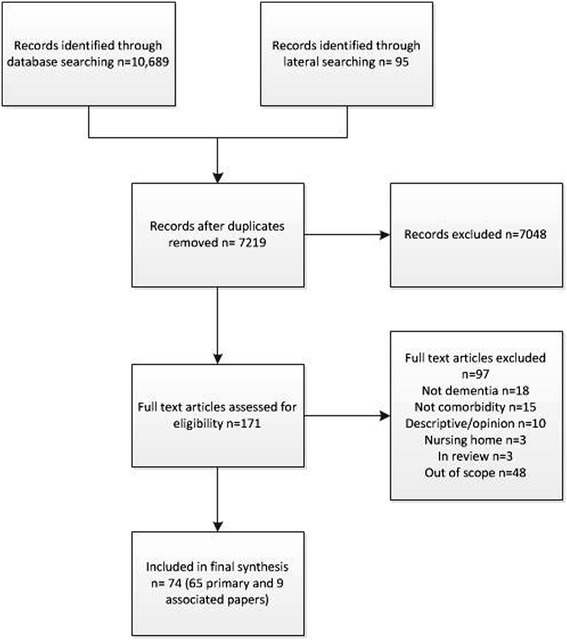
We undertook a scoping review including all types of research relating to the prevalence of comorbidities in people with dementia; current systems, structures and other issues relating to service organisation and delivery; patient and carer experiences; and the experiences and attitudes of service providers. We searched AMED, Cochrane Library, CINAHL, PubMed, NHS Evidence, Scopus, Google Scholar (searched 2012, Pubmed updated 2013), checked reference lists and performed citation searches on PubMed and Google Scholar (ongoing to February 2014).
We included 54 primary studies, eight reviews and three guidelines. Much of the available literature relates to the prevalence of comorbidities in people with dementia or issues around quality of care. Less is known about service organisation and delivery or the views and experiences of people with dementia and their family carers. There is some evidence that people with dementia did not have the same access to treatment and monitoring for conditions such as visual impairment and diabetes as those with similar comorbidities but without dementia.
The prevalence of comorbid conditions in people with dementia is high. Whilst current evidence suggests that people with dementia may have poorer access to services the reasons for this are not clear. There is a need for more research looking at the ways in which having dementia impacts on clinical care for other conditions and how the process of care and different services are adapting to the needs of people with dementia and comorbidity. People with dementia should be included in the debate about the management of comorbidities in older populations and there needs to be greater consideration given to including them in studies that focus on age-related healthcare issues.
有证据表明,在患有痴呆症的人群中,共病医疗状况及相关症状的患病率很高。痴呆症的存在可能会使其他疾病的临床护理变得复杂,并削弱患者管理慢性病的能力。本研究的目的是探究围绕痴呆症与共病的研究活动的范围、广度和性质。
我们进行了一项范围综述,纳入了所有与痴呆症患者共病患病率相关的各类研究;与服务组织和提供相关的现行系统、结构及其他问题;患者及照料者的经历;以及服务提供者的经历和态度。我们检索了医学与健康领域数据库(AMED)、考克兰图书馆、护理学与健康领域数据库(CINAHL)、医学期刊数据库(PubMed)、英国国家医疗服务体系证据库(NHS Evidence)、Scopus数据库、谷歌学术(检索时间为2012年,PubMed更新于2013年),查阅了参考文献列表,并在PubMed和谷歌学术上进行了引文检索(持续至2014年2月)。
我们纳入了54项原发性研究、8篇综述和3项指南。现有文献大多涉及痴呆症患者的共病患病率或护理质量问题。对于服务组织与提供,或痴呆症患者及其家庭照料者的观点和经历,我们了解较少。有证据表明,与患有类似共病但无痴呆症的人相比,痴呆症患者在诸如视力障碍和糖尿病等疾病的治疗和监测方面,获得的机会不同。
痴呆症患者中共病状况的患病率很高。虽然目前的证据表明痴呆症患者获得服务的机会可能较差,但其原因尚不清楚。需要开展更多研究,探究患痴呆症如何影响其他疾病的临床护理,以及护理过程和不同服务如何适应痴呆症合并其他疾病患者的需求。痴呆症患者应被纳入关于老年人群共病管理的讨论中,并且在专注于与年龄相关的医疗保健问题的研究中,需要更多地考虑将他们纳入其中。