Harrison Cheryce L, Lombard Catherine B, Teede Helena J
Int J Behav Nutr Phys Act. 2014 Oct 31;11:134. doi: 10.1186/s12966-014-0134-8.
Pregnancy is a recognised high risk period for excessive weight gain, contributing to postpartum weight retention and obesity development long-term. We aimed to reduce postpartum weight retention following a low-intensity, self-management intervention integrated with routine antenatal care during pregnancy.
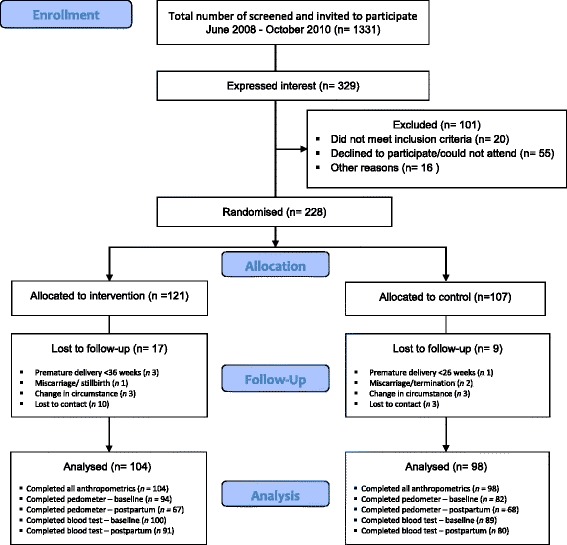
228 women at increased risk of gestational diabetes, <15 weeks gestation were randomised to intervention (4 self-management sessions) or control (generic health information). Outcomes, collected at baseline and 6 weeks postpartum, included anthropometrics (weight and height), physical activity (pedometer) and questionnaires (health behaviours).
Mean age (32.3 ± 4.7 and 31.7 ± 4.4 years) and body mass index (30.4 ± 5.6 and 30.3 ± 5.9 kg/m2) were similar between intervention and control groups, respectively at baseline. By 6 weeks postpartum, weight change in the control group was significantly higher than the intervention group with a between group difference of 1.45 ± 5.1 kg (95% CI: -2.86,-0.02; p < 0.05) overall, with a greater difference in weight found in overweight, but not obese women. Intervention group allocation, higher baseline BMI, GDM diagnosis, country of birth and higher age were all independent predictors of lower weight retention at 6 weeks postpartum on multivariable linear regression. Other factors related to weight including physical activity, did not differ between groups.
A low intensity intervention, integrated with standard antenatal care is effective in limiting postpartum weight retention. Implementation research is now required for scale-up to optimise antenatal health care.
Australian New Zealand Clinical Trial Registry Number: ACTRN12608000233325. Registered 7/5/2008.
妊娠是公认的体重过度增加的高风险时期,长期会导致产后体重滞留和肥胖。我们旨在通过在孕期将低强度自我管理干预与常规产前护理相结合,来减少产后体重滞留。
228名妊娠糖尿病风险增加、妊娠<15周的女性被随机分为干预组(4次自我管理课程)或对照组(一般健康信息)。在基线和产后6周收集的结果包括人体测量学指标(体重和身高)、身体活动(计步器)和问卷调查(健康行为)。
干预组和对照组的平均年龄(分别为32.3±4.7岁和31.7±4.4岁)和体重指数(分别为30.4±5.6kg/m²和30.3±5.9kg/m²)在基线时相似。到产后6周时,对照组的体重变化显著高于干预组,总体组间差异为1.45±5.1kg(95%CI:-2.86,-0.02;p<0.05),超重但非肥胖女性的体重差异更大。在多变量线性回归中,干预组分配、较高的基线BMI、妊娠期糖尿病诊断、出生国家和较高年龄都是产后6周体重滞留较低的独立预测因素。其他与体重相关的因素,包括身体活动,在两组之间没有差异。
与标准产前护理相结合的低强度干预可有效限制产后体重滞留。现在需要进行实施研究以扩大规模,优化产前保健。
澳大利亚新西兰临床试验注册编号:ACTRN12608000233325。2008年5月7日注册。