Laboratory for Cognitive Neuroscience, Center for Information and Neural Networks, Graduate School of Frontier Biosciences, Osaka University Suita, Japan.
Laboratory for Cognitive Neuroscience, Center for Information and Neural Networks, Graduate School of Frontier Biosciences, Osaka University Suita, Japan ; Center for Information and Neural Networks, National Institute of Information and Communications Technology Suita, Japan.
Front Comput Neurosci. 2014 Oct 15;8:127. doi: 10.3389/fncom.2014.00127. eCollection 2014.
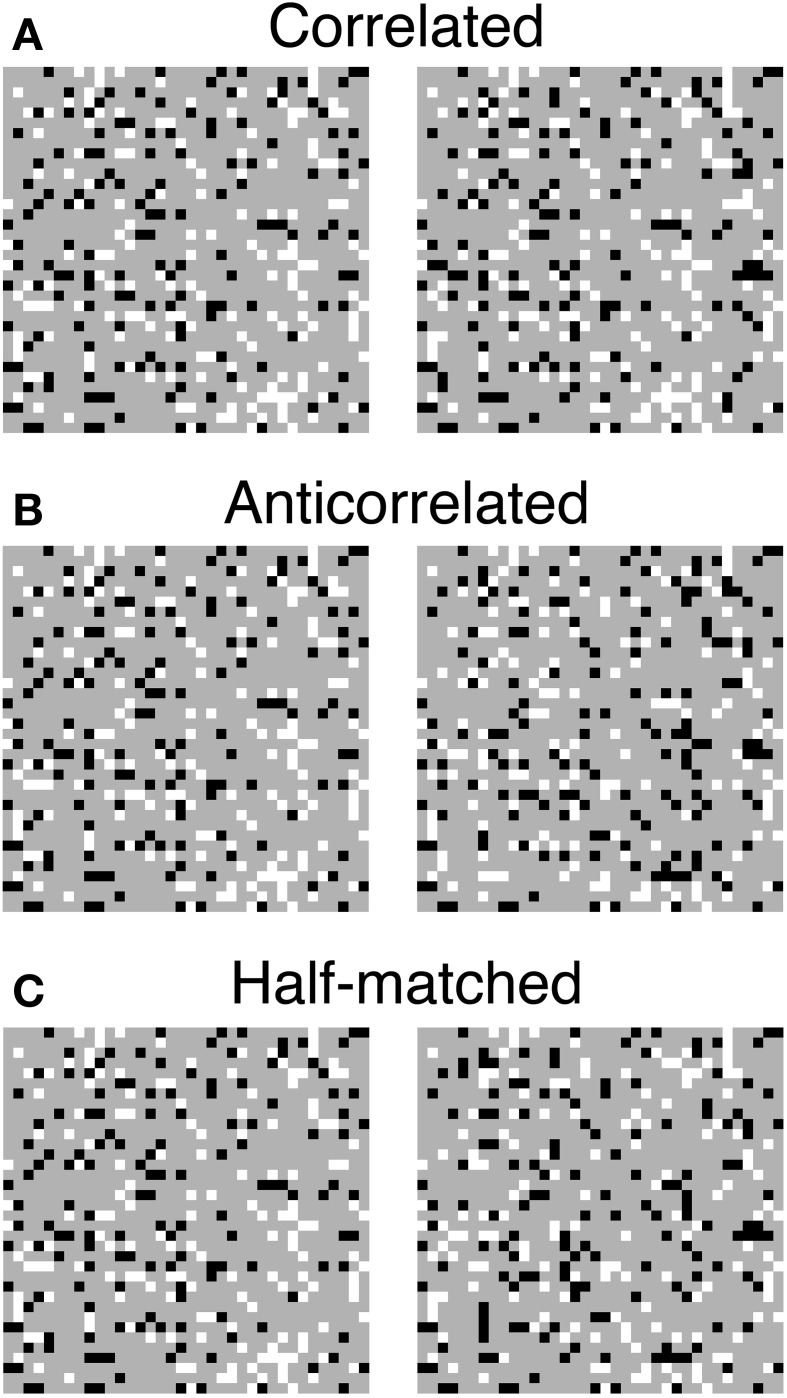
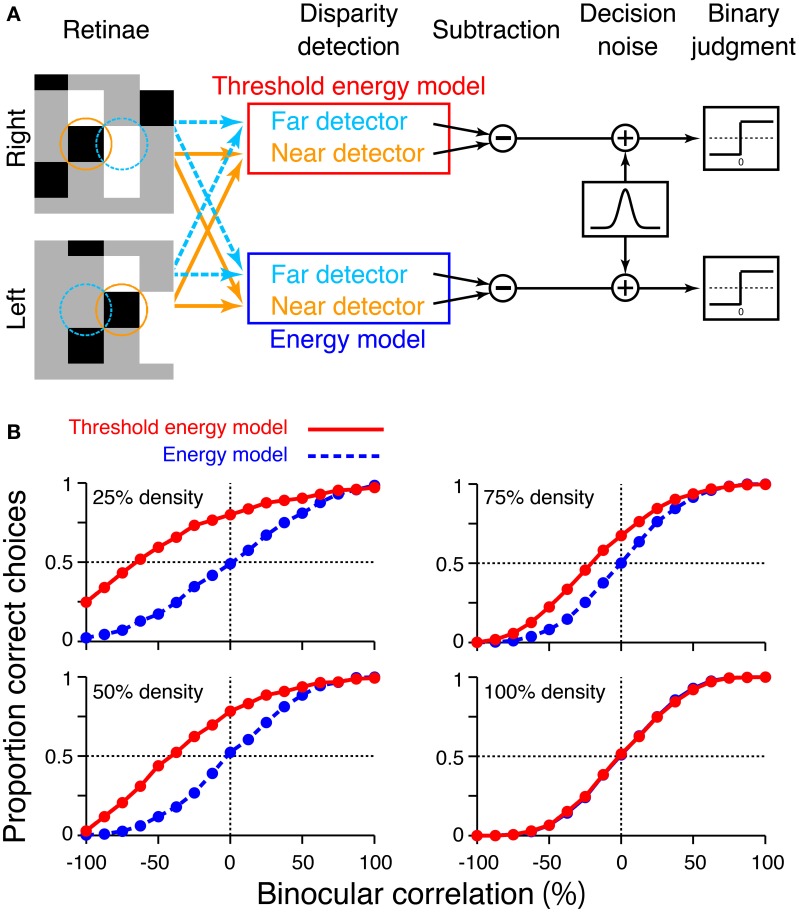
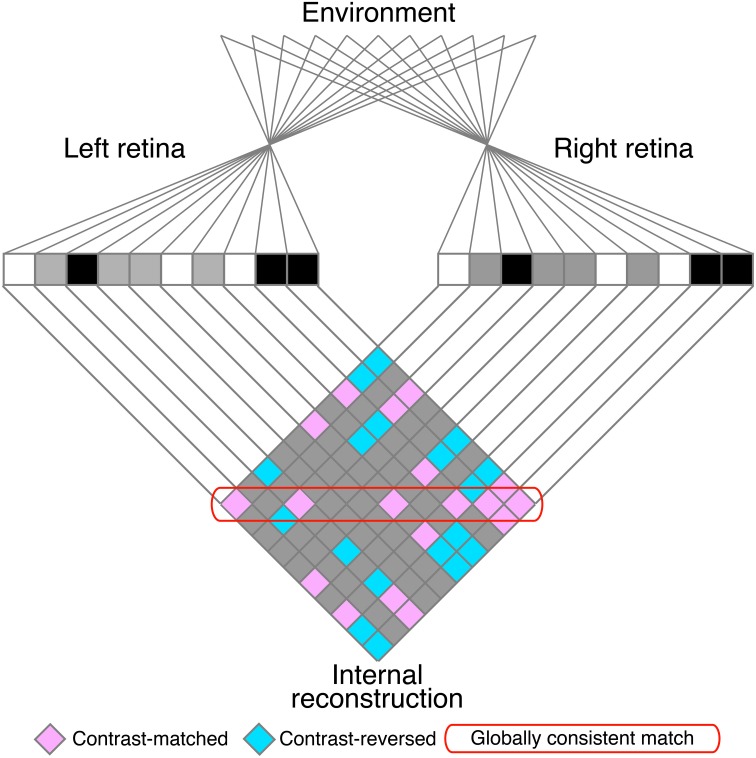
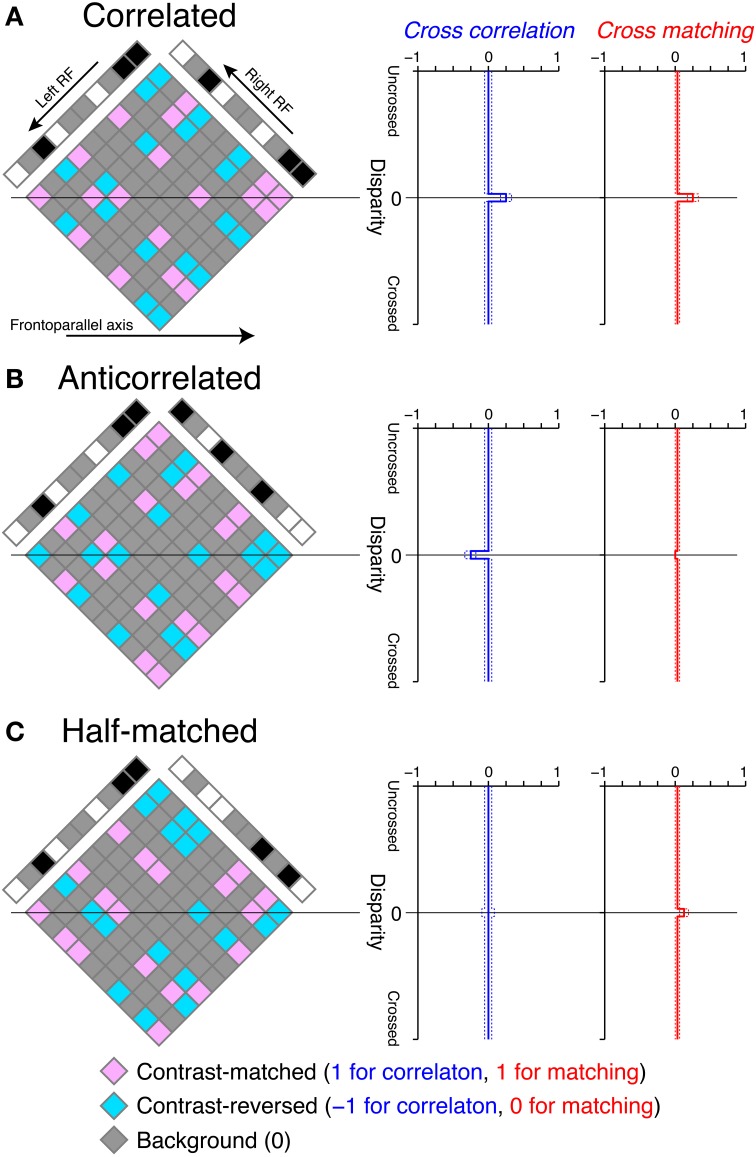
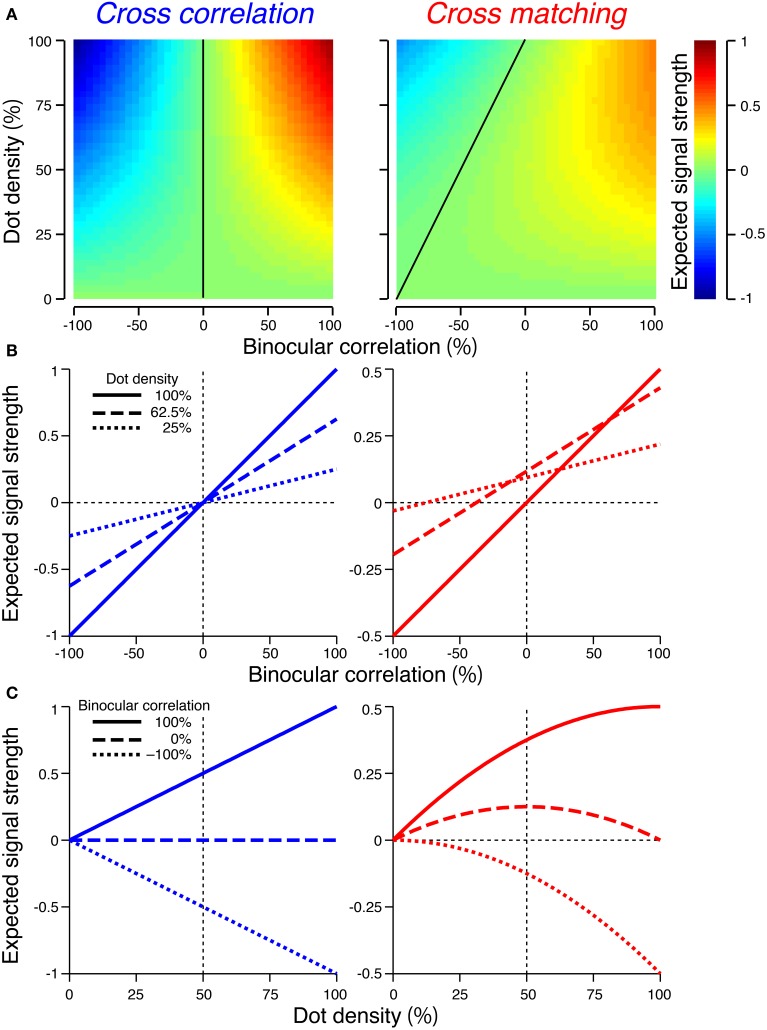
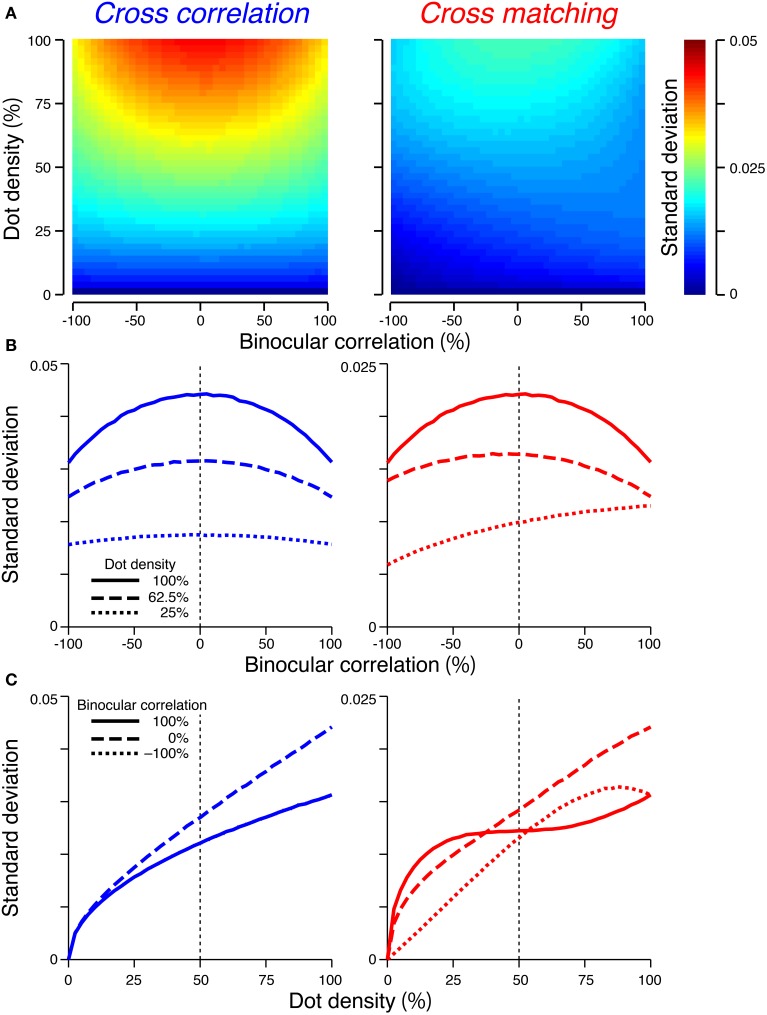
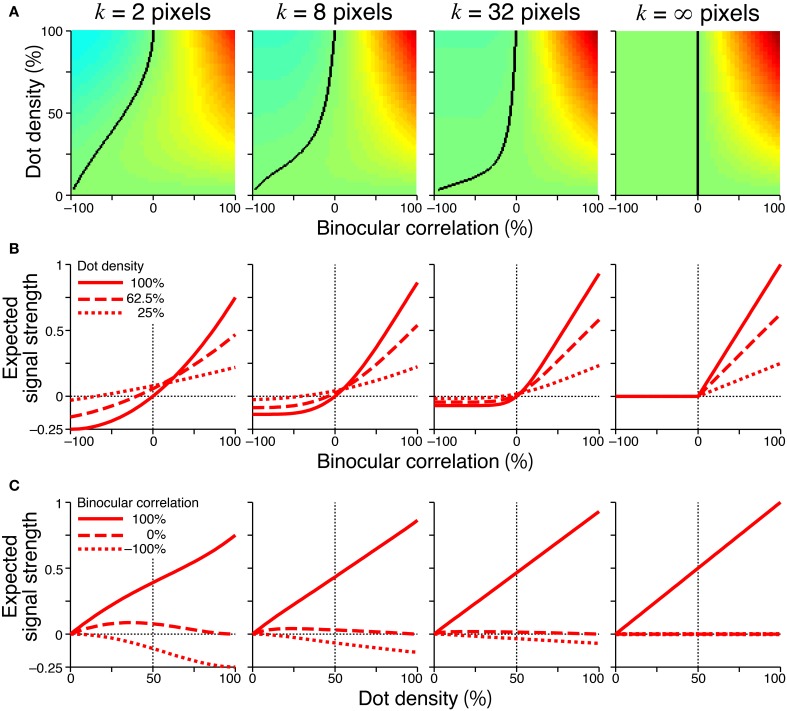
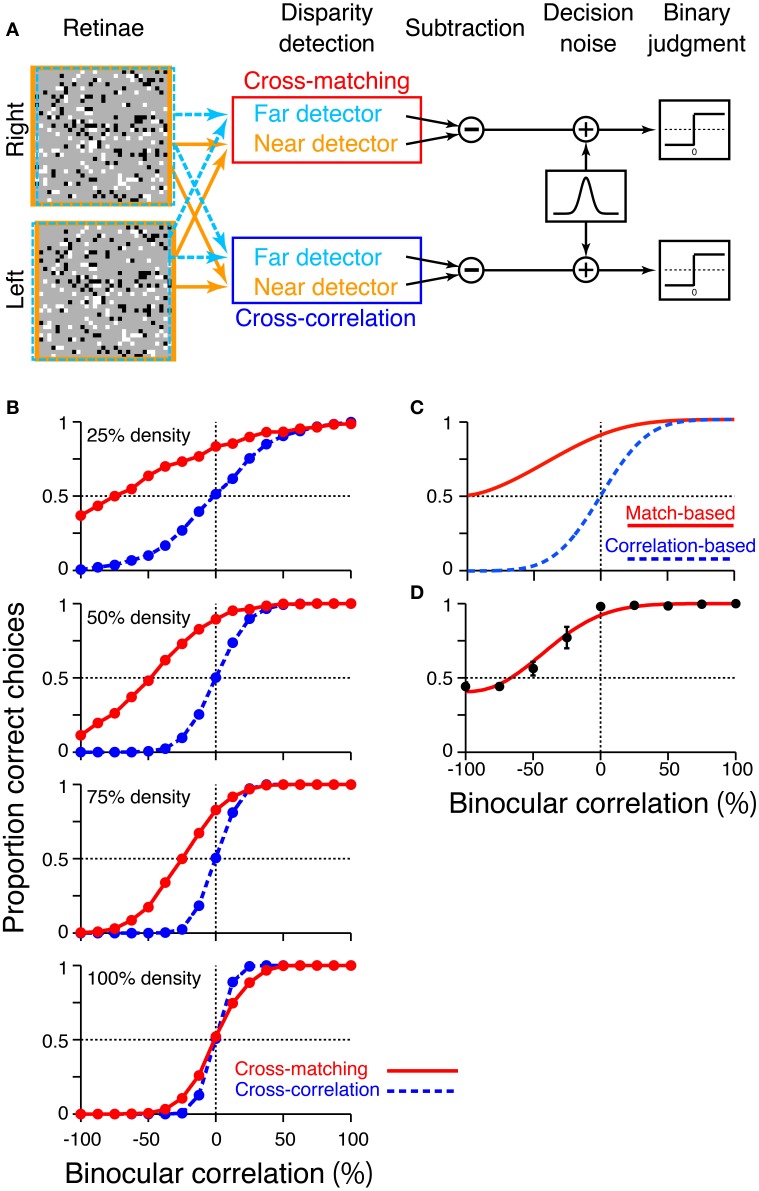
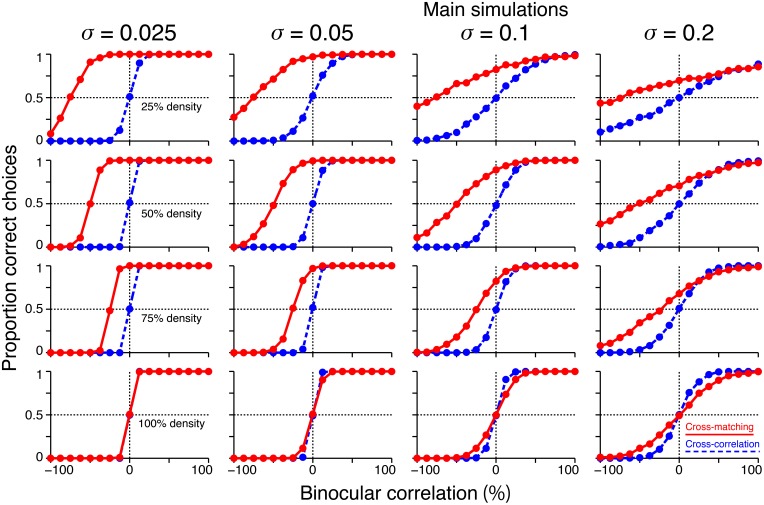
Three-dimensional visual perception requires correct matching of images projected to the left and right eyes. The matching process is faced with an ambiguity: part of one eye's image can be matched to multiple parts of the other eye's image. This stereo correspondence problem is complicated for random-dot stereograms (RDSs), because dots with an identical appearance produce numerous potential matches. Despite such complexity, human subjects can perceive a coherent depth structure. A coherent solution to the correspondence problem does not exist for anticorrelated RDSs (aRDSs), in which luminance contrast is reversed in one eye. Neurons in the visual cortex reduce disparity selectivity for aRDSs progressively along the visual processing hierarchy. A disparity-energy model followed by threshold nonlinearity (threshold energy model) can account for this reduction, providing a possible mechanism for the neural matching process. However, the essential computation underlying the threshold energy model is not clear. Here, we propose that a nonlinear modification of cross-correlation, which we term "cross-matching," represents the essence of the threshold energy model. We placed half-wave rectification within the cross-correlation of the left-eye and right-eye images. The disparity tuning derived from cross-matching was attenuated for aRDSs. We simulated a psychometric curve as a function of graded anticorrelation (graded mixture of aRDS and normal RDS); this simulated curve reproduced the match-based psychometric function observed in human near/far discrimination. The dot density was 25% for both simulation and observation. We predicted that as the dot density increased, the performance for aRDSs should decrease below chance (i.e., reversed depth), and the level of anticorrelation that nullifies depth perception should also decrease. We suggest that cross-matching serves as a simple computation underlying the match-based disparity signals in stereoscopic depth perception.
三维视觉感知需要正确匹配投射到左右眼中的图像。匹配过程面临着一种歧义:一只眼睛的图像的一部分可以与另一只眼睛的图像的多个部分匹配。对于随机点立体图(RDS)来说,这种立体对应问题很复杂,因为具有相同外观的点会产生许多潜在的匹配。尽管如此复杂,人类受试者仍然可以感知到连贯的深度结构。对于亮度对比度在一只眼中反转的反相关 RDS(aRDS),不存在对应问题的连贯解决方案。视觉皮层中的神经元沿着视觉处理层次结构逐渐降低 aRDS 的视差选择性。一个由差异能量模型和阈值非线性(阈值能量模型)组成的模型可以解释这种减少,为神经匹配过程提供了一种可能的机制。然而,阈值能量模型的基本计算并不清楚。在这里,我们提出交叉相关的非线性修正,即“交叉匹配”,代表了阈值能量模型的本质。我们在左眼和右眼图像的交叉相关中放置了半波整流。从交叉匹配得出的视差调谐在 aRDS 中被衰减。我们模拟了一个作为分级反相关函数的心理物理曲线(aRDS 和正常 RDS 的分级混合物);这条模拟曲线再现了人类近/远辨别中观察到的基于匹配的心理物理函数。模拟和观察的点密度均为 25%。我们预测,随着点密度的增加,aRDS 的性能应该低于随机水平(即反转深度),并且消除深度感知的反相关水平也应该降低。我们认为,交叉匹配是立体深度感知中基于匹配的视差信号的一种简单计算。