Gambhira Ratish, Keele Brandon F, Schell John B, Hunter Meredith J, Dufour Jason P, Montefiori David C, Tang Haili, Rose John K, Rose Nina, Marx Preston A
Division of Microbiology, Tulane National Primate Research Center, Tulane University, Covington, Louisiana, United States of America.
AIDS and Cancer Virus Program, SAIC-Frederick Inc., Frederick National Laboratory for Cancer Research, Frederick, Maryland, United States of America.
PLoS One. 2014 Oct 31;9(10):e109678. doi: 10.1371/journal.pone.0109678. eCollection 2014.
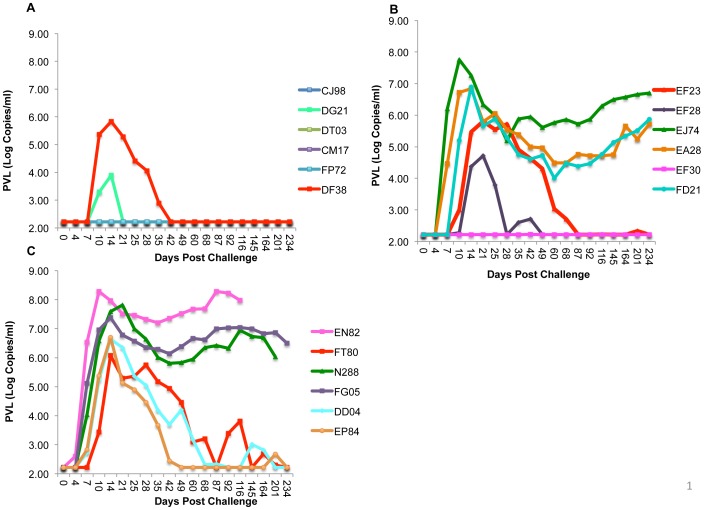
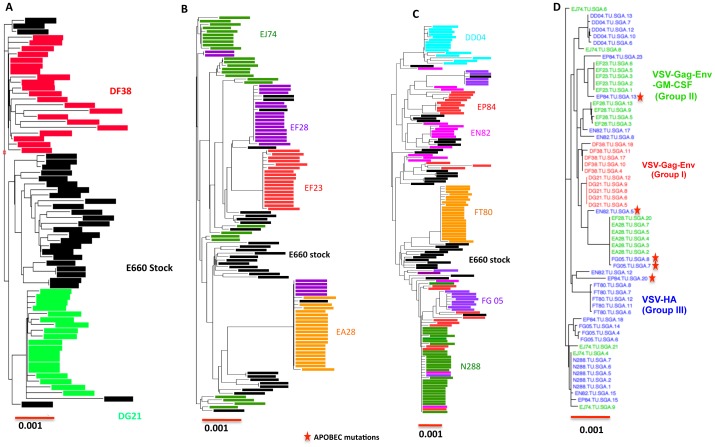
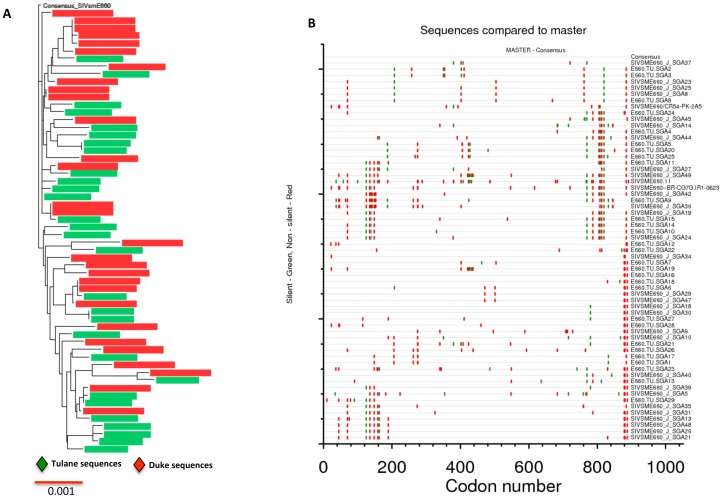
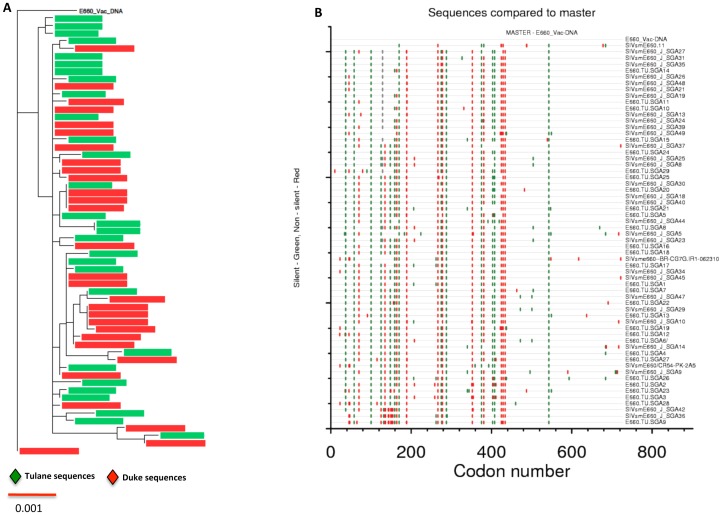
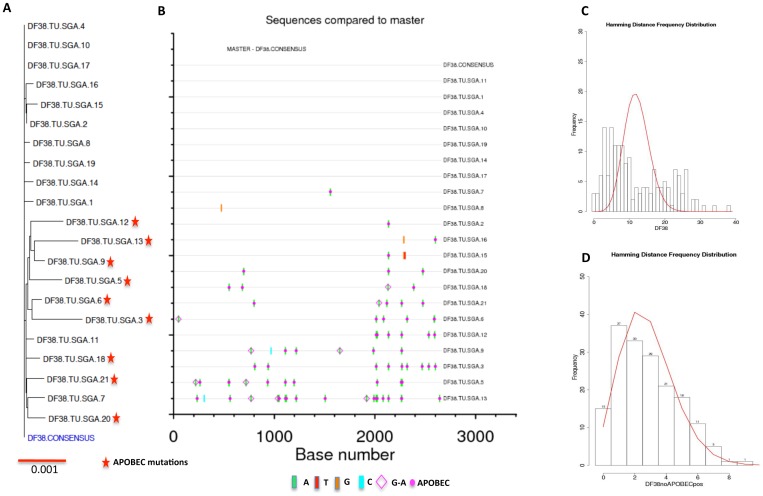
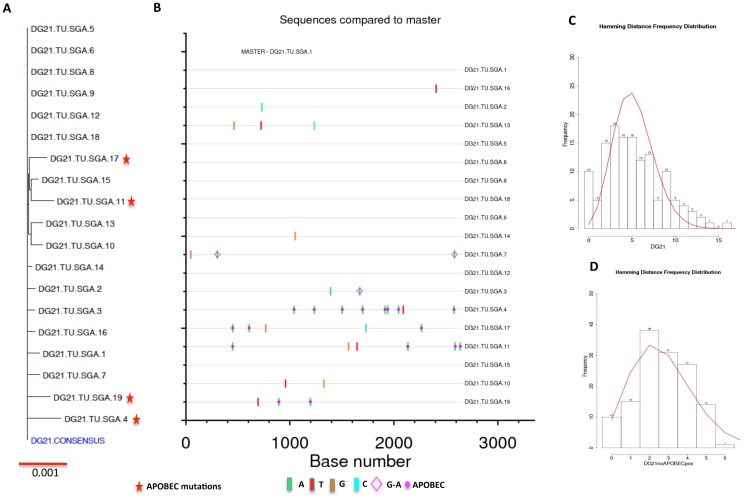
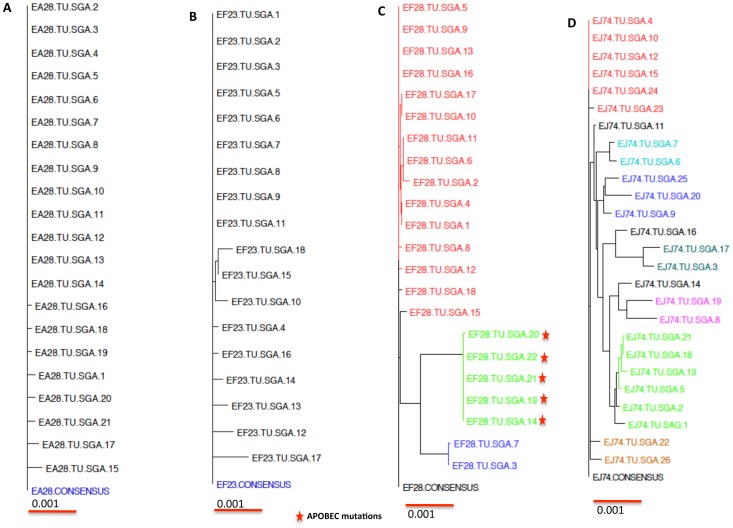
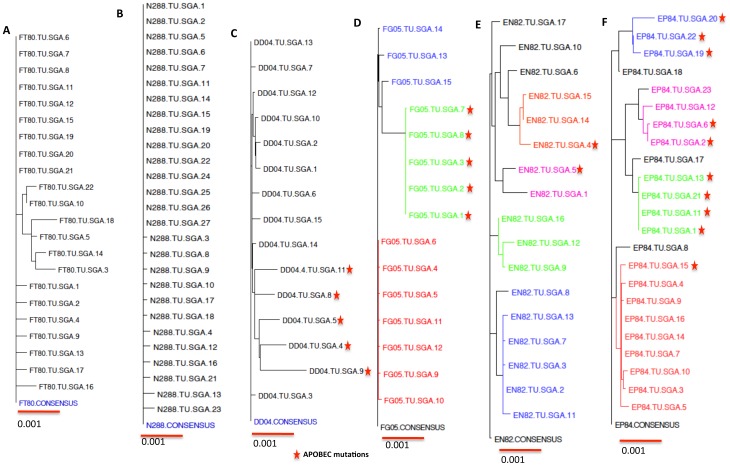
Identification of transmitted/founder simian immunodeficiency virus (SIV) envelope sequences responsible for infection may prove critical for understanding HIV/SIV mucosal transmission. We used single genome amplification and phylogenetic analyses to characterize transmitted/founder SIVs both in the inoculum and in immunized-infected rhesus monkeys. Single genome amplification of the SIVsmE660 inoculum revealed a maximum diversity of 1.4%. We also noted that the consensus sequence of the challenge stock differed from the vaccine construct in 10 amino acids including 3 changes in the V4 loop. Viral env was prepared from rhesus plasma in 3 groups of 6 immunized with vesicular stomatitis virus (VSV) vectors and boosted with Semliki forest virus (SFV) replicons expressing (a) SIVsmE660 gag-env (b) SIVsmE660 gag-env plus rhesus GM-CSF and (c) control influenza hemagglutinin protein. Macaques were immunized twice with VSV-vectors and once with SFV vector and challenged intrarectally with 4000 TCID50. Single genome amplification characterized the infections of 2 unprotected animals in the gag-env immunized group, both of which had reduced acute plasma viral loads that ended as transient infections indicating partial immune control. Four of 6 rhesus were infected in the gag-env + GM-CSF group which demonstrated that GM-CSF abrogated protection. All 6 animals from the control group were infected having high plasma viral loads. We obtained 246 full-length envelope sequences from SIVsmE660 infected macaques at the peak of infection and determined the number of transmitted/founder variants per animal. Our analysis found that 2 of 2 gag-env vaccinated but infected macaques exhibited single but distinct virus envelope lineages whereas rhesus vaccinated with gag-env-GM-CSF or HA control exhibited both single and multiple env lineages. Because there were only 2 infected animals in the gag-env vaccinated rhesus compared to 10 infected rhesus in the other 2 groups, the significance of finding single env variants in the gag-env vaccinated group could not be established.
鉴定导致感染的传播型/奠基型猴免疫缺陷病毒(SIV)包膜序列,可能对理解HIV/SIV的黏膜传播至关重要。我们运用单基因组扩增和系统发育分析,对接种物以及免疫感染的恒河猴体内的传播型/奠基型SIV进行特征描述。对SIVsmE660接种物进行单基因组扩增,结果显示最大多样性为1.4%。我们还注意到,攻击毒株的共有序列与疫苗构建体在10个氨基酸上存在差异,其中V4环有3处变化。从3组各6只经水泡性口炎病毒(VSV)载体免疫并用表达(a)SIVsmE660 gag-env、(b)SIVsmE660 gag-env加恒河猴GM-CSF以及(c)对照流感血凝素蛋白的辛德毕斯病毒(SFV)复制子加强免疫的恒河猴的血浆中制备病毒env。猕猴用VSV载体免疫两次,用SFV载体免疫一次,并经直肠给予4000个半数组织培养感染剂量(TCID50)进行攻击。单基因组扩增对gag-env免疫组中2只未受保护动物的感染情况进行了特征描述,这两只动物的急性血浆病毒载量均有所降低,最终表现为短暂感染,提示存在部分免疫控制。gag-env + GM-CSF组的6只恒河猴中有4只被感染,这表明GM-CSF消除了保护作用。对照组的所有6只动物均被感染,血浆病毒载量很高。我们在感染高峰期从感染SIVsmE660的猕猴中获得了246条全长包膜序列,并确定了每只动物的传播型/奠基型变体数量。我们的分析发现,2只接种gag-env但被感染的猕猴呈现单一但不同的病毒包膜谱系,而接种gag-env-GM-CSF或HA对照的恒河猴则呈现单一和多个env谱系。由于接种gag-env的恒河猴中只有2只被感染,而其他两组有10只被感染,因此在接种gag-env的组中发现单一env变体的意义尚无法确定。