Alout Haoues, Krajacich Benjamin J, Meyers Jacob I, Grubaugh Nathan D, Brackney Doug E, Kobylinski Kevin C, Diclaro Joseph W, Bolay Fatorma K, Fakoli Lawrence S, Diabaté Abdoulaye, Dabiré Roch K, Bougma Roland W, Foy Brian D
Arthropod-borne and Infectious Diseases Laboratory, Department of Microbiology, Immunology and Pathology, Colorado State University, Fort Collins, CO, USA.
Malar J. 2014 Nov 3;13:417. doi: 10.1186/1475-2875-13-417.
Mass drug administration (MDA) of ivermectin to humans for control and elimination of filarial parasites can kill biting malaria vectors and lead to Plasmodium transmission reduction. This study examines the degree and duration of mosquitocidal effects resulting from single MDAs conducted in three different West African countries, and the subsequent reductions in parity and Plasmodium sporozoite rates.
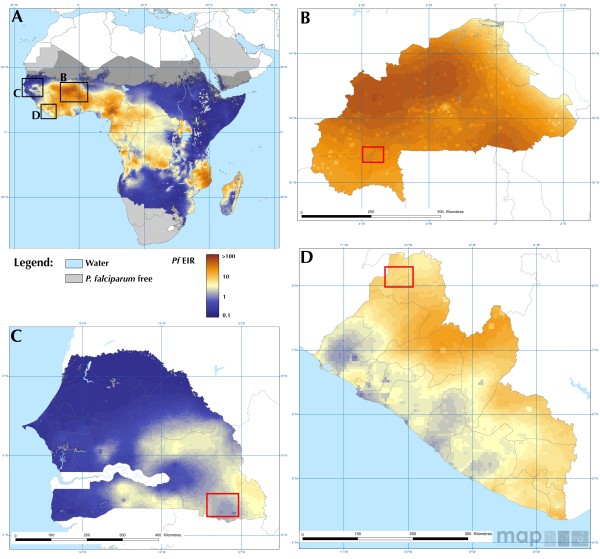
Indoor-resting, blood-fed and outdoor host-seeking Anopheles spp. were captured on days surrounding MDAs from 2008-2013 in Senegalese, Liberian and Burkinabé villages. Mortality was assessed on a portion of the indoor collection, and parity status was determined on host-seeking mosquitoes. The effect of MDA was then analysed against the time relative to the MDA, the distributed drugs and environmental variables.
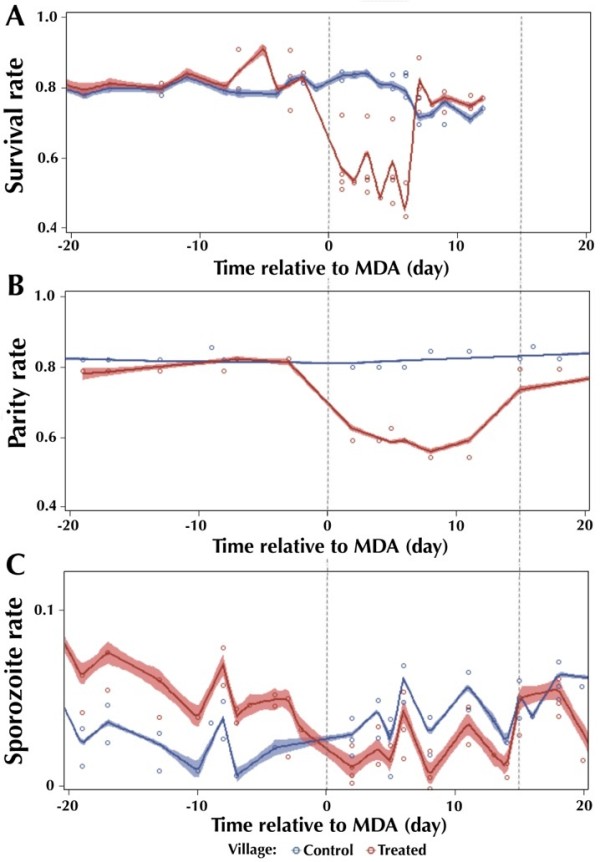
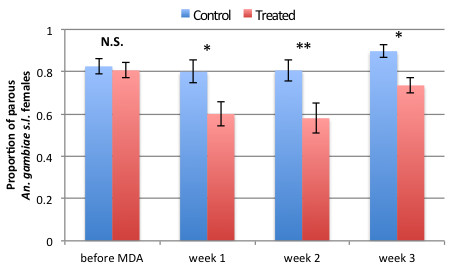
Anopheles gambiae survivorship was reduced by 33.9% for one week following MDA and parity rates were significantly reduced for more than two weeks after the MDAs. Sporozoite rates were significantly reduced by >77% for two weeks following the MDAs in treatment villages despite occurring in the middle of intense transmission seasons. These observed effects were consistent across three different West African transmission dynamics.
These data provide a comprehensive and crucial evidence base for the significant reduction in malaria transmission following single ivermectin MDAs across diverse field sites. Despite the limited duration of transmission reduction, these results support the hypothesis that repeated MDAs with optimal timing could help sustainably control malaria as well as filarial transmission.
用伊维菌素对人类进行群体药物给药(MDA)以控制和消除丝虫寄生虫,可杀死叮咬人的疟疾媒介并减少疟原虫传播。本研究考察了在三个不同西非国家进行的单次MDA所产生的杀蚊效果的程度和持续时间,以及随后的蚊虫产卵率和疟原虫子孢子率的降低情况。
2008年至2013年期间,在塞内加尔、利比里亚和布基纳法索的村庄,于MDA前后数天捕获室内栖息、已吸血和室外寻找宿主的按蚊属蚊子。对一部分室内采集的蚊子评估死亡率,并对寻找宿主的蚊子确定其产卵状态。然后针对相对于MDA的时间、分发的药物和环境变量分析MDA的效果。
MDA后一周内,冈比亚按蚊的存活率降低了33.9%,MDA后两周多时间里,蚊虫产卵率显著降低。在治疗村庄MDA后两周内,子孢子率显著降低>77%,尽管这发生在高强度传播季节中期。在三种不同的西非传播动态中,这些观察到的效果是一致的。
这些数据为在不同实地地点单次使用伊维菌素进行MDA后疟疾传播显著减少提供了全面且关键的证据基础。尽管传播减少的持续时间有限,但这些结果支持这样的假设,即适时重复进行MDA有助于可持续地控制疟疾以及丝虫传播。