Holmgren Noél Michael André, Norrström Niclas, Aps Robert, Kuikka Sakari
Systems Biology Research Centre, School of Bioscience, University of Skövde, Skövde, Sweden.
University of Tartu, Estonian Marine Institute, Tallinn, Estonia.
PLoS One. 2014 Nov 3;9(11):e111614. doi: 10.1371/journal.pone.0111614. eCollection 2014.
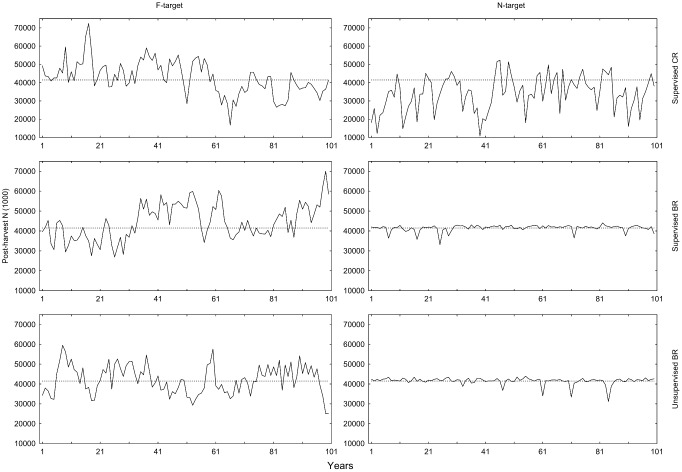
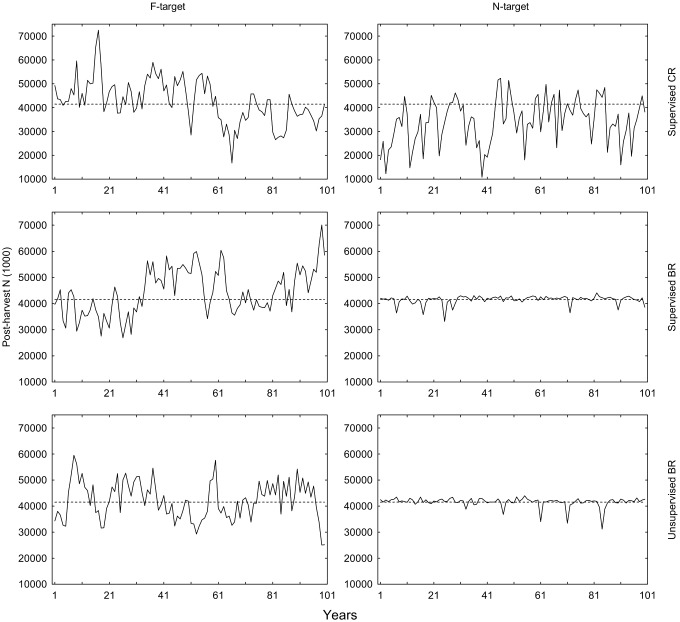
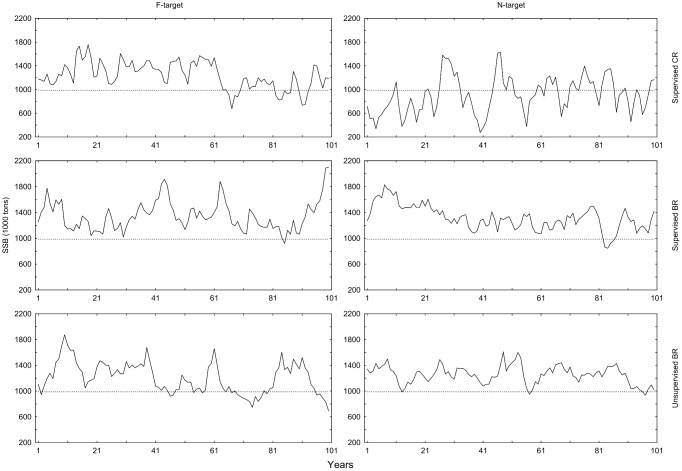
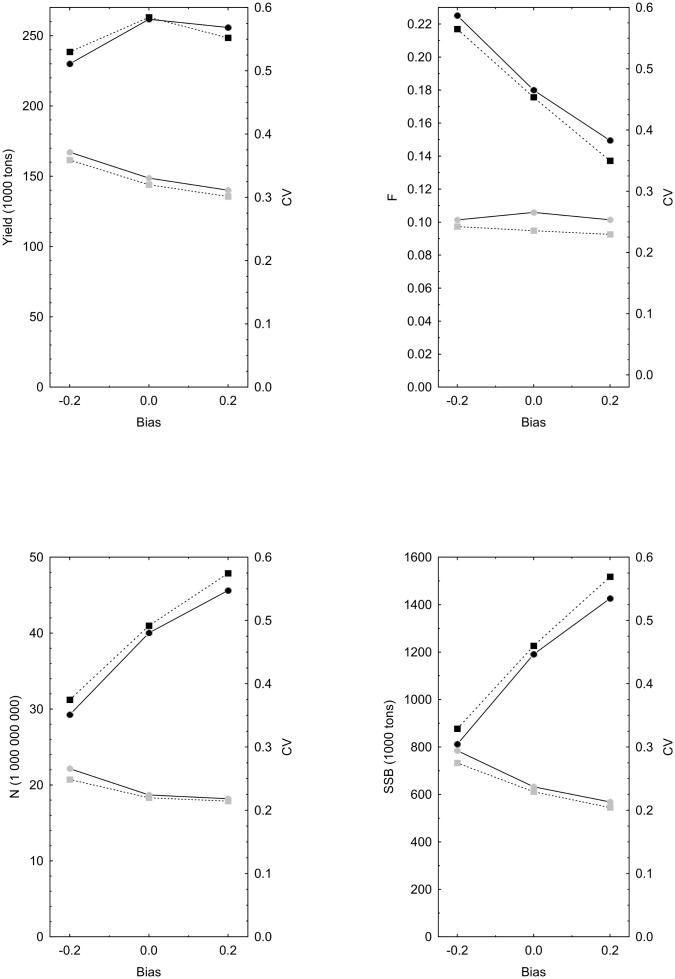
Stochastic variability of biological processes and uncertainty of stock properties compel fisheries managers to look for tools to improve control over the stock. Inspired by animals exploiting hidden prey, we have taken a biomimetic approach combining catch and effort in a concept of Bayesian regulation (BR). The BR provides a real-time Bayesian stock estimate, and can operate without separate stock assessment. We compared the performance of BR with catch-only regulation (CR), alternatively operating with N-target (the stock size giving maximum sustainable yield, MSY) and F-target (the fishing mortality giving MSY) on a stock model of Baltic Sea herring. N-targeted BR gave 3% higher yields than F-targeted BR and CR, and 7% higher yields than N-targeted CR. The BRs reduced coefficient of variance (CV) in fishing mortality compared to CR by 99.6% (from 25.2 to 0.1) when operated with F-target, and by about 80% (from 158.4 to 68.4/70.1 depending on how the prior is set) in stock size when operated with N-target. Even though F-targeted fishery reduced CV in pre-harvest stock size by 19-22%, it increased the dominant period length of population fluctuations from 20 to 60-80 years. In contrast, N-targeted BR made the periodic variation more similar to white noise. We discuss the conditions when BRs can be suitable tools to achieve sustainable yields while minimizing undesirable fluctuations in stock size or fishing effort.
生物过程的随机变异性和种群特性的不确定性迫使渔业管理者寻找工具来加强对种群的控制。受动物捕食隐藏猎物的启发,我们采用了一种仿生方法,将渔获量和捕捞努力量结合在贝叶斯调控(BR)概念中。BR提供实时贝叶斯种群估计,并且无需单独的种群评估即可运行。我们在波罗的海鲱鱼的种群模型上,将BR的性能与仅基于渔获量的调控(CR)进行了比较,CR分别采用N目标(给出最大可持续产量,即MSY的种群规模)和F目标(给出MSY的捕捞死亡率)运行。以N为目标的BR比以F为目标的BR和CR产量高3%,比以N为目标的CR产量高7%。当以F为目标运行时,与CR相比,BR使捕捞死亡率的变异系数(CV)降低了99.6%(从25.2降至0.1);当以N为目标运行时,BR使种群规模的CV降低了约80%(从158.4降至68.4/70.1,具体取决于先验的设定方式)。尽管以F为目标的渔业使收获前种群规模的CV降低了19 - 22%,但它将种群波动的主导周期长度从20年增加到了60 - 80年。相比之下,以N为目标的BR使周期性变化更类似于白噪声。我们讨论了BR在何种条件下可以成为实现可持续产量同时最小化种群规模或捕捞努力量不良波动的合适工具。