Smitz Nathalie, Cornélis Daniel, Chardonnet Philippe, Caron Alexandre, de Garine-Wichatitsky Michel, Jori Ferran, Mouton Alice, Latinne Alice, Pigneur Lise-Marie, Melletti Mario, Kanapeckas Kimberly L, Marescaux Jonathan, Pereira Carlos Lopes, Michaux Johan
BMC Evol Biol. 2014 Nov 1;14:203. doi: 10.1186/s12862-014-0203-2.
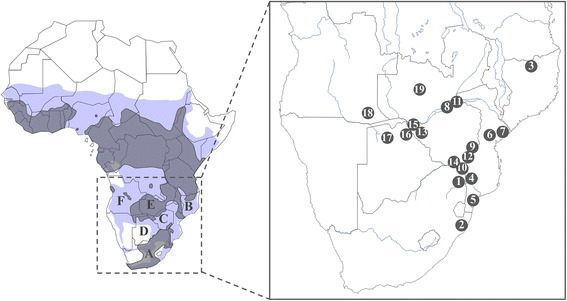
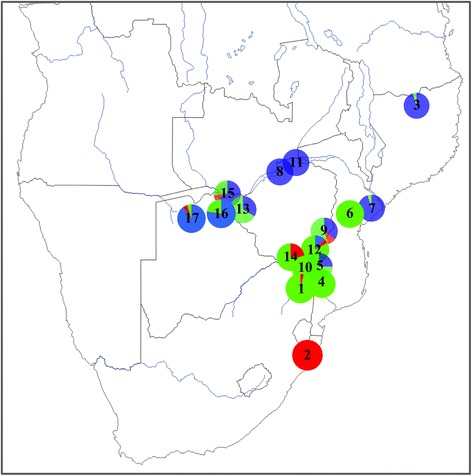
African wildlife experienced a reduction in population size and geographical distribution over the last millennium, particularly since the 19th century as a result of human demographic expansion, wildlife overexploitation, habitat degradation and cattle-borne diseases. In many areas, ungulate populations are now largely confined within a network of loosely connected protected areas. These metapopulations face gene flow restriction and run the risk of genetic diversity erosion. In this context, we assessed the "genetic health" of free ranging southern African Cape buffalo populations (S.c. caffer) and investigated the origins of their current genetic structure. The analyses were based on 264 samples from 6 southern African countries that were genotyped for 14 autosomal and 3 Y-chromosomal microsatellites.
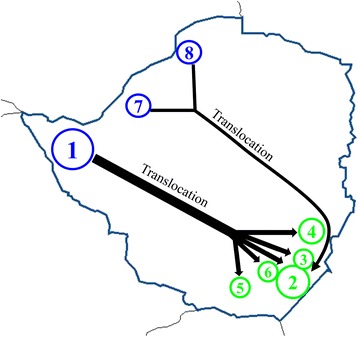
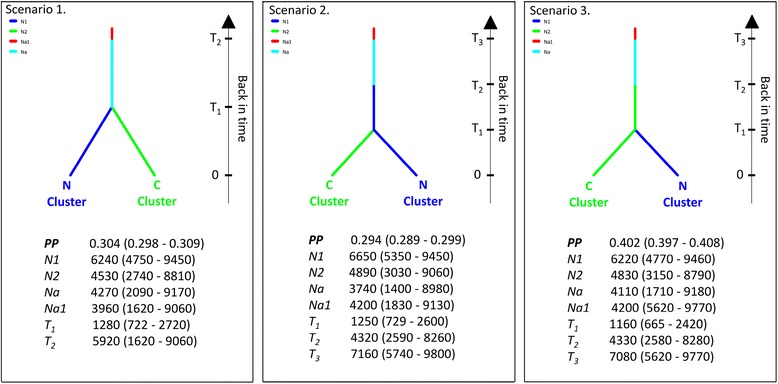
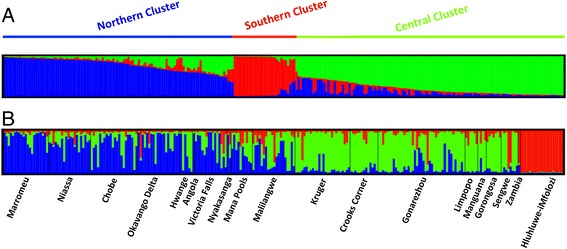
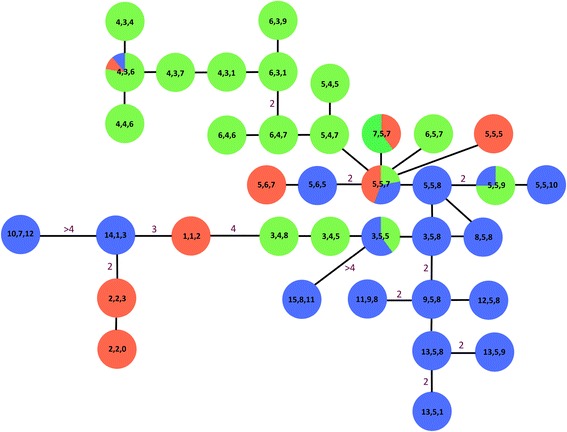
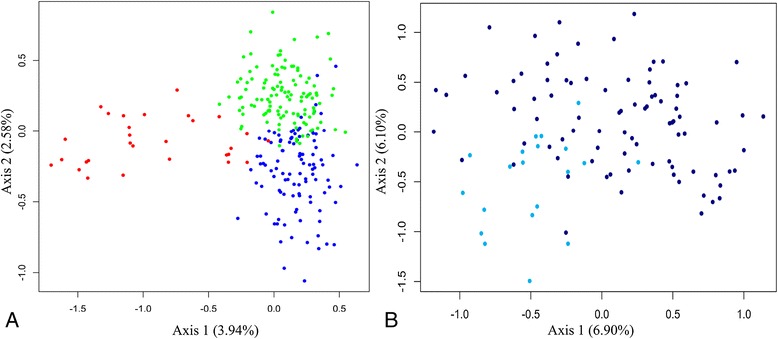
The analyses differentiated three significant genetic clusters, hereafter referred to as Northern (N), Central (C) and Southern (S) clusters. The results suggest that splitting of the N and C clusters occurred around 6000 to 8400 years ago. Both N and C clusters displayed high genetic diversity (mean allelic richness (A r ) of 7.217, average genetic diversity over loci of 0.594, mean private alleles (P a ) of 11), low differentiation, and an absence of an inbreeding depression signal (mean F IS = 0.037). The third (S) cluster, a tiny population enclosed within a small isolated protected area, likely originated from a more recent isolation and experienced genetic drift (F IS = 0.062, mean A r = 6.160, P a = 2). This study also highlighted the impact of translocations between clusters on the genetic structure of several African buffalo populations. Lower differentiation estimates were observed between C and N sampling localities that experienced translocation over the last century.
We showed that the current genetic structure of southern African Cape buffalo populations results from both ancient and recent processes. The splitting time of N and C clusters suggests that the current pattern results from human-induced factors and/or from the aridification process that occurred during the Holocene period. The more recent S cluster genetic drift probably results of processes that occurred over the last centuries (habitat fragmentation, diseases). Management practices of African buffalo populations should consider the micro-evolutionary changes highlighted in the present study.
在过去的一千年里,非洲野生动物的种群数量和地理分布有所减少,特别是自19世纪以来,由于人类人口扩张、野生动物过度开发、栖息地退化和牛传播疾病。在许多地区,有蹄类动物种群现在主要局限于一个联系松散的保护区网络内。这些集合种群面临基因流动限制,有遗传多样性丧失的风险。在此背景下,我们评估了自由放养的南非水牛种群(S.c. caffer)的“遗传健康状况”,并调查了其当前遗传结构的起源。分析基于来自6个南部非洲国家的264个样本,这些样本针对14个常染色体和3个Y染色体微卫星进行了基因分型。
分析区分出三个显著的遗传簇,以下称为北部(N)、中部(C)和南部(S)簇。结果表明,N和C簇的分裂发生在大约6000至8400年前。N和C簇均表现出高遗传多样性(平均等位基因丰富度(Ar)为7.217,各基因座平均遗传多样性为0.594,平均私有等位基因(Pa)为11)、低分化,且无近亲繁殖衰退信号(平均FIS = 0.037)。第三个(S)簇是一个被封闭在一个小的孤立保护区内的小种群,可能起源于较近期的隔离,并经历了遗传漂变(FIS = 0.062,平均Ar = 6.160,Pa = 2)。本研究还强调了簇间迁移对几个非洲水牛种群遗传结构的影响。在过去一个世纪经历过迁移的C和N采样地点之间观察到较低的分化估计值。
我们表明,南非水牛种群当前的遗传结构是古代和近期过程共同作用的结果。N和C簇的分裂时间表明,当前模式是由人为因素和/或全新世期间发生的干旱化过程导致的。较近期的S簇遗传漂变可能是过去几个世纪发生的过程(栖息地破碎化、疾病)的结果。非洲水牛种群的管理实践应考虑本研究中突出的微观进化变化。