Meiyalaghan Sathiyamoorthy, Latimer Julie M, Kralicek Andrew V, Shaw Martin L, Lewis John G, Conner Anthony J, Barrell Philippa J
The New Zealand Institute for Plant & Food Research Ltd, Private Bag 4704, Christchurch, New Zealand.
BMC Res Notes. 2014 Nov 4;7:777. doi: 10.1186/1756-0500-7-777.
The Gibberellin Stimulated-Like (GSL) or Snakin peptides from higher plants are cysteine-rich, with broad spectrum activity against a range of bacterial and fungal pathogens. To detect GSL peptides in applications such as western blot analysis and enzyme-linked immunosorbent assays (ELISA), specific antibodies that recognise GSL peptides are required. However, the intrinsic antimicrobial activity of these peptides is likely to prevent their expression alone in bacterial or yeast expression systems for subsequent antibody production in animal hosts.
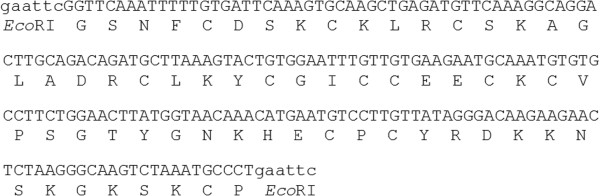
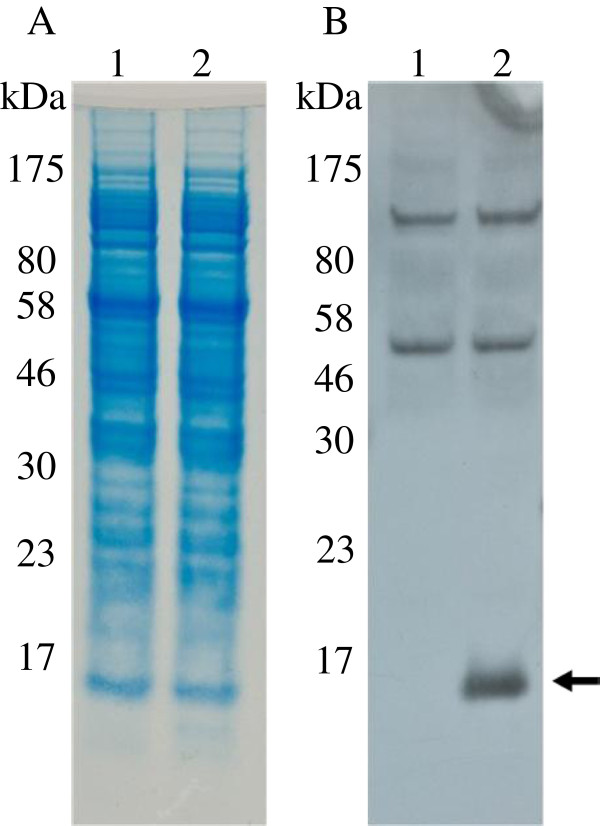
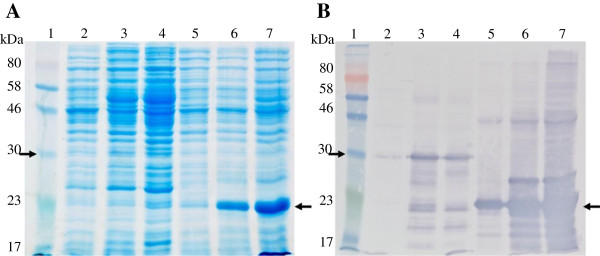
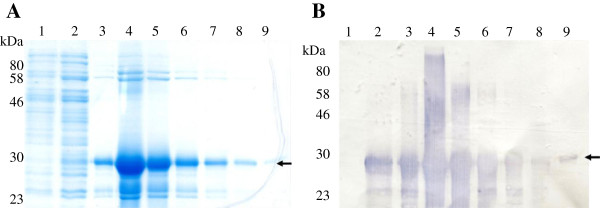
To overcome this issue we developed an Escherichia coli expression strategy based on the expression of the GSL1 peptide as a His-tagged thioredoxin fusion protein. The DNA sequence for the mature GSL1 peptide from potato (Solanum tuberosum L.) was cloned into the pET-32a expression vector to produce a construct encoding N-terminally tagged his6-thioredoxin-GSL1. The fusion protein was overexpressed in E. coli to produce soluble non-toxic protein. The GSL1 fusion protein could be easily purified by using affinity chromatography to yield ~1.3 mg of his6-thioredoxin-GSL1 per L of culture. The fusion protein was then injected into rabbits for antibody production. Western blot analysis showed that the antibodies obtained from rabbit sera specifically recognised the GSL1 peptide that had been expressed in a wheat germ cell-free expression system.
We present here the first report of a GSL1 peptide expressed as a fusion protein with thioredoxin that has resulted in milligram quantities of soluble protein to be produced. We have also demonstrated that a wheat germ system can be used to successfully express small quantities of GSL1 peptide useful as positive control in western blot analysis. To our knowledge this is the first report of antibodies being produced against GSL1 peptide. The antibodies will be useful for analysis of GSL1peptides in western blot, localization by immunohistochemistry (IHC) and quantitation by ELISA.
高等植物中的赤霉素刺激样(GSL)或蛇形肽富含半胱氨酸,对多种细菌和真菌病原体具有广谱活性。为了在蛋白质免疫印迹分析和酶联免疫吸附测定(ELISA)等应用中检测GSL肽,需要能够识别GSL肽的特异性抗体。然而,这些肽的固有抗菌活性可能会阻止它们在细菌或酵母表达系统中单独表达,从而无法在动物宿主中生产后续抗体。
为了克服这个问题,我们开发了一种大肠杆菌表达策略,该策略基于将GSL1肽表达为带有His标签的硫氧还蛋白融合蛋白。将来自马铃薯(Solanum tuberosum L.)的成熟GSL1肽的DNA序列克隆到pET-32a表达载体中,以产生编码N端带有his6-硫氧还蛋白-GSL1的构建体。融合蛋白在大肠杆菌中过量表达,以产生可溶性无毒蛋白。使用亲和色谱法可以轻松纯化GSL1融合蛋白,每升培养物可产生约1.3毫克的his6-硫氧还蛋白-GSL1。然后将融合蛋白注射到兔子体内以产生抗体。蛋白质免疫印迹分析表明,从兔血清中获得的抗体能够特异性识别在无细胞小麦胚表达系统中表达的GSL1肽。
我们在此首次报道了将GSL1肽作为与硫氧还蛋白的融合蛋白进行表达,从而产生了毫克级的可溶性蛋白。我们还证明了小麦胚系统可用于成功表达少量的GSL1肽,该肽可作为蛋白质免疫印迹分析中的阳性对照。据我们所知,这是首次报道针对GSL1肽产生抗体。这些抗体将有助于在蛋白质免疫印迹中分析GSL1肽、通过免疫组织化学(IHC)进行定位以及通过ELISA进行定量。