Instituto de Biotecnología, Centro de Investigación en Ciencias Veterinarias y Agronómicas, Centro Nacional de Investigaciones Agropecuarias, Instituto Nacional de Tecnología Agropecuaria, Repetto y De Los Reseros s/n, CP 1686, Hurlingham, Buenos Aires, Argentina.
Consejo Nacional de Investigaciones Científicas y Técnicas, CONICET, Godoy Cruz 2290, C1425FQB, Autonomous City of Buenos Aires, Argentina.
BMC Biotechnol. 2017 Nov 9;17(1):75. doi: 10.1186/s12896-017-0401-2.
Snakin-1 (StSN1) is a broad-spectrum antimicrobial cysteine-rich peptide isolated from Solanum tuberosum. Its biotechnological potential has been already recognized since it exhibits in vivo antifungal and antibacterial activity. Most attempts to produce StSN1, or homologous peptides, in a soluble native state using bacterial, yeast or synthetic expression systems have presented production bottlenecks such as insolubility, misfolding or low yields.
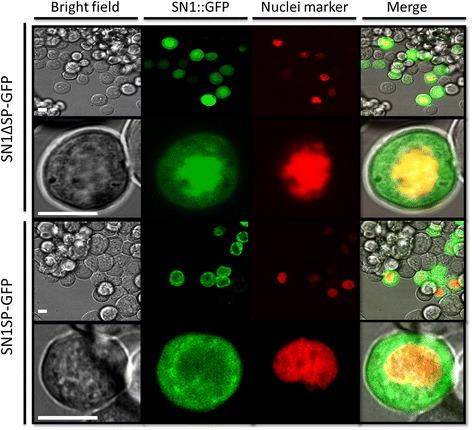
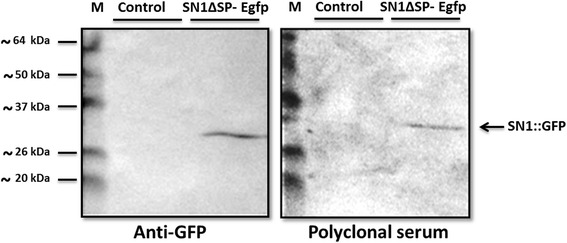
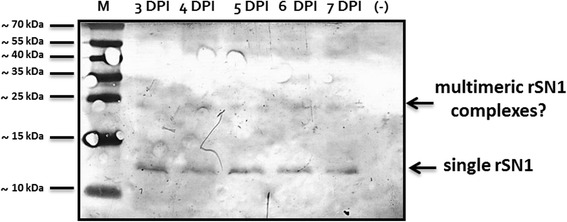
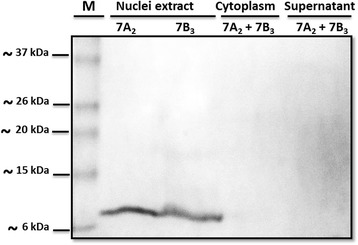
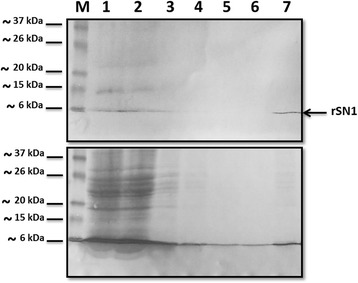
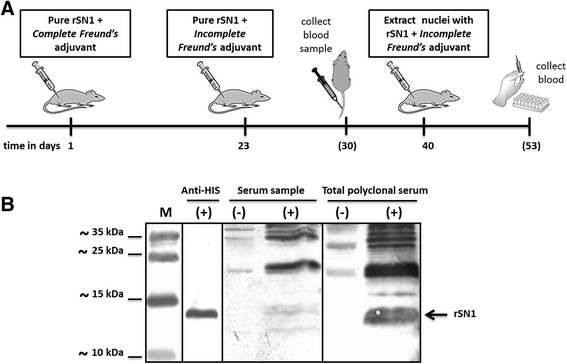
In this work, we successfully expressed a recombinant StSN1 (rSN1) in Spodoptera frugiperda (Sf9) insect cells by optimizing several of the parameters for its expression in the baculovirus expression system. The recombinant peptide lacking its putative signal peptide was soluble and was present in the nuclear fraction of infected Sf9 cells. An optimized purification procedure allowed the production of rSN1 that was used for immunization of mice, which gave rise to polyclonal antibodies that detect the native protein in tissue extracts of both agroinfiltrated plants and stable transgenic lines. Our results demonstrated that this system circumvents all the difficulties associated with recombinant antimicrobial peptides expression in other heterologous systems.
The present study is the first report of a successful protocol to produce a soluble Snakin/GASA peptide in baculovirus-infected insect cells. Our work demonstrates that the nuclear localization of rSN1 in insect cells can be exploited for its large-scale production and subsequent generation of specific anti-rSN1 antibodies. We suggest the use of the baculovirus system for high-level expression of Snakin/GASA peptides, for biological assays, structural and functional analysis and antibody production, as an important step to both elucidate their accurate physiological role and to deepen the study of their biotechnological uses.
Snakin-1(StSN1)是一种从茄属植物中分离出来的广谱抗菌富含半胱氨酸的肽。由于其具有体内抗真菌和抗菌活性,因此其生物技术潜力已经得到认可。大多数使用细菌、酵母或合成表达系统以可溶性天然状态生产 StSN1 或同源肽的尝试都存在生产瓶颈,例如不溶性、错误折叠或低产量。
在这项工作中,我们通过优化杆状病毒表达系统中表达的几个参数,成功地在草地贪夜蛾(Sf9)昆虫细胞中表达了重组 StSN1(rSN1)。缺少假定信号肽的重组肽是可溶的,并且存在于感染的 Sf9 细胞的核部分中。优化的纯化程序允许生产 rSN1,该 rSN1 用于免疫小鼠,产生的多克隆抗体可检测到组织提取物中天然蛋白质 agroinfiltrated 植物和稳定的转基因系。我们的结果表明,该系统避免了在其他异源系统中表达重组抗菌肽所遇到的所有困难。
本研究首次报道了成功的方案,可在杆状病毒感染的昆虫细胞中生产可溶性 Snakin/GASA 肽。我们的工作表明,rSN1 在昆虫细胞中的核定位可用于其大规模生产和随后产生特异性抗 rSN1 抗体。我们建议使用杆状病毒系统进行 Snakin/GASA 肽的高水平表达,用于生物测定、结构和功能分析以及抗体生产,这是阐明其精确生理作用并深入研究其生物技术用途的重要步骤。