Kim Su Jin, Jun Suyeon, Cho Hee-Yeon, Lee Dong Chul, Yeom Young Il, Kim Jong Hyeok, Kang Dongchul
Departments of Internal Medicine, Hallym University Sacred Heart Hospital, Hallym University College of Medicine, Anyang, Korea.
BMC Cancer. 2014 Nov 3;14:804. doi: 10.1186/1471-2407-14-804.
Anterior gradient 2 (AGR2) has been implicated in tumor-associated phenotypes such as cell viability, invasion and metastasis in various human cancers. However, the tumor promoting activity of AGR2 has not yet been determined in biliary tract cancers. Thus, we examined the expression of AGR2 and its tumor-promoting activity in biliary tract cancer cells in this study.
Expression of AGR2 mRNA and protein was analyzed by real time RT-PCR and western blotting, respectively. MTT assay was employed to measure cell viability and pulsed BrdU incorporation by proliferating cells was monitored by flow cytometry. Soft agar colony formation assay and transwell invasion assay were employed to determine anchorage-independent growth and in vitro invasion of the tumor cells, respectively. In vivo tumor formation was examined by injection of tumor cells into immunocompromised mice subcutaneously. Statistical analysis was performed with 2-tailed unpaired Student's t-test for continuous data and with one-way ANOVA for multiple group comparisons. Bonferroni tests were used for post hoc 2-sample comparisons.
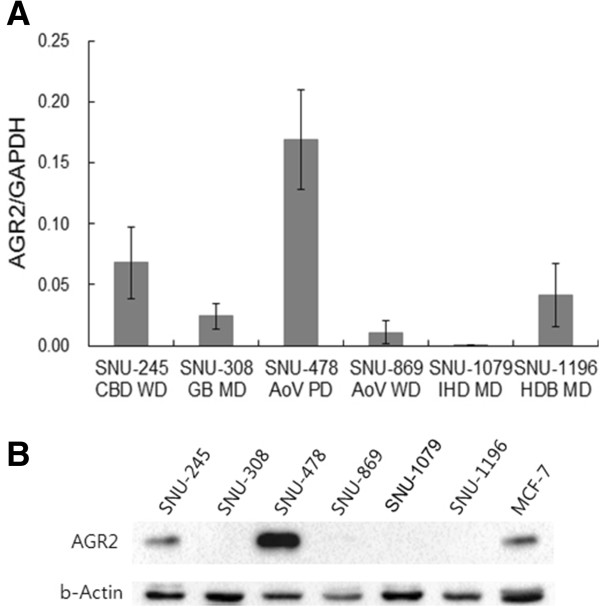
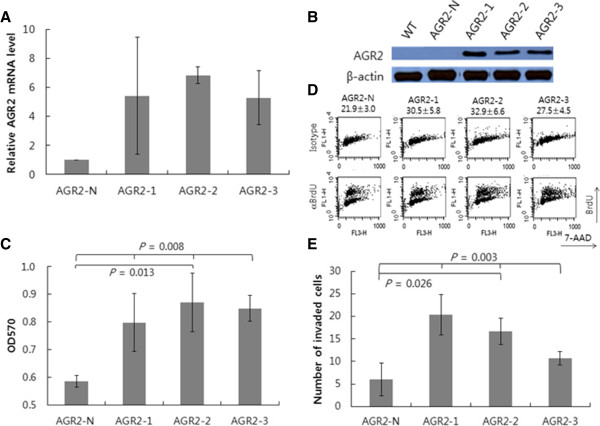
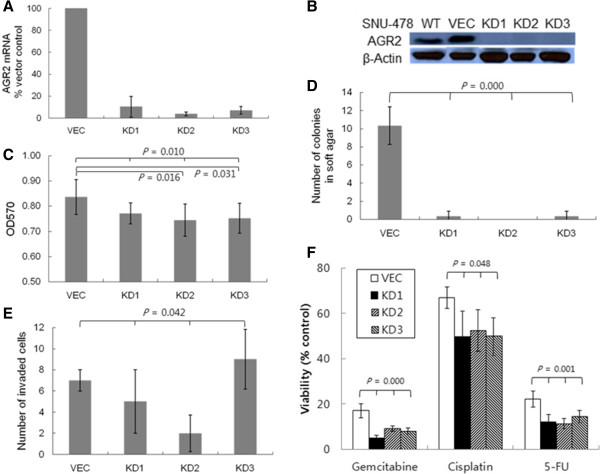
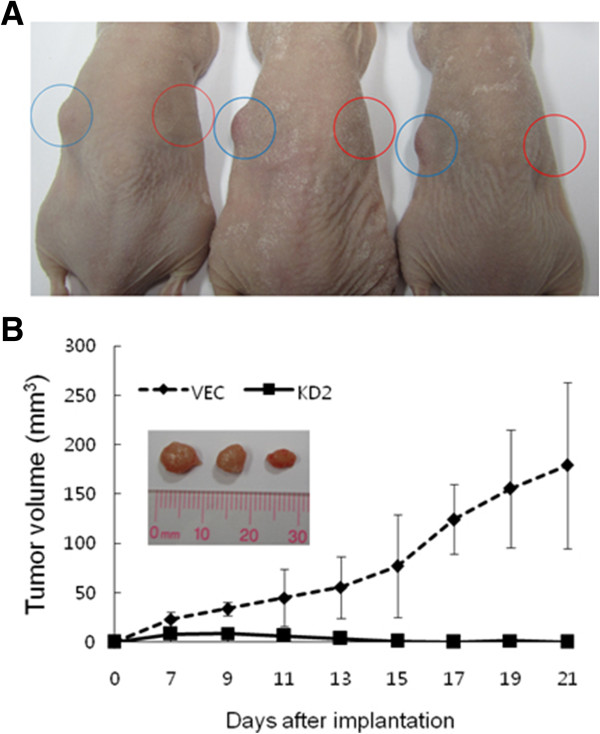
AGR2 mRNA was detected in SNU-245, SNU-478, and SNU-1196 cell lines, and its protein expression was confirmed in SNU-478 and SNU-245 cell lines by western blot analysis. Knockdown of AGR2 expression with an AGR2-specific short hairpin RNA (shRNA) in SNU-478, an ampulla of Vater cancer cell line resulted in decreased cell viability and in decreased anchorage-independent growth by 98%. The AGR2 knockdown also increased the sensitivity of the cells to chemotherapeutic drugs, including gemcitabine, 5-fluorouracil and cisplatin. In addition, SNU-478 cells expressing AGR2-shRNA failed to form detectable tumor xenografts in nude mice, whereas control cells formed tumors with an average size of 179 ± 84 mm3 in 3 weeks. Overexpression of AGR2 in SNU-869 cells significantly increased cell viability through enhanced cell proliferation and the number of Matrigel™-invading cells compared with AGR2-negative SNU-869 cells.
Our findings implicate that AGR2 expression augments tumor-associated phenotypes by increasing proliferative and invasive capacities of the ampulla of Vater cancer cells.
前梯度2(AGR2)与多种人类癌症中的肿瘤相关表型有关,如细胞活力、侵袭和转移。然而,AGR2在胆管癌中的促肿瘤活性尚未确定。因此,在本研究中我们检测了AGR2在胆管癌细胞中的表达及其促肿瘤活性。
分别通过实时逆转录聚合酶链反应(RT-PCR)和蛋白质印迹法分析AGR2 mRNA和蛋白的表达。采用MTT法检测细胞活力,通过流式细胞术监测增殖细胞中脉冲掺入的溴脱氧尿苷(BrdU)。分别采用软琼脂集落形成试验和Transwell侵袭试验来确定肿瘤细胞的非锚定依赖性生长和体外侵袭能力。通过将肿瘤细胞皮下注射到免疫缺陷小鼠体内来检测体内肿瘤形成情况。对连续数据采用双侧不成对学生t检验进行统计分析,对多组比较采用单因素方差分析。采用Bonferroni检验进行事后两组比较。
在SNU-245、SNU-478和SNU-1196细胞系中检测到AGR2 mRNA,通过蛋白质印迹分析在SNU-478和SNU-245细胞系中证实了其蛋白表达。在Vater壶腹癌细胞系SNU-478中用AGR2特异性短发夹RNA(shRNA)敲低AGR2表达导致细胞活力下降,非锚定依赖性生长下降98%。AGR2敲低还增加了细胞对包括吉西他滨、5-氟尿嘧啶和顺铂在内的化疗药物的敏感性。此外,表达AGR2-shRNA的SNU-478细胞在裸鼠中未能形成可检测到的肿瘤异种移植物,而对照细胞在3周内形成了平均大小为179±84 mm³的肿瘤。与AGR2阴性的SNU-869细胞相比,SNU-869细胞中AGR2的过表达通过增强细胞增殖和基质胶侵袭细胞数量显著提高了细胞活力。
我们的研究结果表明,AGR2表达通过增加Vater壶腹癌细胞的增殖和侵袭能力增强了肿瘤相关表型。