Cil Ahmet Said, Bozkurt Murat, Kara Bozkurt Duygu, Gok Mustafa
Department of Radiology, Universal Hospital Groups, Malatya, Turkey.
Department of Obstetrics and Gynecology, Kafkas University School of Medicine, Kars, Turkey.
J Clin Med Res. 2015 Jan;7(1):29-32. doi: 10.14740/jocmr1967w. Epub 2014 Oct 16.
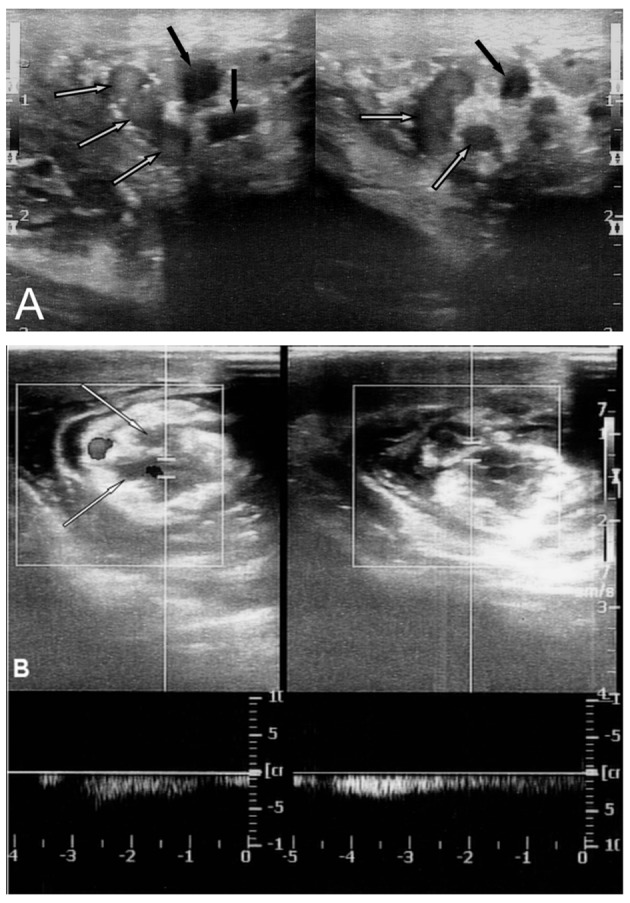
The aim of this study was to investigate the presence of persistent reflux flow on the first postoperative day using color Doppler sonography (CDS) in patients who had undergone sub-inguinal varicocelectomy, and to research the relationship between persistent reflux flow and recurrent varicocele.
A total of 54 patients were included in the study. Ages of the patients were between 21 and 38 years (mean 27.3 ± 7.6). All patients were evaluated four times with CDS: preoperatively, first postoperative day, 3 months postoperative, and finally 6 months after the operation.
Preoperative venous diameters were measured between 3 and 5.5 mm; mean vein diameters were 3.8 ± 0.7 mm for the left side and 3.4 ± 0.4 mm for the right side. Mean duration of reflux was 3.5 ± 0.3 seconds on the left side and 2.9 ± 0.7 seconds on the right side. First postoperative day persistent Valsalva-induced reflux flow was seen in 10 patients (18%). Mean venous diameter was measured 1.8 ± 0.9 mm. Three months after the operation, Valsalva-induced reflux flow was seen in two patients (3%) in whom reflux was not seen on the first postoperative day. After 6 months, venous diameters larger than 2 mm at rest and the occurrence of reflux during the Valsalva maneuver were considered to be a recurrence. Six months after the operation, 12 patients had recurrent varicocele. Detecting persistent reflux with CDS on the first postoperative day was found to be 85% sensitive and 100% specific for showing recurrence.
Valsalva-induced persistent reflux flow investigated with CDS on the first postoperative day can be used to show success of the surgery and is also an indicator of recurrence in varicocelectomy patients.
本研究旨在通过彩色多普勒超声(CDS)调查腹股沟下精索静脉高位结扎术后第1天持续性反流的情况,并研究持续性反流与精索静脉曲张复发之间的关系。
本研究共纳入54例患者。患者年龄在21至38岁之间(平均27.3±7.6岁)。所有患者均接受4次CDS评估:术前、术后第1天、术后3个月以及最后术后6个月。
术前静脉直径测量值在3至5.5毫米之间;左侧平均静脉直径为3.8±0.7毫米,右侧为3.4±0.4毫米。左侧平均反流持续时间为3.5±0.3秒,右侧为2.9±0.7秒。术后第1天,10例患者(18%)出现瓦尔萨尔瓦动作诱发的持续性反流。平均静脉直径测量值为1.8±0.9毫米。术后3个月,2例患者(3%)出现瓦尔萨尔瓦动作诱发的反流,这2例患者在术后第1天未见反流。6个月后,静息时静脉直径大于2毫米且瓦尔萨尔瓦动作时出现反流被视为复发。术后6个月,12例患者出现精索静脉曲张复发。术后第1天通过CDS检测到持续性反流对于显示复发的敏感性为85%,特异性为100%。
术后第1天通过CDS检测瓦尔萨尔瓦动作诱发的持续性反流可用于显示手术的成功与否,也是精索静脉高位结扎术患者复发的一个指标。