Poulton Terry, Ellaway Rachel H, Round Jonathan, Jivram Trupti, Kavia Sheetal, Hilton Sean
Institute of Medical and Biomedical Education, St George's, University of London, London, United Kingdom.
J Med Internet Res. 2014 Nov 5;16(11):e240. doi: 10.2196/jmir.3748.
Problem-based learning (PBL) is well established in medical education and beyond, and continues to be developed and explored. Challenges include how to connect the somewhat abstract nature of classroom-based PBL with clinical practice and how to maintain learner engagement in the process of PBL over time.
A study was conducted to investigate the efficacy of decision-PBL (D-PBL), a variant form of PBL that replaces linear PBL cases with virtual patients. These Web-based interactive cases provided learners with a series of patient management pathways. Learners were encouraged to consider and discuss courses of action, take their chosen management pathway, and experience the consequences of their decisions. A Web-based application was essential to allow scenarios to respond dynamically to learners' decisions, to deliver the scenarios to multiple PBL classrooms in the same timeframe, and to record centrally the paths taken by the PBL groups.
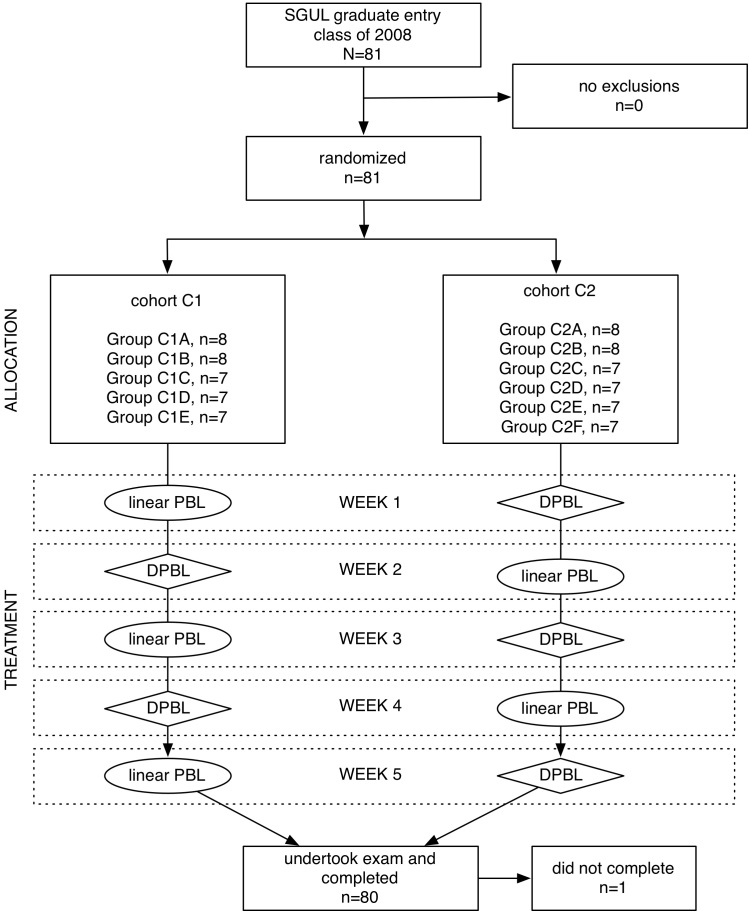
A randomized controlled trial in crossover design was run involving all learners (N=81) in the second year of the graduate entry stream for the undergraduate medicine program at St George's University of London. Learners were randomized to study groups; half engaged in a D-PBL activity whereas the other half had a traditional linear PBL activity on the same subject material. Groups alternated D-PBL and linear PBL over the semester. The measure was mean cohort performance on specific face-to-face exam questions at the end of the semester.
D-PBL groups performed better than linear PBL groups on questions related to D-PBL with the difference being statistically significant for all questions. Differences between the exam performances of the 2 groups were not statistically significant for the questions not related to D-PBL. The effect sizes for D-PBL-related questions were large and positive (>0.6) except for 1 question that showed a medium positive effect size. The effect sizes for questions not related to D-PBL were all small (≤0.3) with a mix of positive and negative values.
The efficacy of D-PBL was indicated by improved exam performance for learners who had D-PBL compared to those who had linear PBL. This suggests that the use of D-PBL leads to better midterm learning outcomes than linear PBL, at least for learners with prior experience with linear PBL. On the basis of tutor and student feedback, St George's University of London and the University of Nicosia, Cyprus have replaced paper PBL cases for midstage undergraduate teaching with D-PBL virtual patients, and 6 more institutions in the ePBLnet partnership will be implementing D-PBL in Autumn 2015.
基于问题的学习(PBL)在医学教育及其他领域已得到广泛应用,并且仍在不断发展和探索。挑战包括如何将基于课堂的PBL的抽象性质与临床实践联系起来,以及如何在PBL过程中长期保持学习者的参与度。
开展一项研究以调查决策式PBL(D-PBL)的效果,D-PBL是PBL的一种变体形式,用虚拟患者取代了线性PBL案例。这些基于网络的交互式案例为学习者提供了一系列患者管理途径。鼓励学习者考虑并讨论行动方案,选择他们的管理途径,并体验其决策的后果。基于网络的应用程序对于使情景能够动态响应学习者的决策、在同一时间范围内将情景分发给多个PBL课堂以及集中记录PBL小组所采取的路径至关重要。
在伦敦圣乔治大学本科医学项目研究生入学流的第二年,对所有学习者(N = 81)进行了交叉设计的随机对照试验。学习者被随机分配到各个学习小组;一半参与D-PBL活动,而另一半就相同主题材料进行传统的线性PBL活动。各小组在整个学期中交替进行D-PBL和线性PBL。衡量标准是学期末特定面对面考试问题上的平均群组表现。
在与D-PBL相关的问题上,D-PBL小组的表现优于线性PBL小组,所有问题的差异均具有统计学意义。对于与D-PBL无关的问题,两组的考试成绩差异无统计学意义。除了1个问题显示出中等正向效应量外,与D-PBL相关问题的效应量均为大且正向(>0.6)。与D-PBL无关问题的效应量均较小(≤0.3),有正有负。
与进行线性PBL的学习者相比,进行D-PBL的学习者考试成绩提高,表明了D-PBL的效果。这表明,至少对于有线性PBL经验的学习者来说,使用D-PBL比线性PBL能带来更好的中期学习成果。根据教师和学生的反馈,伦敦圣乔治大学和塞浦路斯尼科西亚大学已用D-PBL虚拟患者取代了本科中期教学中的纸质PBL案例,ePBLnet伙伴关系中的另外6所机构将于2015年秋季实施D-PBL。