Bener Abdulbari, Ehlayel Mohammad S, Bener Hale Z, Hamid Qutayba
Department of Medical Statistics and Epidemiology, Hamad Medical Corporation, University of Manchester, Manchester, UK ; Department of Public Health, Weill Cornell Medical College, Ar-Rayyan, State of Qatar, University of Manchester, Manchester, UK ; Department of Evidence for Population Health Unit, School of Epidemiology and Health Sciences, University of Manchester, Manchester, UK.
Department of Pediatrics, Section of Pediatric Allergy and Immunology, Hamad Medical Corporation, Doha, State of Qatar ; Department of Paediatrics, Weill Cornell Medical College, Ar-Rayyan, State of Qatar.
J Family Community Med. 2014 Sep;21(3):154-61. doi: 10.4103/2230-8229.142967.
Vitamin D deficiency has been declared a public health problem for both adults and children worldwide. Asthma and related allergic diseases are the leading causes of morbidity in children. The objective of this study was to investigate the potential role of Vitamin D deficiency in childhood asthma and other allergic diseases such as allergic rhinitis and wheezing.
This cross-sectional study was conducted in Primary Health Care Centers (PHCs), from March 2012 to October 2013. A total of 2350 Qatari children below the age of 16 were selected from PHCs, and 1833 agreed to participate in this study giving a response rate of (78%). Face-to-face interviews with parents of all the children were based on a questionnaire that included variables such as socio-demographic information, assessment of nondietary covariates, Vitamin D intake, type of feeding, and laboratory investigations. Their health status was assessed by serum Vitamin D (25-hydoxyvitamin D), family history and body mass index.
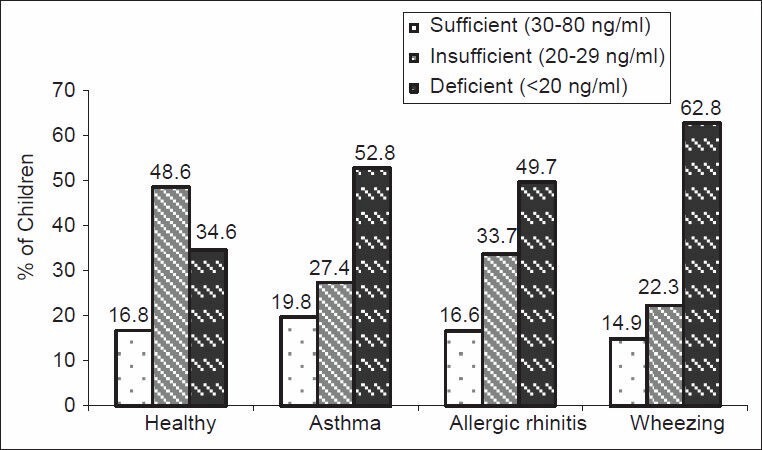
Most of the children who had asthma (38.5%), allergic rhinitis (34.8%) and wheezing (35.7%) were below 5 years. Consanguinity was significantly higher in parents of children with allergic rhinitis (48.6%), followed by those with asthma (46.4%) and wheezing (40.8%) than in healthy children (35.9%) (P < 0.001). The proportion of severe Vitamin D deficiency was significantly higher in children with wheezing (23.4%), allergic rhinitis (18.5%), and asthma (17%) than in healthy children (10.5%). Exposure to the sun was significantly less in Vitamin D deficient children with asthma (60.3%), allergic rhinitis (62.5%) and wheezing (64.4%) than in controls (47.1%) (P = 0.008). It was found that Vitamin D deficiency was a significant correlate for asthma (odds ratio [OR] =2.31; P < 0.001), allergic rhinitis (OR = 1.59; P < 0.001) and wheezing (relative risk = 1.29; P = 0.05).
The study findings revealed a high prevalence of Vitamin D deficiency in children with asthma and allergic diseases. Vitamin D deficiency was a strong correlate for asthma, allergic rhinitis and wheezing.
维生素D缺乏已被宣布为全球成年人和儿童的公共卫生问题。哮喘及相关过敏性疾病是儿童发病的主要原因。本研究的目的是调查维生素D缺乏在儿童哮喘及其他过敏性疾病(如过敏性鼻炎和喘息)中的潜在作用。
本横断面研究于2012年3月至2013年10月在初级卫生保健中心(PHC)进行。从初级卫生保健中心选取了2350名16岁以下的卡塔尔儿童,其中1833名同意参与本研究,应答率为78%。对所有儿童的家长进行面对面访谈,访谈基于一份问卷,问卷包含社会人口学信息、非饮食协变量评估、维生素D摄入量、喂养方式及实验室检查等变量。通过血清维生素D(25-羟维生素D)、家族史和体重指数评估他们的健康状况。
大多数患有哮喘(38.5%)、过敏性鼻炎(34.8%)和喘息(35.7%)的儿童年龄在5岁以下。过敏性鼻炎患儿的父母近亲结婚率(48.6%)显著高于哮喘患儿(46.4%)和喘息患儿(40.8%),高于健康儿童(35.9%)(P < 0.001)。喘息患儿(23.4%)、过敏性鼻炎患儿(18.5%)和哮喘患儿(17%)中严重维生素D缺乏的比例显著高于健康儿童(10.5%)。哮喘(60.3%)、过敏性鼻炎(62.5%)和喘息(64.4%)的维生素D缺乏患儿晒太阳的时间显著少于对照组(47.1%)(P = 0.008)。研究发现维生素D缺乏与哮喘(比值比[OR]=2.31;P < 0.001)、过敏性鼻炎(OR = 1.59;P < 0.001)和喘息(相对风险=1.29;P = 0.05)显著相关。
研究结果显示哮喘和过敏性疾病患儿中维生素D缺乏的患病率很高。维生素D缺乏与哮喘、过敏性鼻炎和喘息密切相关。