Qiao Yanhong, Ning Xue, Chen Qiang, Zhao Ruizhen, Song Wenqi, Zheng Yuejie, Dong Fang, Li Shipeng, Li Juan, Wang Lijuan, Zeng Ting, Dong Yanhong, Yao Kaihu, Yu Sangjie, Yang Yonghong, Shen Xuzhuang
Key Laboratory of Major Diseases in Children and National Key Discipline of Pediatrics, Ministry of Education, Beijing Pediatric Research Institute, Beijing Children's Hospital, Capital Medical University, Beijing, PR China.
BMC Infect Dis. 2014 Nov 7;14:582. doi: 10.1186/s12879-014-0582-4.
This study aims to investigate the clinical features of invasive community-acquired Staphylococcus aureus (CA-SA) infection in Chinese children and analyze its molecular features.
Clinical data and invasive CA-SA isolates were prospectively collected. Pediatric risk of mortality (PRISM) score was used for disease severity measurement. Molecular typing was then performed, followed by expression analysis for virulence genes.
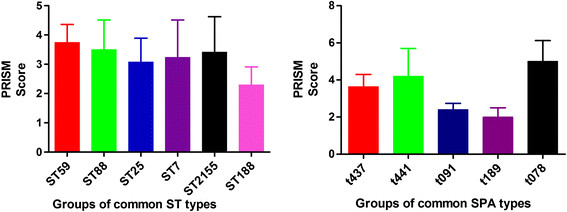
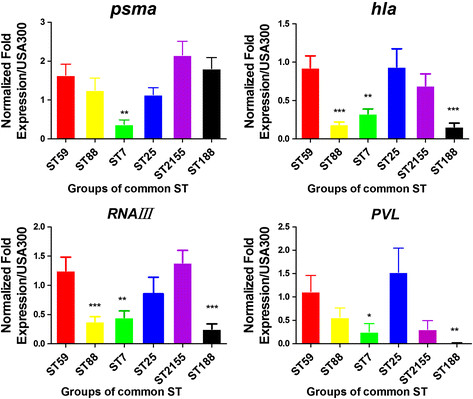
Among 163 invasive CA-SA infection cases, 71 (43.6%) were methicillin-resistant SA (MRSA) infections and 92 (56.4%) were methicillin-susceptible SA (MSSA). A total of 105 (64.4%) children were younger than 1 year old, and 79.7% (129/163) were under 3 years age. Thirteen kinds of diseases were observed, in which bacteremia and pneumonia accounted for 65.6% (107/163) and 52.8% (86/163), respectively. A total of 112 (68.1%) patients had two or more infective sites simultaneously, and four cases (2.5%) died. CA-MSSA more frequently caused multi-sites infections, bacteremia, and musculoskeletal infection than MRSA. A total of 25 sequence types (STs) were detected. MRSA mainly comprised ST59 (49/71, 69%), whereas the most frequent clonotypes were ST88 (15/92, 16.3%), ST25 (13/92, 14.1%), ST7 (13/92, 14.1%), ST2155 (12/92, 13%), and ST188 (9/92, 9.8%) for MSSA. Seven STs were common to both MSSA and MRSA groups. No differences in clinical presentation or PRISM score were found between the two groups or among different ST. The expression levels of the four known virulence genes varied among the six main ST clones.
Invasive CA-SA infections were characterized by high incidence and multi-site infections in young children in China. The clinical manifestations of CA-MSSA were more frequently associated with multi-site infections, bacteremia and musculoskeletal infection than those of CA-MRSA. Isolated genotypes may be relevant to the expressions of virulence genes, but not to clinical manifestations.
本研究旨在调查中国儿童侵袭性社区获得性金黄色葡萄球菌(CA-SA)感染的临床特征,并分析其分子特征。
前瞻性收集临床资料和侵袭性CA-SA分离株。采用儿科死亡风险(PRISM)评分来衡量疾病严重程度。然后进行分子分型,随后对毒力基因进行表达分析。
在163例侵袭性CA-SA感染病例中,71例(43.6%)为耐甲氧西林金黄色葡萄球菌(MRSA)感染,92例(56.4%)为甲氧西林敏感金黄色葡萄球菌(MSSA)感染。共有105例(64.4%)儿童年龄小于1岁,79.7%(129/163)的儿童年龄在3岁以下。观察到13种疾病,其中菌血症和肺炎分别占65.6%(107/163)和52.8%(86/163)。共有112例(68.1%)患者同时有两个或更多感染部位,4例(2.5%)死亡。与MRSA相比,CA-MSSA更常引起多部位感染、菌血症和肌肉骨骼感染。共检测到25种序列类型(STs)。MRSA主要包括ST59(49/71,69%),而MSSA最常见的克隆型为ST88(15/92,16.3%)、ST25(13/92,14.1%)、ST7(13/92,14.1%)、ST2155(12/92,13%)和ST188(9/92,9.8%)。MSSA和MRSA组共有7种STs。两组之间或不同ST之间在临床表现或PRISM评分上未发现差异。六个主要ST克隆中四种已知毒力基因的表达水平各不相同。
在中国,侵袭性CA-SA感染在幼儿中具有高发病率和多部位感染的特点。与CA-MRSA相比,CA-MSSA的临床表现更常与多部位感染、菌血症和肌肉骨骼感染相关。分离的基因型可能与毒力基因的表达有关,但与临床表现无关。