Ashwell Margaret, Gibson Sigrid
Ashwell Associates, Ashwell Street, Ashwell SG7 5PZ, Herts, UK.
BMC Med. 2014 Nov 7;12:207. doi: 10.1186/s12916-014-0207-1.
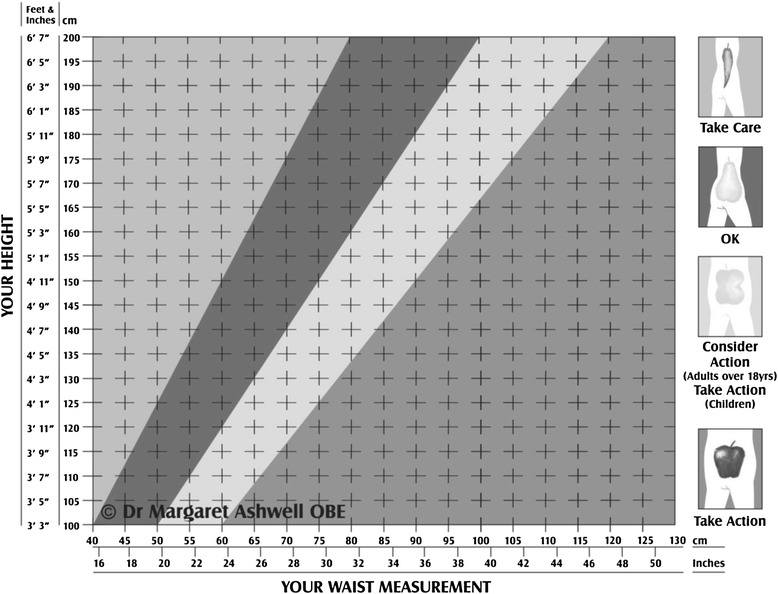
There is now overwhelming scientific evidence that central obesity, as opposed to total obesity assessed by body mass index (BMI), is associated with the most health risks and that the waist-to-height ratio (WHtR) is a simple proxy for this central fat distribution. This Opinion reviews the evidence for the use of WHtR to predict mortality and for its association with morbidity. A boundary value of WHtR of 0.5 has been proposed and become widely used. This translates into the simple screening message 'Keep your waist to less than half your height'. Not only does this message appear to be suitable for all ethnic groups, it also works well with children.
Ignoring this simple message and continuing to use BMI as a sole indicator of risk would mean that 10% of the whole UK population, and more than 25% of the UK population who are judged to be normal weight using BMI, are misclassified and might not be alerted to the need to take care or to take action.
Accepting that a boundary value whereby WHtR should be less than 0.5 not only lends itself to the simple message 'Keep your waist to less than half your height' but it also provides a very cheap primary screening method for increased health risks: A piece of string, measuring exactly half a person's height should fit around that person's waist.
目前有大量科学证据表明,与通过体重指数(BMI)评估的总体肥胖不同,中心性肥胖与最多的健康风险相关,且腰高比(WHtR)是这种中心性脂肪分布的一个简单替代指标。本观点综述了使用WHtR预测死亡率及其与发病率关联的证据。已提出并广泛使用了WHtR的临界值0.5。这转化为简单的筛查信息“保持腰围小于身高的一半”。这条信息不仅似乎适用于所有种族群体,对儿童也很有效。
忽略这条简单信息并继续将BMI作为唯一的风险指标,意味着英国全体人口的10%,以及使用BMI判定为正常体重的英国人口中超过25%的人会被错误分类,可能不会被提醒需要注意或采取行动。
接受WHtR应小于0.5的临界值,不仅能得出“保持腰围小于身高的一半”这条简单信息,还提供了一种非常廉价的针对健康风险增加的初筛方法:一段正好为一个人身高一半的绳子,应该能环绕该人的腰部。