Ashwell Margaret, Gibson Sigrid
Ashwell Associates, Ashwell, Herts, UK Honorary Senior Visiting Fellow, City University London, UK.
Sig-Nurture Ltd, Guildford, Surrey, UK.
BMJ Open. 2016 Mar 14;6(3):e010159. doi: 10.1136/bmjopen-2015-010159.
There is now good evidence that central obesity carries more health risks compared with total obesity assessed by body mass index (BMI). It has therefore been suggested that waist circumference (WC), a proxy for central obesity, should be included with BMI in a 'matrix' to categorise health risk. We wanted to compare how the adult UK population is classified using such a 'matrix' with that using another proxy for central obesity, waist-to-height ratio (WHtR), using a boundary value of 0.5. Further, we wished to compare cardiometabolic risk factors in adults with 'healthy' BMI divided according to whether they have WHtR below or above 0.5.
SETTING, PARTICIPANTS AND OUTCOME MEASURES: Recent data from 4 years (2008-2012) of the UK National Diet and Nutrition Survey (NDNS) (n=1453 adults) were used to cross-classify respondents on anthropometric indices. Regression was used to examine differences in levels of risk factors (triglycerides (TG), total cholesterol (TC), low-density lipoprotein (LDL), high-density lipoprotein (HDL), TC: HDL, glycated haemoglobin (HbA1c), fasting glucose, systolic (SBP) and diastolic blood pressure (DBP)) according to WHtR below and above 0.5, with adjustment for confounders (age, sex and BMI).
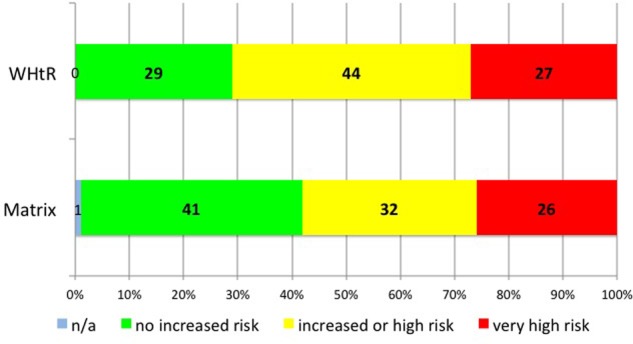
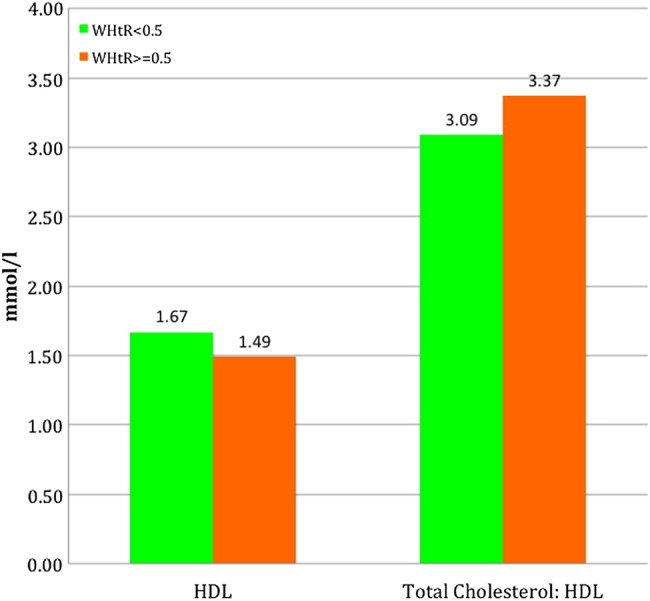
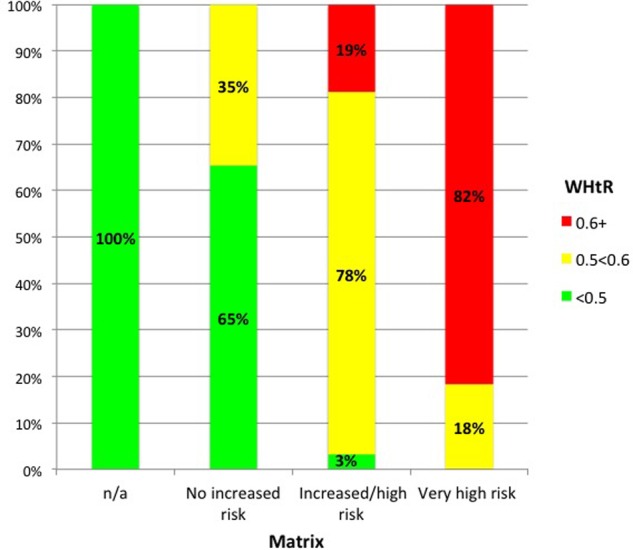
35% of the group who were judged to be at 'no increased risk' using the 'matrix' had WHtR ≥ 0.5. The 'matrix' did not assign 'increased risk' to those with a 'healthy' BMI and 'high' waist circumference. However, our analysis showed that the group with 'healthy' BMI, and WHtR ≥ 0.5, had some significantly higher cardiometabolic risk factors compared to the group with 'healthy' BMI but WHtR below 0.5.
Use of a simple boundary value for WHtR (0.5) identifies more people at 'early health risk' than does a more complex 'matrix' using traditional boundary values for BMI and WC. WHtR may be a simpler and more predictive indicator of the 'early heath risks' associated with central obesity.
目前有充分证据表明,与通过体重指数(BMI)评估的总体肥胖相比,中心性肥胖具有更多健康风险。因此,有人建议将腰围(WC)(中心性肥胖的一个替代指标)与BMI纳入一个“矩阵”中,以对健康风险进行分类。我们想比较使用这样一个“矩阵”对英国成年人群进行分类的情况与使用另一个中心性肥胖替代指标腰高比(WHtR)(边界值为0.5)进行分类的情况。此外,我们希望比较根据WHtR低于或高于0.5划分的“健康”BMI成年人的心血管代谢危险因素。
设置、参与者和结果测量:使用英国国家饮食与营养调查(NDNS)4年(2008 - 2012年)的最新数据(n = 1453名成年人),根据人体测量指标对受访者进行交叉分类。采用回归分析来检验根据WHtR低于和高于0.5划分的危险因素(甘油三酯(TG)、总胆固醇(TC)、低密度脂蛋白(LDL)、高密度脂蛋白(HDL)、TC:HDL、糖化血红蛋白(HbA1c)、空腹血糖、收缩压(SBP)和舒张压(DBP))水平的差异,并对混杂因素(年龄、性别和BMI)进行调整。
使用“矩阵”判定为 “无风险增加” 的人群中,35% 的人WHtR≥0.5。“矩阵” 未将 “风险增加” 归为BMI“健康”但腰围“高”的人群。然而,我们的分析表明,与BMI“健康”但WHtR低于0.5的人群相比,BMI“健康”且WHtR≥0.5的人群具有一些显著更高的心血管代谢危险因素。
与使用BMI和WC的传统边界值的更复杂“矩阵”相比,使用简单的WHtR边界值(0.5)能识别出更多处于“早期健康风险”的人。WHtR可能是与中心性肥胖相关的“早期健康风险”的一个更简单且更具预测性的指标。