Shin Ho Cheol, Seo Jongwon, Kang Byung Woog, Moon Joon Ho, Chae Yee Soo, Lee Soo Jung, Lee Yoo Jin, Han Seoae, Seo Sang Kyung, Kim Jong Gwang, Sohn Sang Kyun, Park Tae-In
Department of Hematology and Oncology, Kyungpook National University Hospital, Daegu, Korea.
Department of Pathology, Kyungpook National University Hospital, Daegu, Korea.
Korean J Intern Med. 2014 Nov;29(6):785-92. doi: 10.3904/kjim.2014.29.6.785. Epub 2014 Oct 31.
BACKGROUND/AIMS: This study investigated the expression of nuclear factor κB (NF-κB) and the chemokine receptor (CXCR4) in patients with diffuse large B-cell lymphoma (DLBCL) who received rituximab-based therapy.
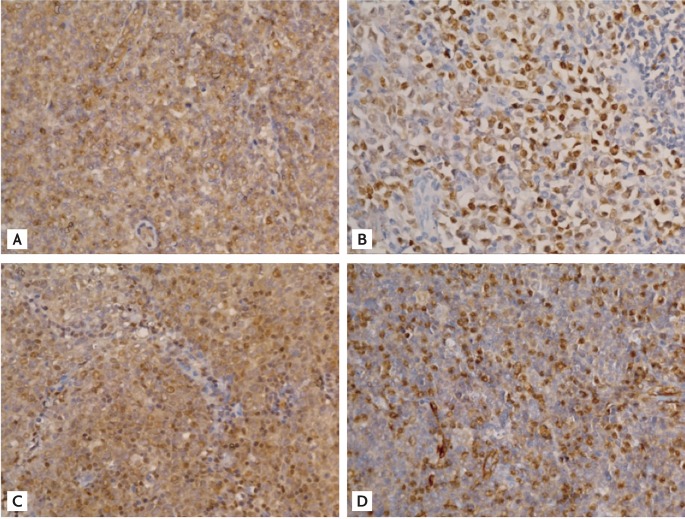
Seventy patients with DLBCL and treated with rituximab-CHOP (R-CHOP) were included, and immunohistochemistry was performed to determine the expression of NF-κB (IκB kinase α, p50, and p100/p52) and CXCR4. To classify DLBCL cases as germinal center B-cell-like (GCB) and non-GCB, additional immunohistochemical expression of CD10, bcl-6, or MUM1 was used in this study. The expression was divided into two groups according to the intensity score (negative, 0 or 1+; positive, 2+ or 3+).
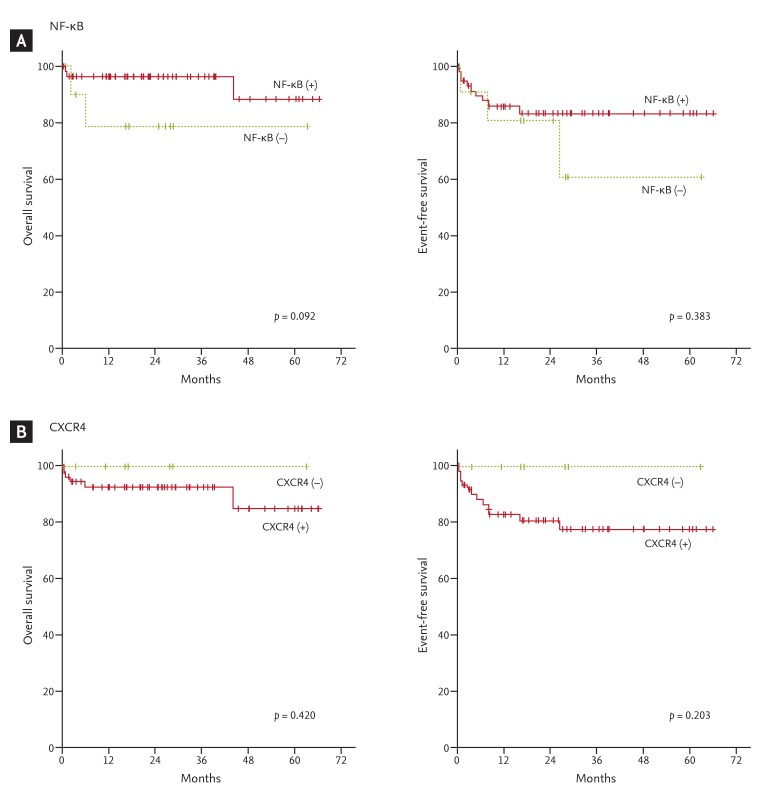
The median age of the patients was 66 years (range, 17 to 87), and 58.6% were male. Twenty-seven patients (38.6%) had stage III or IV disease at diagnosis. Twenty-three patients (32.9%) were categorized as high or high-intermediate risk according to their International Prognostic Indexs (IPIs). The overall incidence of bone marrow involvement was 5.7%. Rates of positive NF-κB and CXCR4 expression were 84.2% and 88.6%, respectively. High NF-κB expression was associated with CXCR4 expression (p = 0.002), and 56 patients (80.0%) showed coexpression. However, the expression of NF-κB or CXCR4 was not associated with overall survival and EFS. On multivariate analysis that included age, gender, performance status, stage, and the IPI, no significant association between the grade of NF-κB or CXCR4 expression and survival was observed.
The current study suggests that the tissue expression of NF-κB and CXCR4 may not be an independent prognostic marker in DLBCL patients treated with R-CHOP.
背景/目的:本研究调查了接受基于利妥昔单抗治疗的弥漫性大B细胞淋巴瘤(DLBCL)患者中核因子κB(NF-κB)和趋化因子受体(CXCR4)的表达情况。
纳入70例接受利妥昔单抗-环磷酰胺、阿霉素、长春新碱、泼尼松(R-CHOP)方案治疗的DLBCL患者,采用免疫组织化学方法检测NF-κB(IκB激酶α、p50和p100/p52)和CXCR4的表达。为将DLBCL病例分类为生发中心B细胞样(GCB)和非GCB,本研究还采用了CD10、bcl-6或MUM1的免疫组织化学表达情况。根据强度评分将表达分为两组(阴性,0或1+;阳性,2+或3+)。
患者的中位年龄为66岁(范围17至87岁),58.6%为男性。27例患者(38.6%)诊断时处于III期或IV期。根据国际预后指数(IPI),23例患者(32.9%)被归类为高或高中危。骨髓受累的总发生率为5.7%。NF-κB和CXCR4阳性表达率分别为84.2%和88.6%。NF-κB高表达与CXCR4表达相关(p = 0.002),56例患者(80.0%)表现为共表达。然而,NF-κB或CXCR4的表达与总生存期和无事件生存期无关。在包括年龄、性别、体能状态、分期和IPI的多因素分析中,未观察到NF-κB或CXCR4表达水平与生存之间存在显著关联。
本研究表明,在接受R-CHOP治疗的DLBCL患者中,NF-κB和CXCR4的组织表达可能不是一个独立的预后标志物。