Lim Kil-Byung, Lee Hong-Jae, Yoo Jeehyun, Kwon Yong-Geol
Department of Physical Medicine and Rehabilitation, Inje University Ilsan Paik Hospital, Goyang, Korea.
Ann Rehabil Med. 2014 Oct;38(5):592-602. doi: 10.5535/arm.2014.38.5.592. Epub 2014 Oct 30.
To investigate the effect of low-frequency repetitive transcranial magnetic stimulation (rTMS) and neuromuscular electrical stimulation (NMES) on post-stroke dysphagia.
Subacute (<3 months), unilateral hemispheric stroke patients with dysphagia were randomly assigned to the conventional dysphagia therapy (CDT), rTMS, or NMES groups. In rTMS group, rTMS was performed at 100% resting motor threshold with 1 Hz frequency for 20 minutes per session (5 days per week for 2 weeks). In NMES group, electrical stimulation was applied to the anterior neck for 30 minutes per session (5 days per week for 2 weeks). All three groups were given conventional dysphagia therapy for 4 weeks. We evaluated the functional dysphagia scale (FDS), pharyngeal transit time (PTT), the penetration-aspiration scale (PAS), and the American Speech-Language Hearing Association National Outcomes Measurement System (ASHA NOMS) swallowing scale at baseline, after 2 weeks, and after 4 weeks.
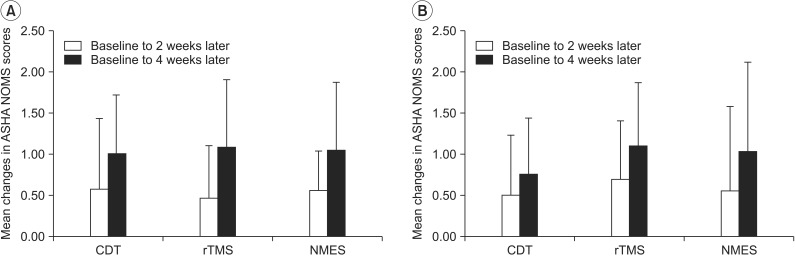
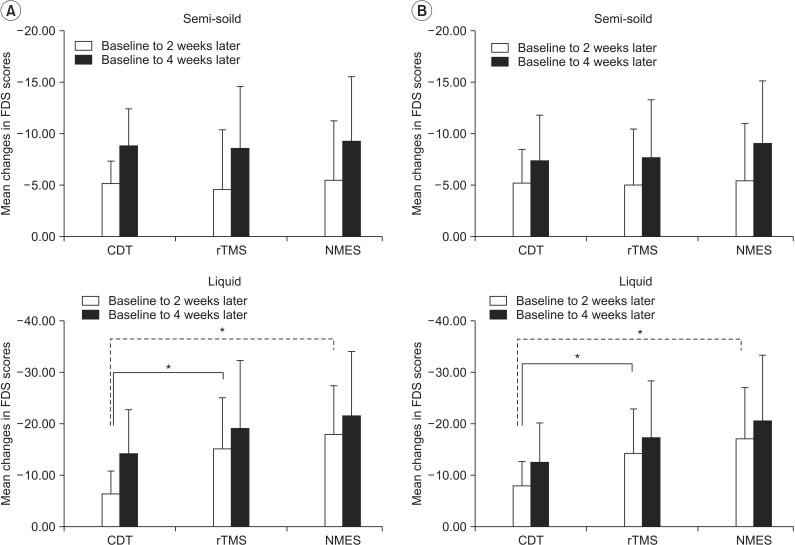
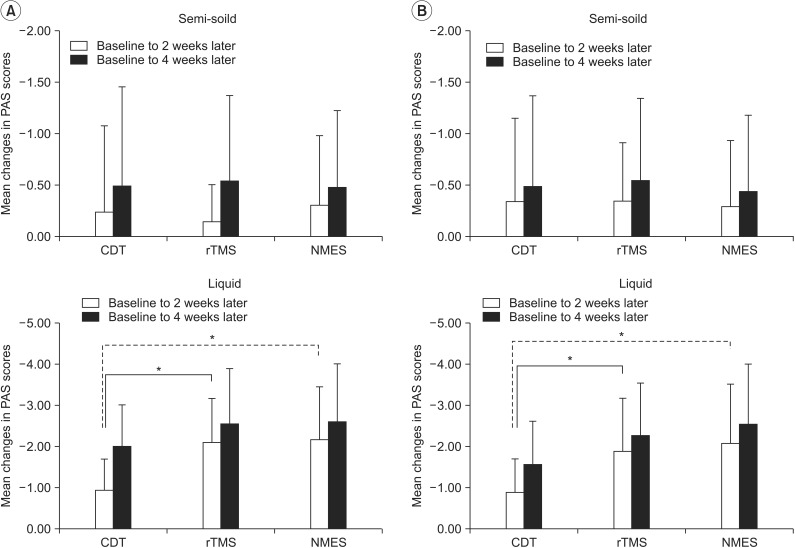
Forty-seven patients completed the study; 15 in the CDT group, 14 in the rTMS group, and 18 in the NMES group. Mean changes in FDS and PAS for liquid during first 2 weeks in the rTMS and NMES groups were significantly higher than those in the CDT group, but no significant differences were found between the rTMS and NMES group. No significant difference in mean changes of FDS and PAS for semi-solid, PTT, and ASHA NOMS was observed among the three groups.
These results indicated that both low-frequency rTMS and NMES could induce early recovery from dysphagia; therefore, they both could be useful therapeutic options for dysphagic stroke patients.
探讨低频重复经颅磁刺激(rTMS)和神经肌肉电刺激(NMES)对脑卒中后吞咽困难的影响。
将亚急性(<3个月)、单侧半球脑卒中伴吞咽困难的患者随机分为传统吞咽困难治疗(CDT)组、rTMS组或NMES组。rTMS组以100%静息运动阈值、1Hz频率进行rTMS治疗,每次20分钟(每周5天,共2周)。NMES组对颈部前方进行电刺激,每次30分钟(每周5天,共2周)。三组均接受4周的传统吞咽困难治疗。在基线、2周后和4周后,我们评估了功能性吞咽困难量表(FDS)、咽部通过时间(PTT)、渗透-误吸量表(PAS)以及美国言语-语言听力协会国家结局测量系统(ASHA NOMS)吞咽量表。
47例患者完成了研究;CDT组15例,rTMS组14例,NMES组18例。rTMS组和NMES组在最初2周内液体的FDS和PAS平均变化显著高于CDT组,但rTMS组和NMES组之间未发现显著差异。三组在半固体的FDS和PAS平均变化、PTT以及ASHA NOMS方面未观察到显著差异。
这些结果表明,低频rTMS和NMES均可促使吞咽困难早期恢复;因此,它们均可能是吞咽困难脑卒中患者有用的治疗选择。