Strijbis Karin, Yilmaz Omer H, Dougan Stephanie K, Esteban Alexandre, Gröne Andrea, Kumamoto Carol A, Ploegh Hidde L
Whitehead Institute for Biomedical Research, Cambridge, Massachusetts, United States of America.
Department of Pathobiology, Faculty of Veterinary Medicine, Utrecht University, Utrecht, The Netherlands.
PLoS One. 2014 Nov 7;9(11):e112472. doi: 10.1371/journal.pone.0112472. eCollection 2014.
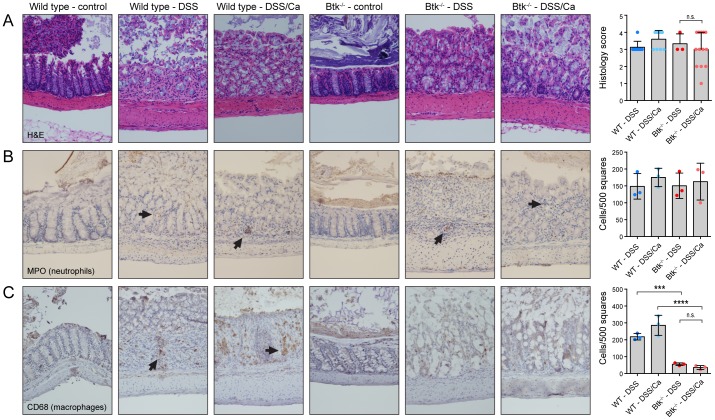
The commensal yeast Candida albicans is part of the human intestinal microflora and is considered a "pathobiont", a resident microbe with pathogenic potential yet harmless under normal conditions. The aim of this study was to investigate the effect of C. albicans on inflammation of the intestinal tract and the role of Bruton's tyrosine kinase (Btk). Btk is an enzyme that modulates downstream signaling of multiple receptors involved in innate and adaptive immunity, including the major anti-fungal receptor Dectin-1. Colitis was induced in wild type and Btk-/- mice by treatment with dextran sodium sulfate (DSS) and the gastrointestinal tract of selected treatment groups were then colonized with C. albicans. Colonization by C. albicans neither dampened nor exacerbated inflammation in wild type mice, but colon length and spleen weight were improved in Btk-deficient mice colonized with C. albicans. Neutrophil infiltration was comparable between wild type and Btk-/- mice, but the knockout mice displayed severely reduced numbers of macrophages in the colon during both DSS and DSS/Candida treatment. Smaller numbers and reduced responsiveness of Btk-/- macrophages might partially explain the improved colon length of Btk-/- mice as a result of Candida colonization. Surprisingly, DSS/Candida-treated Btk-/- animals had higher levels of certain pro-inflammatory cytokines and levels of the anti-inflammatory cytokine TGF-β were reduced compared to wild type. A clustering and correlation analysis showed that for wild type animals, spleen TGF-β and colon IL-10 and for Btk-/- spleen and colon levels of IL-17A best correlated with the inflammatory parameters. We conclude that in Btk-/- immunocompromised animals, colonization of the gastrointestinal tract by the commensal yeast C. albicans alters inflammatory symptoms associated with colitis.
共生酵母白色念珠菌是人类肠道微生物群的一部分,被认为是一种“病理共生菌”,即一种在正常条件下具有致病潜力但无害的常驻微生物。本研究的目的是调查白色念珠菌对肠道炎症的影响以及布鲁顿酪氨酸激酶(Btk)的作用。Btk是一种调节多种参与固有免疫和适应性免疫的受体下游信号传导的酶,包括主要的抗真菌受体脱噬素-1。通过用葡聚糖硫酸钠(DSS)处理在野生型和Btk基因敲除小鼠中诱导结肠炎,然后在选定治疗组的胃肠道中定殖白色念珠菌。白色念珠菌定殖既没有减轻也没有加剧野生型小鼠的炎症,但在定殖了白色念珠菌的Btk缺陷小鼠中结肠长度和脾脏重量得到改善。野生型和Btk基因敲除小鼠之间的中性粒细胞浸润相当,但在DSS和DSS/念珠菌治疗期间,基因敲除小鼠结肠中的巨噬细胞数量严重减少。Btk基因敲除巨噬细胞数量减少和反应性降低可能部分解释了由于念珠菌定殖导致Btk基因敲除小鼠结肠长度改善的原因。令人惊讶的是,与野生型相比,DSS/念珠菌处理的Btk基因敲除动物某些促炎细胞因子水平较高,而抗炎细胞因子转化生长因子-β(TGF-β)水平降低。聚类和相关性分析表明,对于野生型动物,脾脏TGF-β和结肠白细胞介素-10(IL-10)以及对于Btk基因敲除动物脾脏和结肠中的IL-17A水平与炎症参数最相关。我们得出结论,在Btk基因敲除的免疫受损动物中,共生酵母白色念珠菌在胃肠道中的定殖改变了与结肠炎相关的炎症症状。