Research Services / Analytical Intelligence, KRONOS INTERNATIONAL, Inc., Peschstrasse 5, 51373 Leverkusen, Germany.
Beilstein J Nanotechnol. 2014 Oct 21;5:1815-22. doi: 10.3762/bjnano.5.192. eCollection 2014.
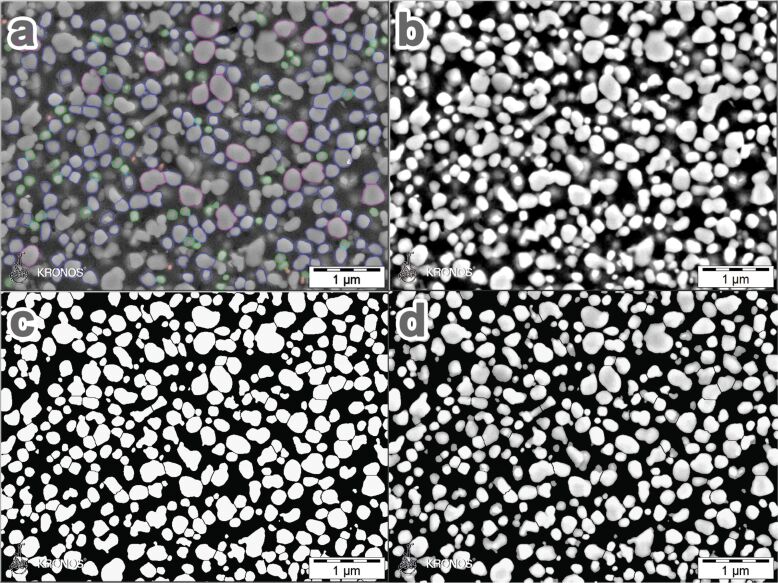
A strong demand for reliable characterization methods of particulate materials is triggered by the prospect of forthcoming national and international regulations concerning the classification of nanomaterials. Scientific efforts towards standardized number-based sizing methods have so far been concentrated on model systems, such as spherical gold or silica nanoparticles. However, for industrial particulate materials, which are typically targets of regulatory efforts, characterisation is in most cases complicated by irregular particle shapes, broad size distributions and a strong tendency to agglomeration. Reliable sizing methods that overcome these obstacles, and are practical for industrial use, are still lacking. By using the example of titanium dioxide, this paper shows that both necessities are well met by the sophisticated counting algorithm presented here, which is based on the imaging of polished sections of embedded particles and subsequent automated image analysis. The data presented demonstrate that the typical difficulties of sizing processes are overcome by the proposed method of sample preparation and image analysis. In other words, a robust, reproducible and statistically reliable method is presented, which leads to a number-based size distribution of pigment-grade titanium dioxide, for example, and therefore allows reliable classification of this material according to forthcoming regulations.
由于即将出台有关纳米材料分类的国家和国际法规,人们对可靠的颗粒材料特性描述方法有强烈需求。科学界目前一直致力于标准化的基于数量的粒度测量方法,这些方法主要针对诸如球形金或二氧化硅纳米颗粒等模型体系。然而,对于工业颗粒材料(通常是监管工作的目标),其特性描述在大多数情况下受到不规则颗粒形状、较宽的尺寸分布以及强烈的团聚趋势的影响。克服这些障碍并适用于工业用途的可靠测量方法仍然缺乏。本文以二氧化钛为例,展示了这里提出的基于嵌入颗粒抛光截面成像和后续自动图像分析的复杂计数算法能够很好地满足这些需求。所提供的数据表明,通过所提出的样品制备和图像分析方法可以克服典型的粒度测量过程中的困难。换句话说,本文提出了一种稳健、可重复且具有统计学可靠性的方法,该方法可获得颜料级二氧化钛的基于数量的粒径分布,从而可以根据即将出台的法规对该材料进行可靠分类。