Sak Bohumil, Petrželková Klára J, Květoňová Dana, Mynářová Anna, Pomajbíková Kateřina, Modrý David, Cranfield Michael R, Mudakikwa Antoine, Kváč Martin
Institute of Parasitology, Biology Centre of the Academy of Sciences of the Czech Republic, v.v.i., České Budějovice, Czech Republic.
Institute of Parasitology, Biology Centre of the Academy of Sciences of the Czech Republic, v.v.i., České Budějovice, Czech Republic; Institute of Vertebrate Biology, Academy of Sciences of the Czech Republic, v.v.i., Brno, Czech Republic; Liberec Zoo, Liberec, Czech Republic; Department of Pathology and Parasitology, Faculty of Veterinary Medicine, University of Veterinary and Pharmaceutical Sciences, Brno, Czech Republic.
PLoS One. 2014 Nov 11;9(11):e109751. doi: 10.1371/journal.pone.0109751. eCollection 2014.
Infectious diseases represent the greatest threats to endangered species, and transmission from humans to wildlife under increased anthropogenic pressure has been always stated as a major risk of habituation.
To evaluate the impact of close contact with humans on the occurrence of potentially zoonotic protists in great apes, one hundred mountain gorillas (Gorilla beringei beringei) from seven groups habituated either for tourism or for research in Volcanoes National Park, Rwanda were screened for the presence of microsporidia, Cryptosporidium spp. and Giardia spp. using molecular diagnostics.
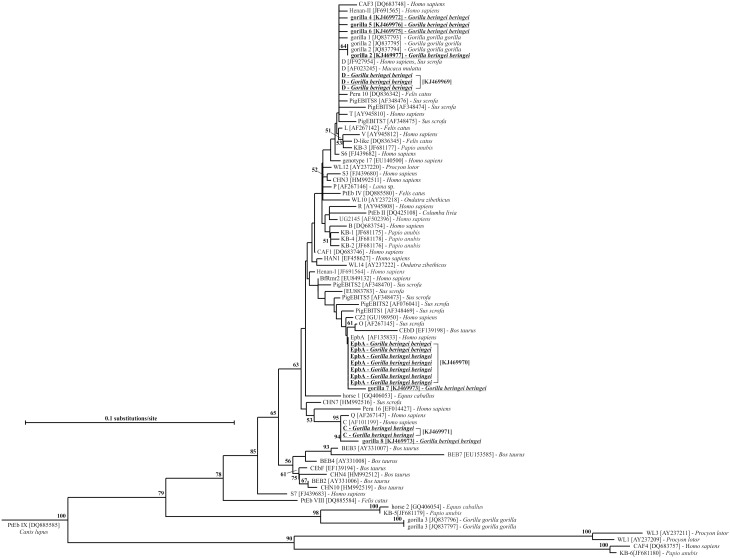
The most frequently detected parasites were Enterocytozoon bieneusi found in 18 samples (including genotype EbpA, D, C, gorilla 2 and five novel genotypes gorilla 4-8) and Encephalitozoon cuniculi with genotype II being more prevalent (10 cases) compared to genotype I (1 case). Cryptosporidium muris (2 cases) and C. meleagridis (2 cases) were documented in great apes for the first time. Cryptosporidium sp. infections were identified only in research groups and occurrence of E. cuniculi in research groups was significantly higher in comparison to tourist groups. No difference in prevalence of E. bieneusi was observed between research and tourist groups.
Although our data showed the presence and diversity of important opportunistic protists in Volcanoes gorillas, the source and the routes of the circulation remain unknown. Repeated individual sampling, broad sampling of other hosts sharing the habitat with gorillas and quantification of studied protists would be necessary to acquire more complex data.
传染病是濒危物种面临的最大威胁,在日益增加的人为压力下,从人类向野生动物的传播一直被视为习惯化的主要风险。
为了评估与人类密切接触对大猩猩中潜在人畜共患原生生物出现的影响,对卢旺达火山国家公园中因旅游或研究而习惯化的七个群体的100只山地大猩猩(Gorilla beringei beringei)进行了筛查,使用分子诊断方法检测微孢子虫、隐孢子虫属和贾第虫属的存在。
最常检测到的寄生虫是在18个样本中发现的比氏肠胞微孢子虫(包括基因型EbpA、D、C、大猩猩2型以及五个新基因型大猩猩4 - 8型),以及基因型II型比基因型I型更普遍的兔脑炎微孢子虫(10例对比1例)。首次在大猩猩中记录到鼠隐孢子虫(2例)和火鸡隐孢子虫(2例)。仅在研究群体中发现隐孢子虫属感染,并且与旅游群体相比,研究群体中兔脑炎微孢子虫的发生率显著更高。研究群体和旅游群体之间比氏肠胞微孢子虫的患病率没有差异。
尽管我们的数据显示了火山大猩猩中重要机会性原生生物的存在和多样性,但其来源和传播途径仍然未知。需要进行重复个体采样、对与大猩猩共享栖息地的其他宿主进行广泛采样以及对所研究的原生生物进行定量,以获取更复杂的数据。