
通过自由能计算揭示的HIV-1 Vpu的原子详细机制和弱阳离子传导活性。
Atomistic detailed mechanism and weak cation-conducting activity of HIV-1 Vpu revealed by free energy calculations.
作者信息
Padhi Siladitya, Burri Raghunadha Reddy, Jameel Shahid, Priyakumar U Deva
机构信息
Centre for Computational Natural Sciences and Bioinformatics, International Institute of Information Technology, Hyderabad, India.
International Centre for Genetic Engineering and Biotechnology, New Delhi, India.
出版信息
PLoS One. 2014 Nov 13;9(11):e112983. doi: 10.1371/journal.pone.0112983. eCollection 2014.
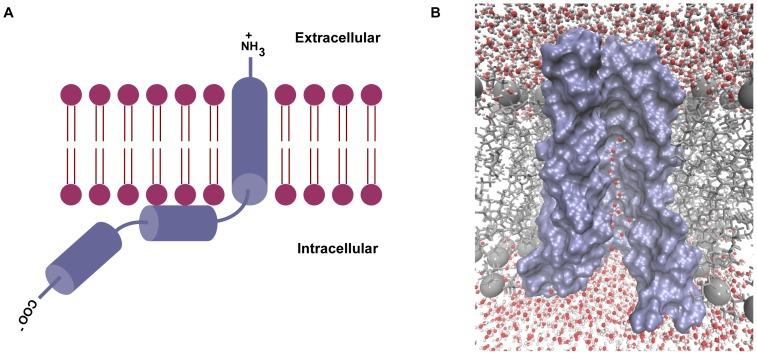
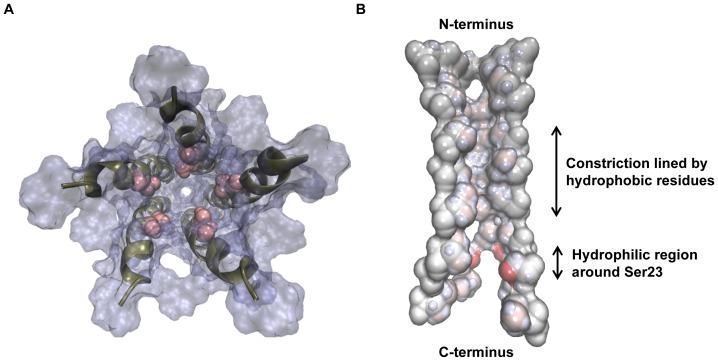
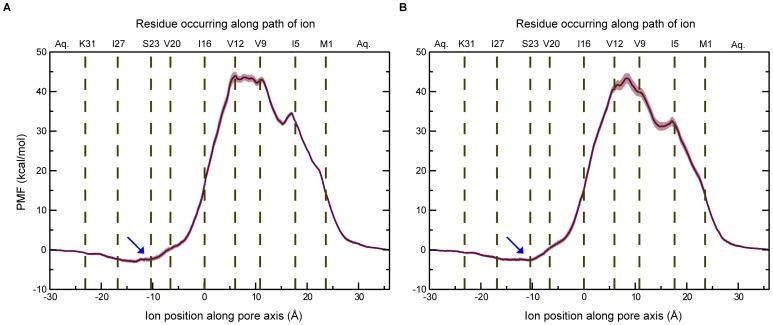
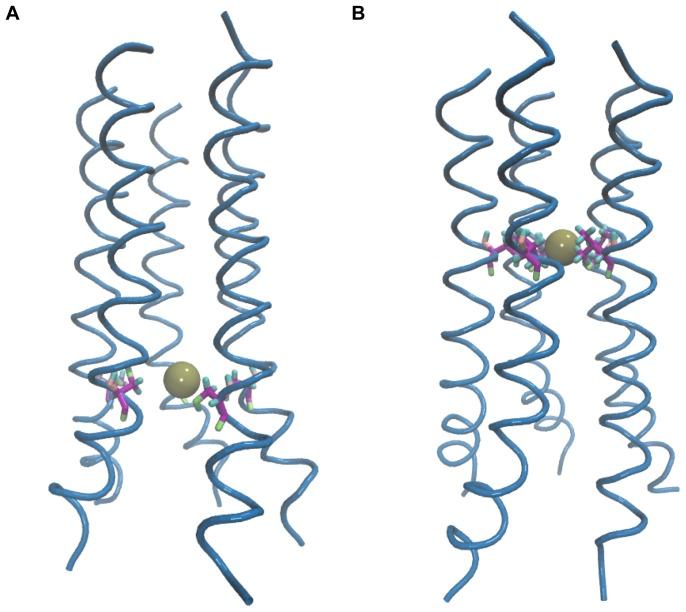
The viral protein U (Vpu) encoded by HIV-1 has been shown to assist in the detachment of virion particles from infected cells. Vpu forms cation-specific ion channels in host cells, and has been proposed as a potential drug target. An understanding of the mechanism of ion transport through Vpu is desirable, but remains limited because of the unavailability of an experimental structure of the channel. Using a structure of the pentameric form of Vpu--modeled and validated based on available experimental data--umbrella sampling molecular dynamics simulations (cumulative simulation time of more than 0.4 µs) were employed to elucidate the energetics and the molecular mechanism of ion transport in Vpu. Free energy profiles corresponding to the permeation of Na+ and K+ were found to be similar to each other indicating lack of ion selection, consistent with previous experimental studies. The Ser23 residue is shown to enhance ion transport via two mechanisms: creating a weak binding site, and increasing the effective hydrophilic length of the channel, both of which have previously been hypothesized in experiments. A two-dimensional free energy landscape has been computed to model multiple ion permeation, based on which a mechanism for ion conduction is proposed. It is shown that only one ion can pass through the channel at a time. This, along with a stretch of hydrophobic residues in the transmembrane domain of Vpu, explains the slow kinetics of ion conduction. The results are consistent with previous conductance studies that showed Vpu to be a weakly conducting ion channel.
人类免疫缺陷病毒1型(HIV-1)编码的病毒蛋白U(Vpu)已被证明有助于病毒粒子从受感染细胞中释放。Vpu在宿主细胞中形成阳离子特异性离子通道,并已被提议作为潜在的药物靶点。了解离子通过Vpu的转运机制是很有必要的,但由于缺乏该通道的实验结构,相关认识仍然有限。利用基于现有实验数据建模和验证的五聚体形式的Vpu结构,采用伞形抽样分子动力学模拟(累积模拟时间超过0.4微秒)来阐明Vpu中离子转运的能量学和分子机制。发现对应于Na+和K+渗透的自由能分布彼此相似,表明缺乏离子选择性,这与先前的实验研究一致。Ser23残基通过两种机制增强离子转运:创建一个弱结合位点,并增加通道的有效亲水长度,这两种机制在先前的实验中都曾被假设过。计算了二维自由能景观以模拟多个离子的渗透,并在此基础上提出了离子传导机制。结果表明,一次只有一个离子可以通过该通道。这一点,连同Vpu跨膜结构域中的一段疏水残基,解释了离子传导的缓慢动力学。这些结果与先前的电导率研究一致,该研究表明Vpu是一个弱导电离子通道。



 Zotero 插件