Bansal Raman, Mian M A R, Mittapalli Omprakash, Michel Andy P
Department of Entomology, The Ohio Agricultural Research and Development Center, The Ohio State University, 1680 Madison Ave,, Wooster, OH 44691, USA.
BMC Genomics. 2014 Nov 16;15(1):972. doi: 10.1186/1471-2164-15-972.
While much recent research has expanded our understanding of the molecular interactions between aphids and their host plants, it is lacking for the soybean aphid, Aphis glycines. Since its North American invasion, A. glycines has become one of the most damaging insect pests on this important crop. Five soybean genes for host plant resistance to A. glycines have been identified, but populations of A. glycines have already adapted to overcome these resistance genes. Understanding the molecular interactions between resistant soybean and A. glycines can provide clues to its adaptation mechanisms. Here, we used RNA-Sequencing to compare and contrast A. glycines gene expression when fed resistant (Rag1) and susceptible soybean.
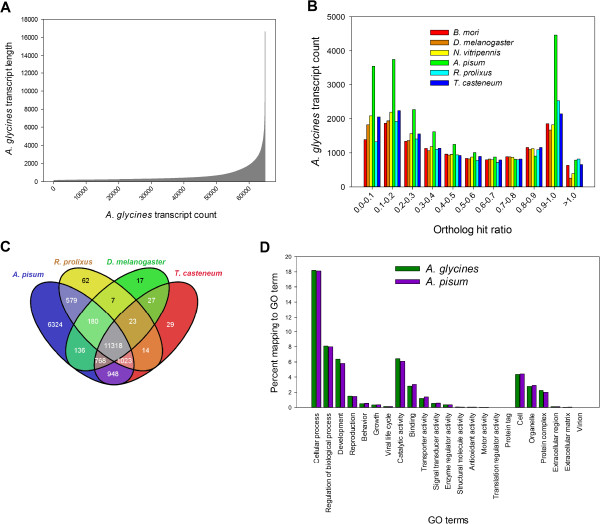
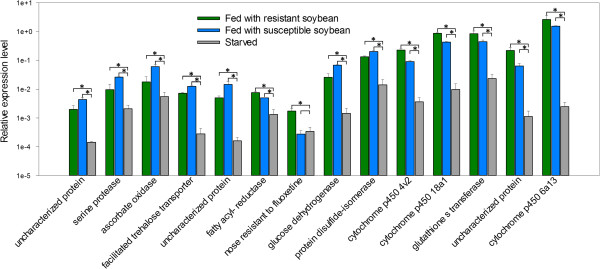
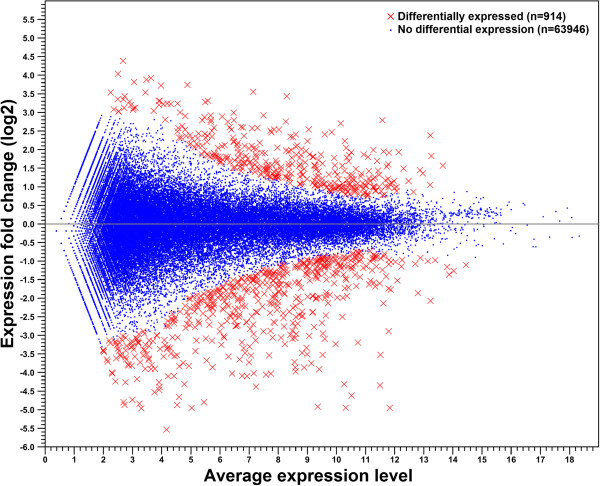
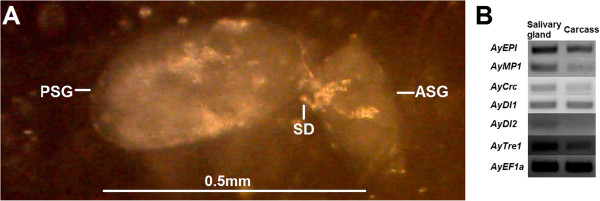
Combining results from a previous A. glycines transcriptome, we generated 64,860 high quality transcripts, totaling 41,151,086 bases. Statistical analysis revealed 914 genes with significant differential expression. Most genes with higher expression in A. glycines on resistant plants (N = 352) were related to stress and detoxification such as cytochrome P450s, glutathione-S-transferases, carboxyesterases, and ABC transporters. A total of 562 genes showed lower transcript abundance in A. glycines on resistant plants. From our extensive transcriptome data, we also identified genes encoding for putative salivary effector proteins (N = 73). Among these, 6 effector genes have lower transcript abundance in A. glycines feeding on resistant soybean.
Overall, A. glycines exhibited a pattern typical of xenobiotic challenge, thereby validating antibiosis in Rag1, presumably mediated through toxic secondary metabolites. Additionally, this study identified many A. glycines genes and gene families at the forefront of its molecular interaction with soybean. Further investigation of these genes in other biotypes may reveal adaptation mechanisms to resistant plants.
尽管最近的许多研究扩展了我们对蚜虫与其寄主植物之间分子相互作用的理解,但对于大豆蚜(Aphis glycines)而言,这方面的研究仍很欠缺。自入侵北美以来,大豆蚜已成为这种重要作物上最具破坏力的害虫之一。已鉴定出五个对大豆蚜具有寄主植物抗性的大豆基因,但大豆蚜种群已经适应并克服了这些抗性基因。了解抗性大豆与大豆蚜之间的分子相互作用可为其适应机制提供线索。在此,我们使用RNA测序来比较和对比取食抗性(Rag1)和感病大豆时大豆蚜的基因表达情况。
结合先前大豆蚜转录组的结果,我们生成了64,860个高质量转录本,总计41,151,086个碱基。统计分析显示有914个基因存在显著差异表达。在抗性植物上大豆蚜中表达较高的大多数基因(N = 352)与应激和解毒相关,如细胞色素P450、谷胱甘肽-S-转移酶、羧酸酯酶和ABC转运蛋白。共有562个基因在抗性植物上的大豆蚜中表现出较低的转录本丰度。从我们广泛的转录组数据中,我们还鉴定出了编码假定唾液效应蛋白的基因(N = 73)。其中,6个效应基因在取食抗性大豆的大豆蚜中具有较低的转录本丰度。
总体而言,大豆蚜表现出典型的异生物质挑战模式,从而验证了Rag1中的抗生性,推测是由有毒次生代谢物介导的。此外,本研究鉴定了许多处于大豆蚜与大豆分子相互作用前沿的基因和基因家族。对其他生物型中这些基因的进一步研究可能揭示其对抗性植物的适应机制。